New York City Ballet

Beginning to End

New York City Ballet

Beginning to End


"Apollo", "Mozartiana", "Cortège Hongrois"
New York City Ballet
David H. Koch Theater
New York, New York
January 27, 2018, matinee
.


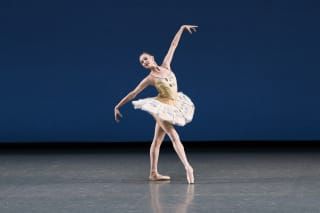
The all-Balanchine program began with "Apollo", the oldest Balanchine work danced by New York City ballet (though Balanchine did rework the 1928 ballet in 1979, stripping it of its Expressionistic prologue), followed by "Mozartiana", choreographed in 1981, his last major work.  It ended with the bon-bon "Cortège Hongrois" from 1973, with its generous helping of Petipa, a
By Mary Cargill
The King is Dead, Long Live the Company

New York City Ballet

The King is Dead, Long Live the Company


“Divertimento No. 15,” “The Four Temperaments,” “Chaconne”
New York City Ballet
The David H. Koch Theater
New York, New York
January 24, 2018


New York City Ballet entered its interregnum this week dancing two straight all Balanchine programs. Programmed by Peter Martins before his resignation, they now serve to emphasize continuity between the reigns in a way Martins probably didn’t imagine. It’s neither the new world (and won’t be until a replacement for him is named) nor

By Michael Popkin
The Gold Standard

New York City Ballet

The Gold Standard


"The Nutcracker"
New York City Ballet
David H. Koch Theater
New York, New York
December 5, 2017
.


The enduring charm of Balanchine's "The Nutcracker" continues to light up the stage with its combination of the Maryinsky of his youth (the little Nutcracker's mime, the hoop dance, the floating arabesque trick, the snowflake's pom poms, and the magical tree that all came from the Russian version) and the more daring style of his own company (notably in the

By Mary Cargill
Moving On

New York City Ballet

Moving On


"Cortège Hongrois", "La Valse", "Square Dance", "Duo Concertant"
New York City Ballet
David H. Koch Theater
New York, New York
October 15, 2015


Robert Fairchild gave his farewell performance at New York City Ballet in Balanchine's low-key, pensive, and very personal "Duo Concertant", which was rescheduled to close the afternoon, in place of the apotheosis of closers, "Cortège Hongrois", which opened the performance. If the switch made for a somewhat unbalanced schedule, it let the audience thank Fairchild

By Mary Cargill
Fashion Forward

New York City Ballet

Fashion Forward


"The Wind Still Brings", "Composer's Holiday", "Not Our Fate", "Pulcinella Variations"
New York City Ballet
Koch Theater
New York, New York
September 27, 2017


New York City Ballet's Fall gala, with its now traditional spotlight on fashion designers, clocked in at an efficient two hours. There was a brief opening film with glimpses of the new designs, no speeches, no intermissions, and four new ballets. The first three shared a distinct family resemblance (opaque titles, young dancers, bare

By Mary Cargill
The Heart of the Matter

New York City Ballet

The Heart of the Matter


"Swan Lake"
New York City Ballet
Koch Theater
New York, New York
September 27, 2017


Peter Martins' "Swan Lake", for all its problematic moments, does leave the iconic black and white pas de deux reasonably intact, and, since they constitute "Swan Lake's" emotional core, a committed pair can wrest a moving performance from those dreary, blotchy paint drips. Even without Odette's mime to explain the situation (how is Martins' Siegfried to know that foreswearing Odette will doom her?

By Mary Cargill
Midsummer Madness

New York City Ballet

Midsummer Madness


"A Midsummer Night's Dream"
New York City Ballet
David H. Koch Theater
Lincoln Center
New York, New York
May 26, 2017


After the month-long Here/Now blowout (43 ballets by 22 choreographers) New York City Ballet settled down to a week of Balanchine's "A Midsummer Night's Dream".  Understandably the corps seemed a bit winded and the energy came in fits and starts, though the children were exceptionally well-drilled.  There were few major debuts

By Mary Cargill
Spring Forward

New York City Ballet

Spring Forward


"Jeu de Cartes", "After the Rain", "Tschaikovsky Pas de Deux", "Odessa"
New York City Ballet
David H. Koch Theater
New York, NY
May 4, 2017


The New York City Ballet's spring gala clocked in at a crisp and efficient one and a half hours and included two complete ballets, two pas de deux, no speeches, and no intermission.  The main attraction was Alexei Ratmansky's new work "Odessa", to "Sketches to Sunset" by Leonid Desyatnikov who also

By Mary Cargill
Ladies' Night

New York City Ballet

Ladies' Night


"Allegro Brillante", "The Four Temperaments", "Symphony in C"
New York City Ballet
David H. Koch Theater
New York, New York
April 18, 2017


The New York City Ballet's spring season opened with three popular (judging from the packed house and prolonged ovations) Balanchine ballets. Not surprisingly the women were front and center with some tremendous performances and Alston MacGill's impressive debut in the third movement in "Symphony in C".  "Allegro Brillante", one of Balanchine's most concise

By Mary Cargill
Homage to the Queen

New York City Ballet

Homage to the Queen


"Allegro Brillante", "Swan Lake", "The Four Temperaments"
New York City Ballet
David H. Koch Theater
New York, NY
January 31, 2017


The well-balanced, all-Balanchine program wasn't given a name by the marketing department, but it could have been called "Salute to Maria Tallchief", since both "Allegro Brillante" and "Swan Lake" were choreographed for her and Sanguinic in "The Four Temperaments" was one of her important roles. Tallchief was a dancer of power and majesty, characteristics which,

By Mary Cargill
High Energy

New York City Ballet

High Energy


"Fearful Symmetries", "The Shimmering Asphalt", "The Times are Racing"
New York City Ballet
David H. Koch Theater
New York, NY
January 26, 2017


For the past several years New York City Ballet has celebrated Balanchine with at least one new work under the rubric of "New Combina- tions", honoring Balanchine's statement "There are no new steps, only new combinations". This year the two premieres, by Pontus Lidberg and Justin Peck, showed that new combinations are hard to

By Mary Cargill