The King is Dead, Long Live the Company
“Divertimento No. 15,” “The Four Temperaments,” “Chaconne”
New York City Ballet
The David H. Koch Theater
New York, New York
January 24, 2018
New York City Ballet entered its interregnum this week dancing two straight all Balanchine programs. Programmed by Peter Martins before his resignation, they now serve to emphasize continuity between the reigns in a way Martins probably didn’t imagine. It’s neither the new world (and won’t be until a replacement for him is named) nor the old. But between the two, we saw some of the company’s enduring strengths in real time.
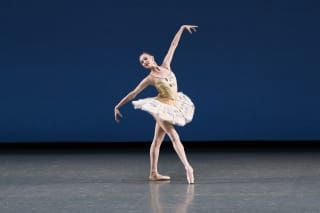
A superb opening performance of “Divertimento No. 15” showed the orchestra (conducted by Andrew Litton) rendering the Mozart score transparently and a balanced cast dancing with effortless classicism. Basically a linear arrangement of variations and duets, with an updated minuet for a corps de ballet of eight women adding architecture about one third of the way through, the ballet’s step patterns have an unusual simplicity and clarity for Balanchine. There’s room for each individual dancer’s personality to show in lucid choreography that always seems to carry the dance’s momentum forward.
Amongst the women, principal dancers Megan Fairchild, Abi Stafford and Sterling Hyltin reprised roles they have polished over their careers, with Fairchild dancing the extremely fast and challenging sixth variation with nearly impossible speed and articulation. Yet beside these accomplished performances, it was Ashley Laracey and Lauren King (both soloists) who lifted this performance to a serene level. King rendered the first variation with a wit that included brief moments in staccato balance, making her hip swivels and slight pauses in flow delightfully musical. Laracey (back on stage after a foot injury last summer in Saratoga) was for her part completely radiant. Even just standing in pose alongside the others, she dominated dancers of higher rank; moving, she displayed lines to die for. Her duet with Andrew Veyette gave us a breathtaking presentation of arabesques and extensions, interlineated with the most beautiful use of arms, pushing forward on a diagonal against a perfectly angled presentation of her face in effacé. Post-Martins (who certainly had his favorites and often promoted quite idiosyncratic dancers) both of these classical women deserve a long second look.
Meanwhile, among the three men in the cast – Daniel Applebaum, Andrew Scordato and principal dancer Andrew Veyette – it was the two members of the corps de ballet who gave us the most exemplary Balanchine classicism. The calm and secure partnering of Scordato and Applebaum along with their sure diagonals of battements into relevé arabesque lifted the performance.
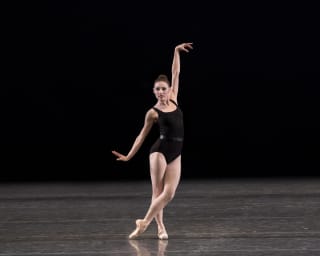
In “The Four Temperaments,“ the company continued to display the deep strength of its Balanchine repertory and sureness of interpretation. Here Tiler Peck deserves primary mention (partnered by Tyler Angle ) for her Sanguinic, delivered with supreme aplomb and a physical attack that was, if anything, too daring. Longer lined women have often shone in this choreography (Mary Ellen Moylan created the role and Merrill Ashley danced it among many others) but the slightly smaller Peck adapted to it by utilizing her knack for creating divine clarity amidst speed, all the while looking great in a leotard. One suddenly realized they hadn’t seen her much in the great Balanchine leotard roles; her success here bids fair to open another third of the Balanchine repertory to her and the audience’s profit.
Anthony Huxley continued to progress in the role of Melancholic, despite being light for the part. Ask La Cour and Teresa Reichlen reprised their successful and natural interpretations of Phlegmatic and Choleric. In total, the great ballet punched to its weight.
In ending the evening with “Chaconne” – danced by Sara Mearns and Adrian Danchig-Waring as the principal couple – the company presented a ballet whose connection to Martins was as a dancer even more than as a director (he created the original of course with Suzanne Farrell) with Danchig-Waring acquitting himself very nicely in the former master’s role. Of the three ballets, all the same, this got the most uneven performance. After the usual gorgeous opening in the Dance of the Blessed Spirits, with the young women’s corps de ballet looking uniformly dreamy and beautiful with their hair down, the opening duet felt somehow smaller in scale than it should have.
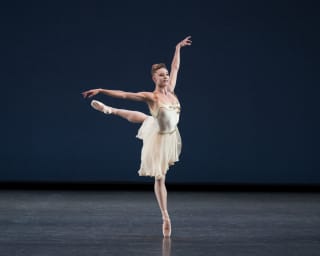
Mearns’ great solo then momentarily lifted the performance to a haunting majesty, as if her searching in the dark were a grief-stricken loss, not just of Orpheus, but for the company’s now recent past. But the allegro middle duet then felt choppy. And among the ensembles the level of performance was uneven. Troy Schumacher and Eric Pereira were momentarily brilliant in their duet but then Aaron Sanz looked stiff and uncomfortable playing an imaginary lute, and Indiana Woodward heavily footed her landings and lacked the slightest turnout in her quartet sequence with Rachel Hutsell, the extremely promising Baily Jones, Laine Habony, and Mimi Staker; and so the performance went, from peak to valley.
But nothing in “Chaconne” merited deep criticism. The overall feeling at the curtain was a sense of relief that life at New York City Ballet indeed goes on. The masterworks are there along with the masterful dancers. Each curtain call represents a renewal of the connection that matters most: performers and audience in great works of dance.
copyright © 2018 by Michael Popkin



