Ladies' Night
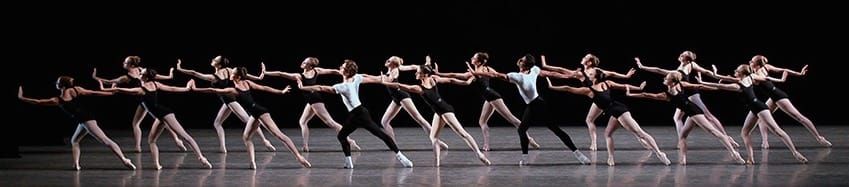
"Allegro Brillante", "The Four Temperaments", "Symphony in C"
New York City Ballet
David H. Koch Theater
New York, New York
April 18, 2017
The New York City Ballet's spring season opened with three popular (judging from the packed house and prolonged ovations) Balanchine ballets. Not surprisingly the women were front and center with some tremendous performances and Alston MacGill's impressive debut in the third movement in "Symphony in C". "Allegro Brillante", one of Balanchine's most concise and exhilarating salutes to feminine virtuosity, is a perfect opening ballet, surprising the audience with the corps in mid-jump.
Tiler Peck and Andrew Veyette were a stylish is slightly cool leading couple. Peck's intense musicality made for some stunning moments, as she seemed to hover at the top of a move, almost pausing time and she can find undiscovered nuances in the most familiar score. I did miss some of the emotional gleams that can shine through the dancing, and though her triumphant smile had a special radiance, it did make it seem as if she were happier alone. Peck, with her astounding technical finesse, is a very self-sufficient dancer.
So too, in her own way, is Sara Mearns who gave Sanguinic in "The Four Temperaments" an unusually restless but completely convincing approach, emphasizing the urgent off-center moves. She was tamed by Jared Angle, always a gracious and self-effacing partner, who made the final skimming lifts look magical. Men do get their own spotlight in "The Four Temperaments". Gonzalo Garcia made smooth work of Melancholic, a bit too smooth, as he didn't have the weight it needs. He is such an elegant dancer that the push-pull feel, as the poor Everyman struggles to rise, didn't have enough effort. Ask la Cour was a fine Phlegmatic with a Buster Keaton-like resigned pathos. Teresa Reichlen was a towering Choleric, with a sharp, commanding, acerbic attack. The moment when she spread her arms to calm the chaos was a powerful and dramatic moment; she looked like a twentieth century Lilac Fairy ruling her domain.
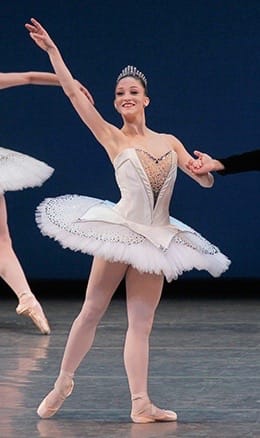
"Symphony in C" has not quite settled into its bright new costumes and the grey crystals ombreing down the front look like spilled soup, but the glorious choreography triumphs over any extraneous glitter. Alston MacGill, who had made such an impression with her generous enthusiasm and powerful dancing in last season's "Fearful Symmetries", confirmed the excitement with her performance in the third movement. There was a last minute partner change (Harrison Ball for Anthony Huxley) and some of the supported moves were a bit iffy, though Ball was a warm and generous partner. Even a slightly over-rotated pirouette in the finale didn't disturb her aplomb and the sheer joy of her dancing with the sparkling, effortless little (and big) jumps were irresistible.
Ashley Bouder danced the first movement with her usual controlled abandon and beautifully held poses, though with a directness that, while exciting, isn't exactly regal. Maria Kowroski returned to the second movement, showing off her long limbs. It was a bit of a white-knuckle performance, though as the technical challenges threatened to get the better of her; those legs aren't really built for turning. Tyler Angle was a noble support and his elegant timing made the sudden drops as he catches her and lowers her to the ground breathtaking.
Copyright © 2017 by Mary Cargill