What the Doctor Ordered
"Whipped Cream"
American Ballet Theatre
Metropolitan Opera House
New York, New York
May 24, 2017
In a recent interview, Alexei Ratmansky said that his new ballet was modeled after the nineteenth century balletféerie with its elaborate processions and spectacular theatrical effects. Petipa's "The Sleeping Beauty" is of course one of the most famous of these and when asked if his work reconstructing this ballet influenced "Whipped Cream" he agreed emphatically. Like "The Sleeping Beauty" "Whipped Cream" combines magical sets with elaborate transformations, fantastic creatures, great music, and sparkling and varied choreography, linked by a wisp of a story.
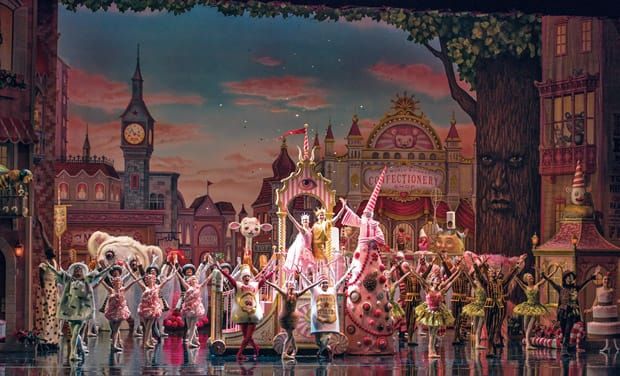
Most of the publicity has focused on the sets and costumes designed by pop-surrealist Mark Ryden, and they are superb: rich, detailed, and whimsical. He had never designed for the stage before, and Camellia Koo and Holly Hynes helped transform his ideas into three dimensions. The spacious sets allow plenty of room for dancing and supported but don't overwhelm the choreography, and the several transformation scenes were simply but elegantly managed. The costumes were fun and imaginative (children of all ages will love the gumball lady and the worm candy man) as well as danceable. Even the wonderful swirl girls accompanying Princess Praline managed to look like hard candies while prancing around doing Petipa's beloved emboîtés. The colors, while vivid, were not cartoon-bright and were both sophisticated and whimsical.
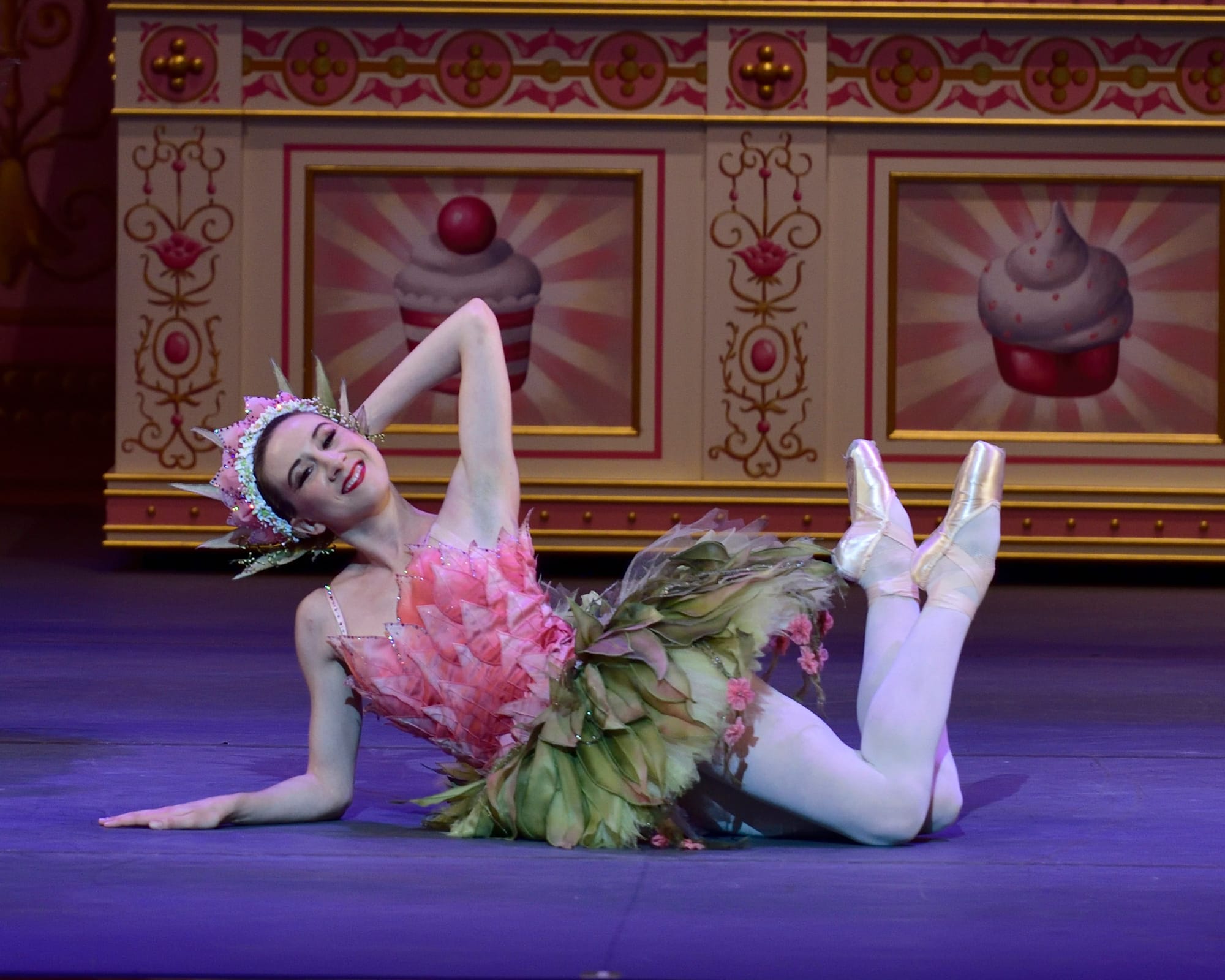
The episodic score by Richard Strauss has been unaccountably ignored and is a perfect match for the slightly off-beat story of a boy (Daniil Simkin) who eats too much whipped cream while celebrating his first communion and of the food that comes to life in the pastry shop after it has closed. The leaders of that group were Princess Tea Flower (Isabella Boylston) and Prince Coffee (Alban Lendorf), who emerged from their canisters to dance a languorous (though over-long) pas de deux. I saw a few glimpses of Fokine's Firebird in Boylston's luxurious phrasing and spiky headdress, which made her Tea look appropriately Russian. Lendorf's Coffee was dark and smooth and his choreography, with a slightly arched back and open hands gave his dancing an abstract quality, as if he were a flavor rather than a human. Their dancing looked like vapors merging rather than a standard courtship; it was a choreographically witty tour de force.
So too was the opening dance, a stylized battle between three groups of four men, the black and white Marzipan Men (who wielded their bows like candy Polovtsy), the pink Sugarplum Men, and the brown (cone-headed) Gingerbread men. Ratmansky moved these groups with ease, merging and separating them so that the colors made constantly shifting patterns.
The first act ended with a dish of whipped cream, as another transformation scene turned the stage into a mass of white dollops full of dry ice, with a ramp for drops of whipped cream to slide down (a witty Trocadero-style solution to the Bayaderes' entrance) – as every ballet goer knows, there must be a vision scene of some sort. Ratmansky matched the swirling music with sixteen dancers wearing chiffon shifts; like the boy, I would have liked more cream.
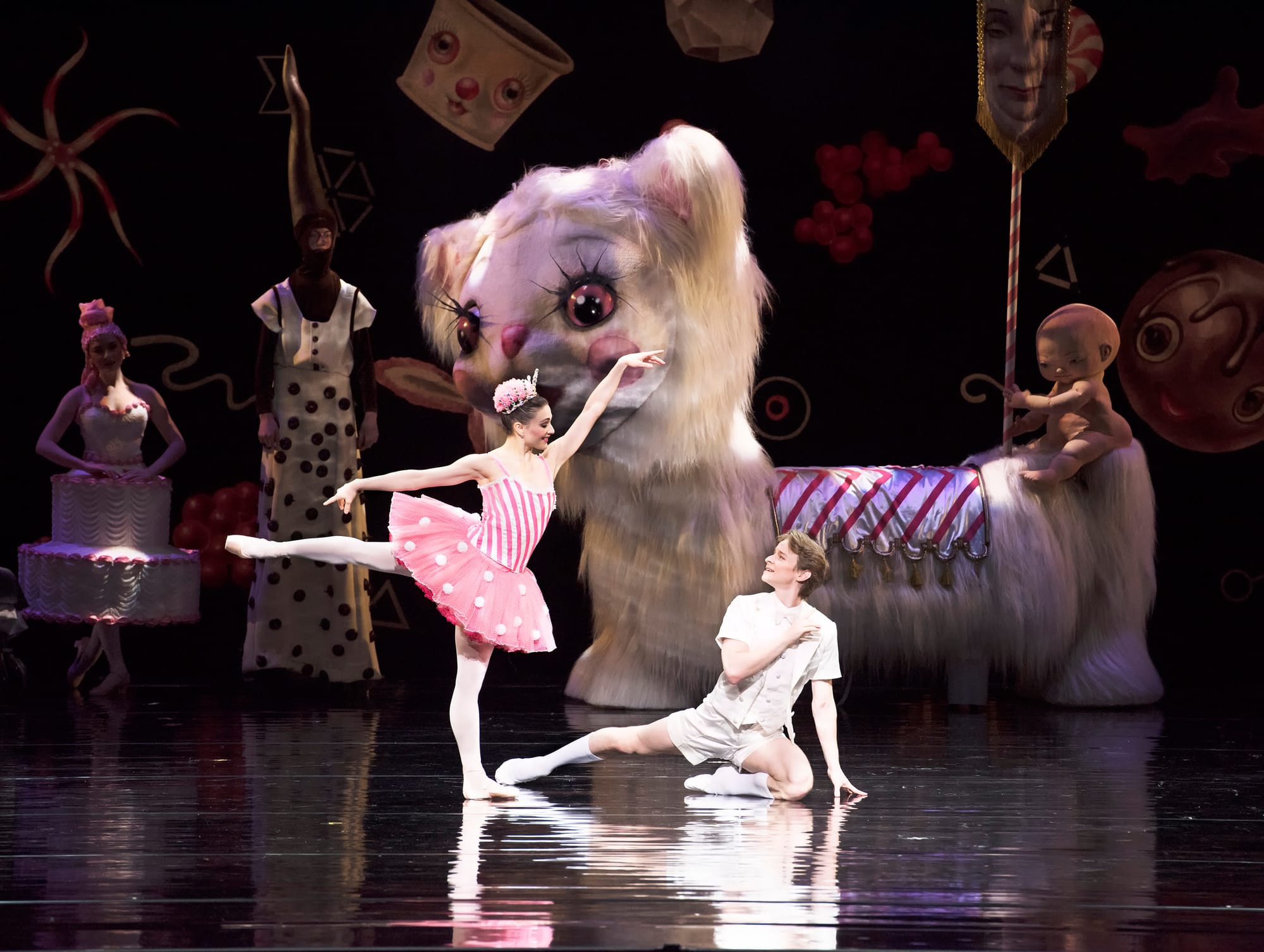
Act II returned to the story, such as it was, as the Boy recovered in a hospital bed. His stay was interrupted by a massive procession led by Princess Praline (Sarah Lane) who rode in on a giant snow yak. Lane, a lush, musical dancer with crisp, precise footwork, got a role of a lifetime; Petipa's dancers may have made lace with their feet, but hers seemed able to whip cream.
Back in the hospital a doctor (Alexei Agoudine in a giant head--grownups look huge to children) and a group of nurses who aspired to Wilidom, attempted to operate on him, watched over by a surreal, possibly benign eye. The procedure was interrupted by another of Ratmansky's choreographic personifications, as Catherine Hurlin, Duncan Lyle, and Roman Zhurbin embodied bottles of chartreuse, vodka, and plum brandy who enticed the medical team to drunken excess. Their witty pas de trois, led by the leggy and thrilling Hurlin, was a wonderfully comic interlude, perhaps an indirect nod to Petipa's equally witty cats in "The Sleeping Beauty".
The Boy was then magically transported to Princess Praline's kingdom, where all the characters from the first act appeared to welcome him. Tea, Coffee, Praline, and the Boy had a serene little dance, ending in a quiet huddle to a gentle bit of music, which I found a surprisingly moving illustration of friendship. This was followed by a rip-roaring solo for Simkin, full of astounding jumps. Though it did change the reflective mood, he danced it with such innocent and eager bravura his was impossible to object when he was crowned King.
Though the ballet has no serious message ("eat too much sugar and escape to a magical kingdom" makes Sleeping Beauty's "double-check your guest list" sound positively philosophical), "Whipped Cream" does have a genuine underlying faith. It believes in the ability of theater to transport an audience, and has a faith in innocent wonder devoid of cynicism, a faith in pure dance as a complete art form which doesn't rely on narrative to give it significance, and a faith in ABT's dancers that was completely rewarded.
Copyright © 2017 by Mary Cargill