The Pirate King
"Le Corsaire"
American Ballet Theatre
Metropolitan Opera House
Lincoln Center
New York, New York
June 12, 2019 matinee
ABT's version of "Le Corsaire" is loosely based on Petipa's revisions to the 1856 French ballet by Joseph Mazilier, which was even more loosely based on the 1814 poem by Byron. This season, ABT has included a somewhat apologetic note in the program explaining that in 1814 "pirates, pashas, and damsels in distress" were commonplace. In fact, Byron's poem has Medora, already married to Conrad, stay home because she disagreed with his decision to go out pirating, and Gulnare, the pasha's slave, stabs the pasha herself after Conrad chivalrously refused to kill someone in cold blood; these women were not shrinking violets. Nor can it really be said that "slavery and polygamy were driving forces of the economic and social landscape" since Great Britain had abolished the slave trade in its territories in 1807. Sociology and ballet are uneasy companions and "Le Corsaire", though it is one of the few nineteenth century ballets where the hero has any visible means of support, is really about the dancing.
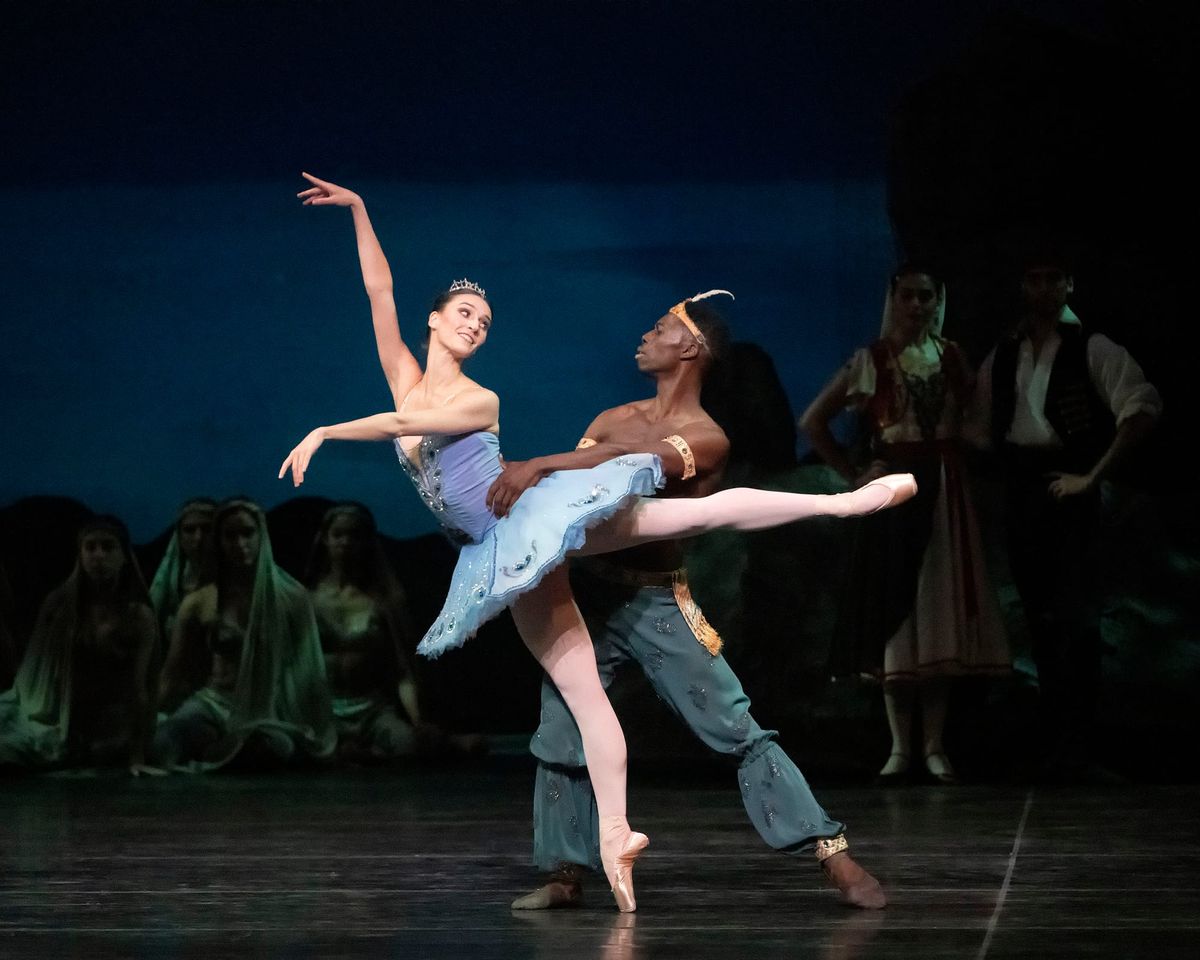
The women do come out better than the men since they get some gorgeous choreography; the men get to jump. There was some exciting jumping in the June 12 matinee, and some fine debuts. Guest artist Brooklyn Mack, formerly of the Washington Ballet, made his New York debut as Ali, Conrad's faithful slave. He was not as servile as some, moving with a dignified pride through the story. He gets the best known dancing in the ballet, the pas de deux with Medora in the pirate's cave (with a supporting appearance by Conrad). Mack was a magnificent Ali, with airy jumps and silent landings combined with weighted power that carved through the air. He threw in some very impressive tricks (whirling his back legs over each other in impressive Bolshoi style and ending with a backbend that had his head touching the ground) and his dancing, while powerful, never looked strained. He deserved all his cheers.
Devon Teuscher also debuted as Medora, the frequently abducted heroine. She gave the role a delicate richness; while Medora's story may be farfetched, Teuscher's emotions were real. Her lighthearted opening dance with the Pasha for once made sense, as she seemed buoyed by her joy in watching Conrad as she danced, confident that he would save her. The Romeo-and-Julietish pas de deux in Act II had an emotional arc, growing in intensity, which made it much richer than the ice-dancing competition it can become.
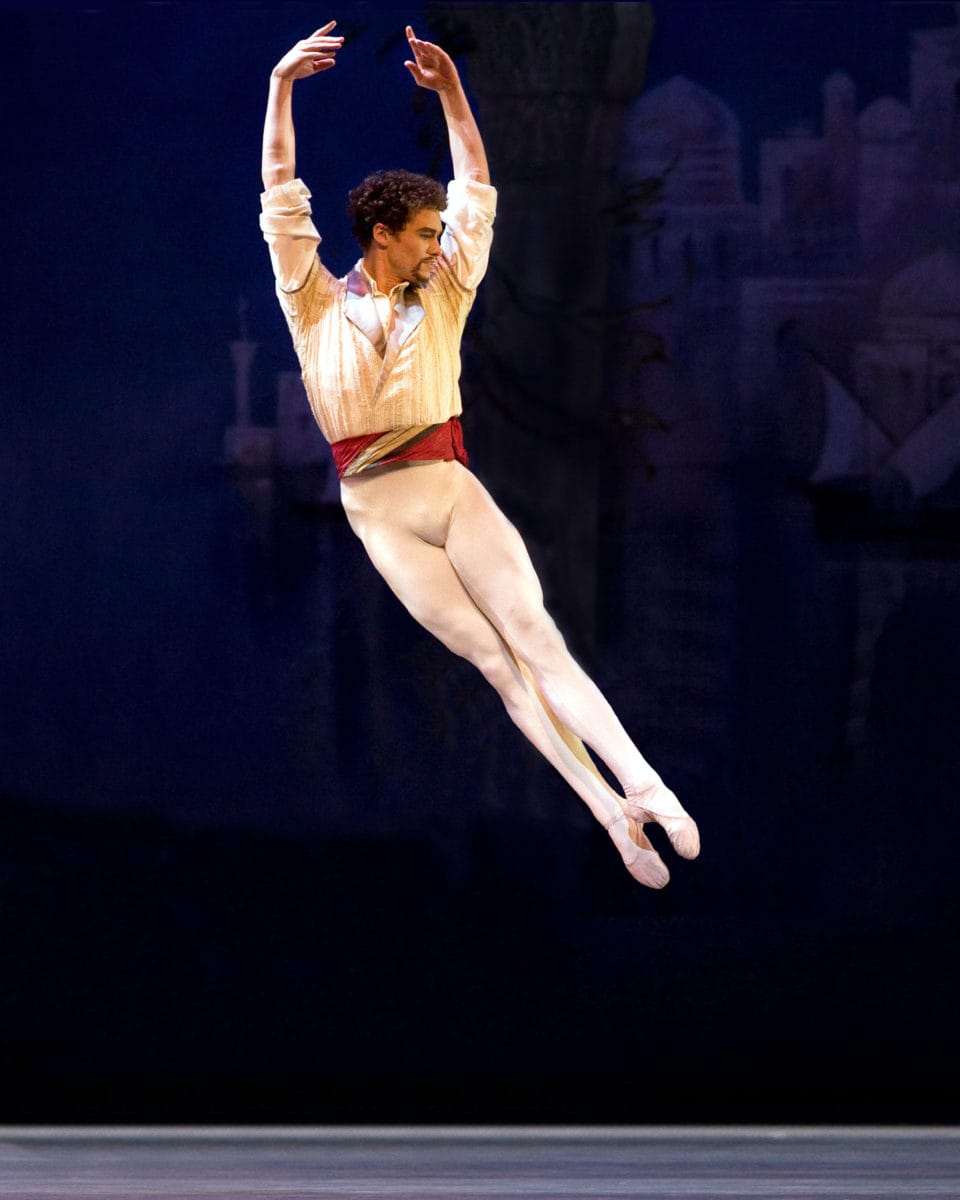
As Conrad, Cory Stearns matched her elegant sincerity. His choreography can seem a bit of an afterthought, with the hero trying to out jump the other men (the original Conrad was primarily a mimed role), but Stearns didn't condescend to the role and like Teuscher, found the emotional core, as well as a beautiful arabesque. They were a beautifully matched couple.
In another debut, Katherine Williams was a sweet-faced, gentle Gulnare, who gave the pas d'exclave a mournful tinge, elevating it to a sigh for lost freedom. Her fellow slaves (the Odalisques Zimmi Coker, Brittany DeGroft, and Catherine Hurlin) had no plot, however slim, to advance, but seemed to revel in their pas de trois, one of the glories of this ballet. In the first solo, Coker had joyful little jumps and secure balances, DeGroft was all bounding emboîtés in the second solo, and Hurlin's diagonal in the third solo had some impressive double and triple pirouettes, though they were a bit wobbly by the end. (A recent demonstration of Petipa's original solo, based on the Stepanov notations, showed that this diagonal alternated single pirouettes with bouncy little jumps, much more musically secure than the current no holds barred version.) But holds or no holds, it seems a shame that the Odalisques disappear after Act I -- they would be right at home in the Pasha's Act III dream.
That dream is an absolutely magical interlude, as the stage fills up with Petipa's shimmering architectural shapes. How that man loved garlands, and how many designs he could come up with! Williams seemed to float through her solo, with the little backward jumps. Teuscher was a queenly contrast, seeming to luxuriate in the majesty of her dancing. Her Italian fouettés were fearless; commanding, clear, and confident.
Then it was back to the story. The new, more politically correct Conrad doesn't have his buddies slice the palace guard's throats. He has them show off their loot to the Pasha, while one pirate pretends to be sick so the Pasha will offer to bring them inside. Then back to the ship (maybe the guards were too busy gloating over the jewels to guard the girls), the wreck, and the island for Medora and Conrad. It does seem a shame that in revising the story Ali and Gulnare weren't saved too – their dancing certainly deserved preserving.
Copyright © 2019 by Mary Cargill



