Dancers' Holiday
"Divertimento No. 15", "Zakouski", "Composer's Holiday", "Heatscape"
New York City Ballet
David H. Koch Theater
New York, NY
April 29, 2026
This evening’s program, one pas de deux (Peter Martins’ “Zakouski”) and three longer works (Balanchine’s sublime “Divertimento No. 15”, and two newer works by younger choreographers (Gianna Reisen’s “Composer’s Holiday” and Justin Peck’s “Heatscape”), seemed to be designed to show off the company’s current impressive collection of dancers. “Zakouski” celebrated the soon to retire Megan Fairchild while “Composer’s Holiday” starred four soloist and corps dancers and both “Divertimento” and “Heatscape” had large casts and many featured roles; with no overlapping casting, the evening gave the audience a chance to see an astounding array of very strong and very individual dancers.
“Divertimento No. 15”, choreographed in 1956 to Mozart, looked fresh and sparkling; Arlene Croce’s quip about it being a ballet famous for never being done well finally seemed outdated and it did look like the purest of Viennese cream as the dancers poured out in a smooth, elegant stream. The three men (Peter Walker, Jules Mabie, and Owen Flacke, in his debut) danced with a courtly reticence, melting into the music, with jumps that floated up and landed softly. Mabie and Flacke danced their duo with a gracious courtesy, almost like a conversation, pausing to let the other person have his say. Mabie’s upper body was especially elegant, as he bent and turned, appearing to part the air.
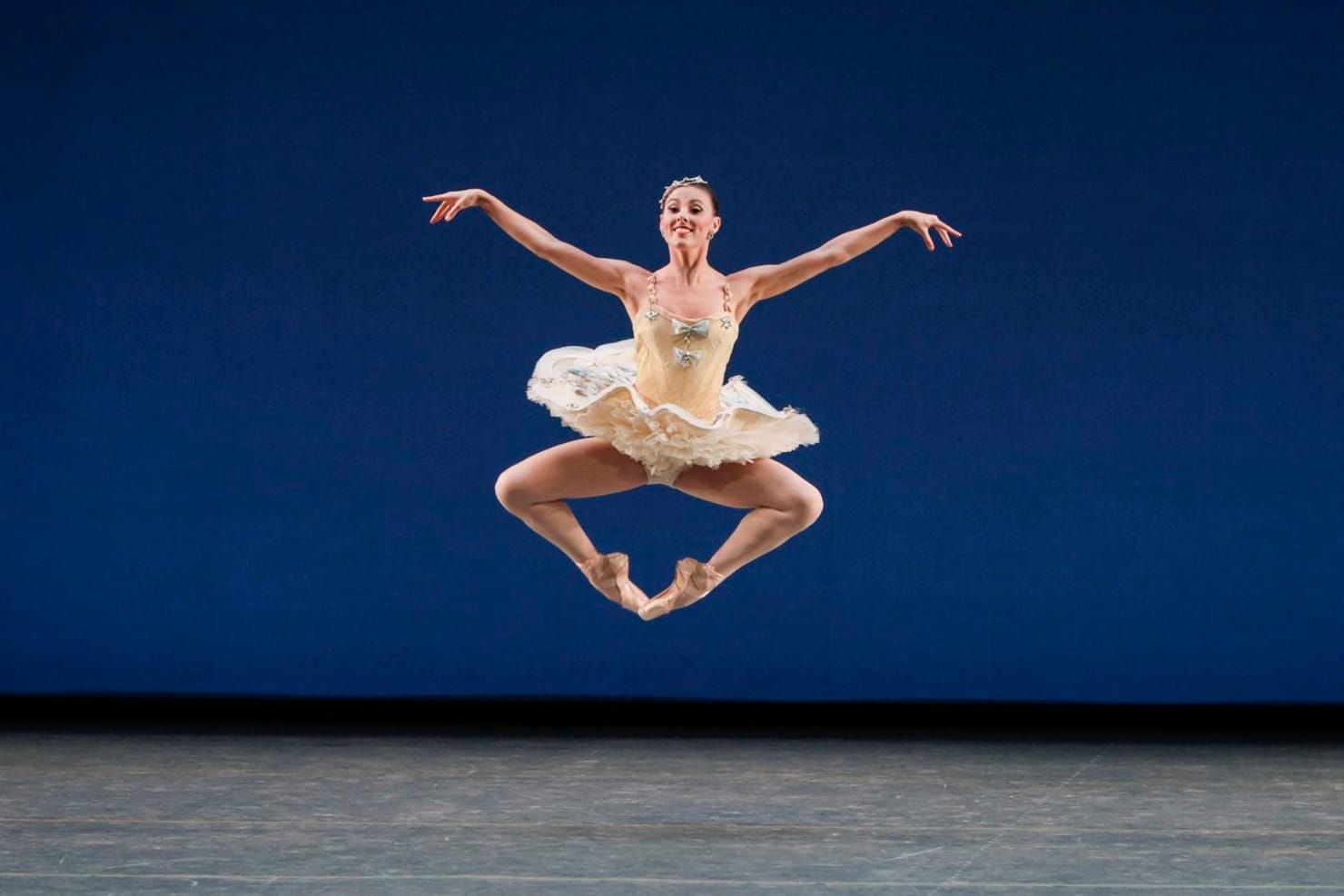
Tiler Peck, as the primus inter pares of the five females, certainly parted the air in her solo with her fleet, crisp footwork and elegant little pauses. Her ability to fly through the steps while making every shape and turn pop with a radiant clarity was breathtaking. Dominika Afanasenkov, in her debut, danced the third solo with a notable creaminess, as her body seemed to be pulled one way and then another. Emily Kikta, in the fourth variation, was scintillating, swinging her legs with perfect control. Isabella LaFreniere in the first variation and Ashley Hod in the second were also lovely; I enjoyed LaFreniere’s playful balances and quick changes of direction and Hod’s fearless jumps.
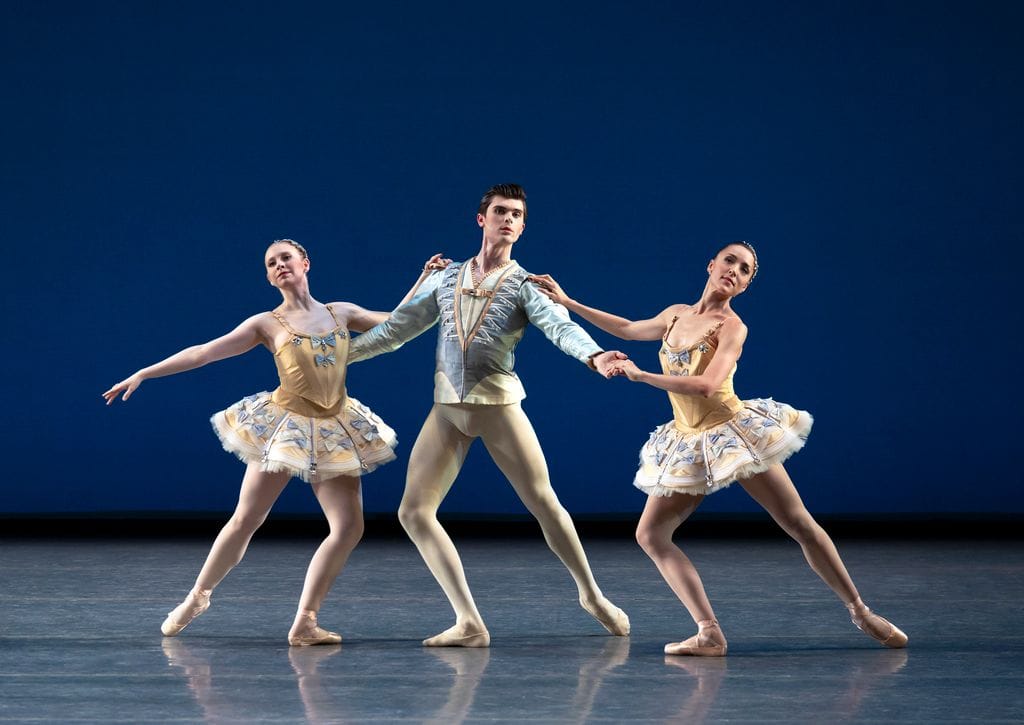
But their performances were more than technical felicities, and the Andante had an air of quiet joy, of friends (very exalted ones) sharing a peaceful, luxurious, and occasionally playful sunny afternoon.
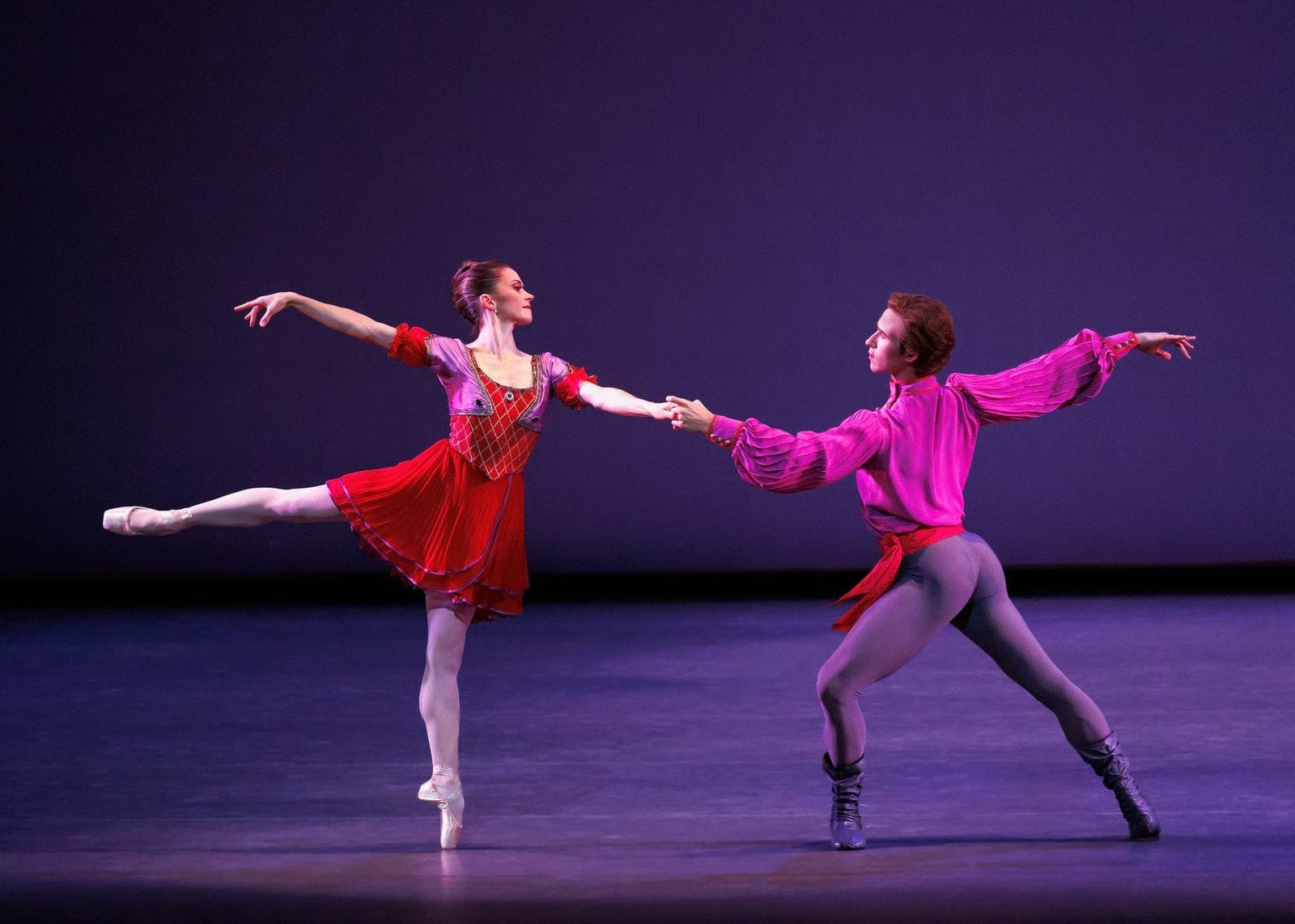
Peter Martins’ “Zakouski”, danced by Megan Fairchild and Joseph Gordon, was a more energetic conversation. Martins choreographed it in 1992 for Margaret Tracey and Nikolaj Hübbe for an opening night gala, and it has reappeared sporadically. It follows the traditional grand pas de deux form, with an adagio, two solos, and a bravura finale, using selections from Rachmaninoff, Stravinsky, Prokofiev, and Tchaikovsky; zakouski is Russian for hors d’oeuvres, but it does seem as if any one of those composers would make a full meal.
“Zakouski” has less of the finicky, anatomical partnering that Martins often used, and the opening adagio had a wistful, windswept flow, as the dancers walked and paused to listen to the music. Gordon’s solo had a Russian tinge with a lot of crossed arms, almost as if he were trying to remember the old country, and then he burst into an orgy of thigh slapping, an energetic but slightly mannered episode. Fairchild joined him in the fun, and then broke into her own solo. Martins’ choreography for her was a bit cutesy (lots of flatfooted jumps into point) combined with some stiff, doll-like moves, but Fairchild’s openhearted joy and Gordon’s dignified reticence elevated the work, and it was an enjoyable interlude.
Gianna Reisen’s “Composer’s Holiday”, choreographed in 2017 when she was just eighteen, features four dancers (Ava Sautter, Mia Williams, David Gabriel, and Kennard Henson) supported by a corps of eight. It is a confident work, though it does meander a bit and looses focus. It opened with a striking vignette, as Williams, in black, was held flat by the corps men, as if lying on a bier, with the corps women pointing at her. This ominous opening, though, didn’t develop, as Williams soon joined the throng, and, despite her occasional odd woman out poses and distinctive presence, seemed quite happy dancing with Gabriel.
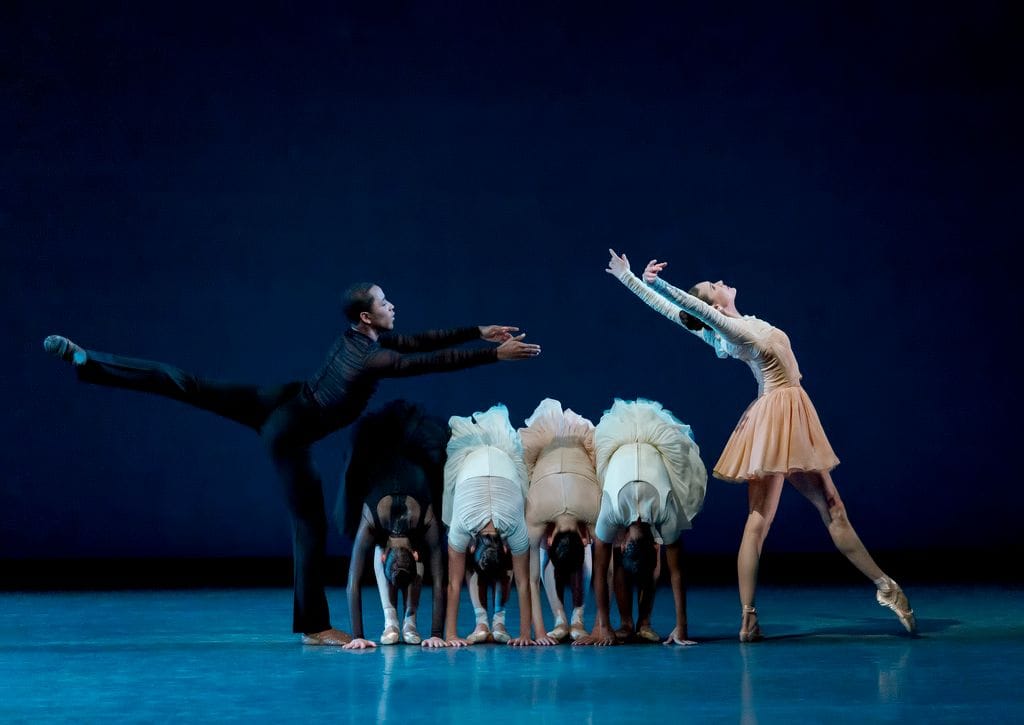
The scene then shifted to the powerful Henson, lying on the ground struggling against some hidden sorrow, who was soon joined by Sautter, another powerful and incisive dancer. The struggle seemed to disappear, as the entire cast whipped off some fast jogs through shifting shapes. The dancers were certainly impressive and the hints of drama, though undeveloped, (there seemed to be no connection between the two couples) emerged through the choreographic shapes.
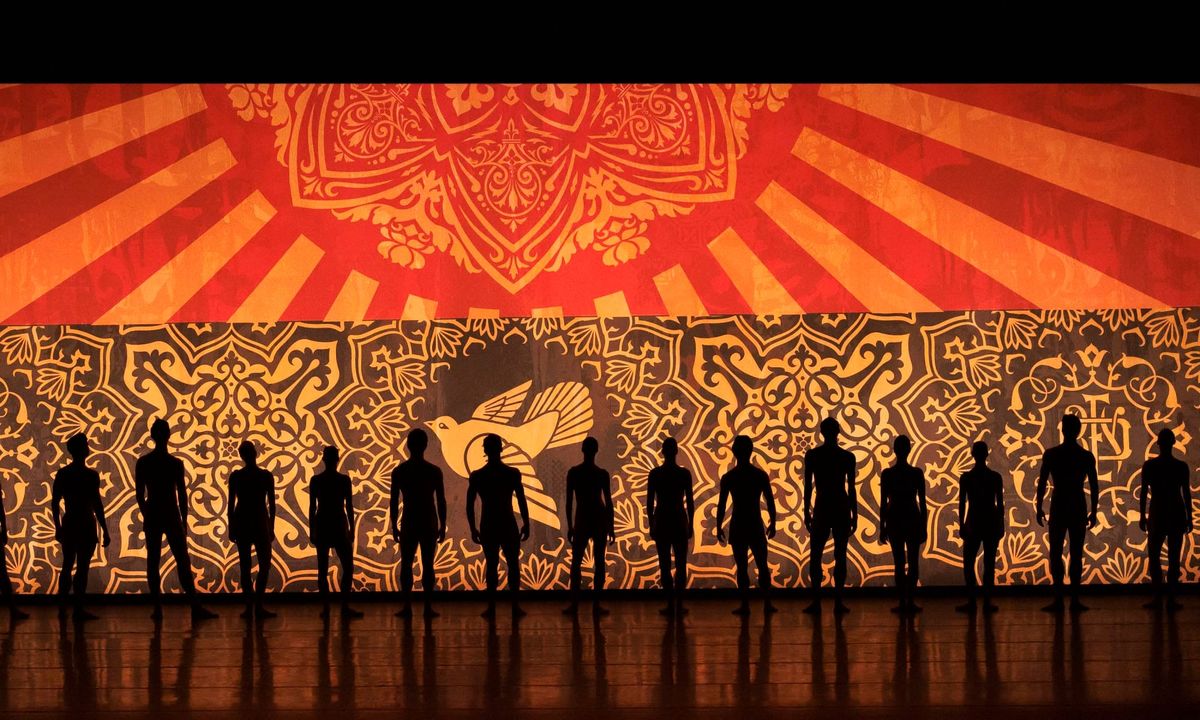
Justin Peck’s “Heatscape” is another early work choreographed in 2015 for the Miami City Ballet; it was first performed by NYCB in 2025. The striking opening has silhouetted dancers standing in front of a brightly patterned backdrop by Shepard Fairey, inspired, the artist has explained, by the heat and humidity of Miami. The simple costumes by Reid Bartelme and Harriet Jung look like casual beachwear. Peck’s choreography for his cast of 17 is anything but relaxed and casual, as the music, Bohuslav Martinů’s throbbing “Piano Concerto No. 1” seemed to propel the dancers. Peck used his frequent “just friends in a circle having fun” approach, and the seven principals (Alexa Maxwell, Mira Nadon, Emma von Enck, Chun Wai Chan, Harrison Coll, Roman Mejia, and KJ Takahashi) emerged quietly from the group, and, when their turns were over, blended back in, rejoining the friendly, non-hierarchical world.
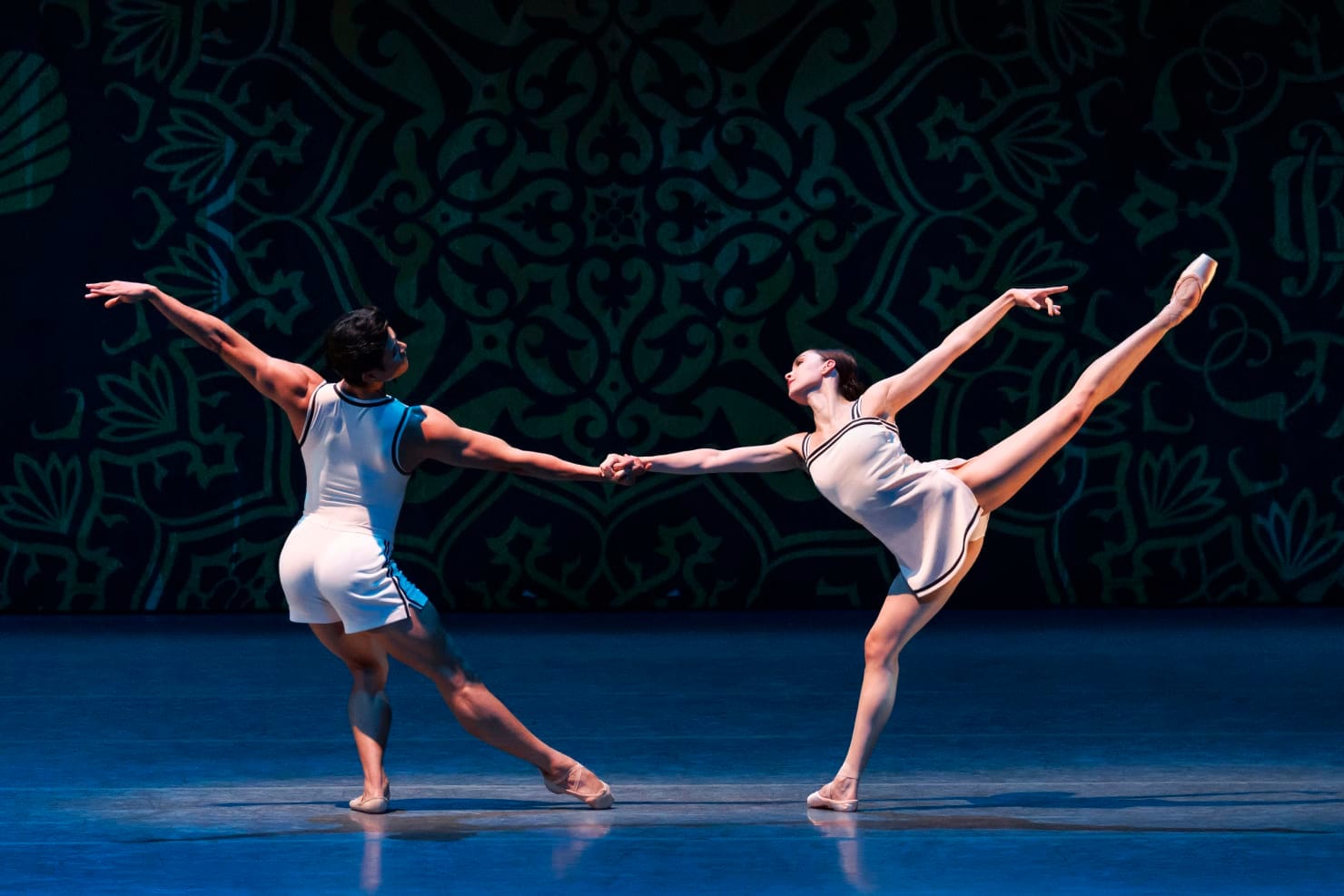
There were hints of drama; Mejia seemed to be an odd man out in the first movement, and in a brief quotation of the sunburst from Balanchine’s “Apollo”, chose his muse, Alexa Maxwell, a joyful and sympathetic presence. Nadon and Chan led the more lyrical second movement, dancing a soaring pas de deux which showed off her long, strong legs, her magical ability to make every little move shimmer, and Chan’s gentle nobility.
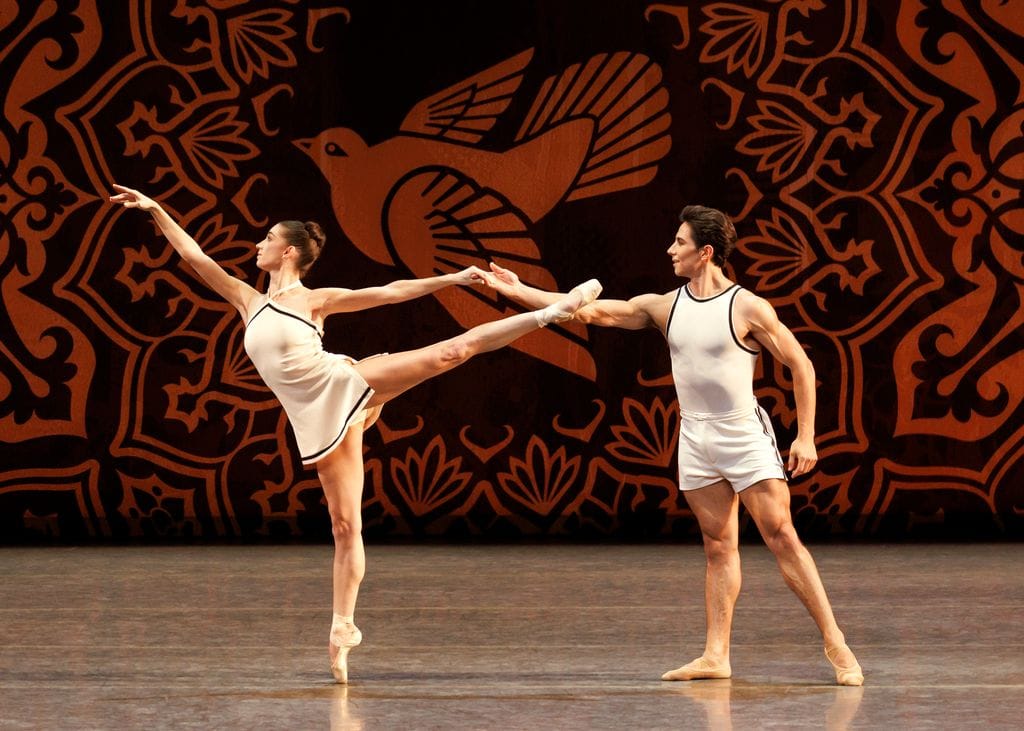
The third movement, led by von Enck, Coll, and Takahashi, had little drama; it was all excitement, as the trio bounded through a sparking set of turns as if they were playing on the beach. Von Enck got a quirky little solo, full of fast arms and changes of direction. Then the whole cast joined together to rush forward, as if embracing the audience. The entire theater, it seemed, was having a holiday.
© 2026 Mary Cargill



