The Handkerchief Trick
"Othello: A Dance in Three Acts"
American Ballet Theatre
David H. Koch Theater
New York, NY
March 10, 2026
ABT’s quest for seat-filling full-length ballets has in recent years focused on works based on literary works (“Crime and Punishment”, “Jane Eyre”, Virginia Woolf, “A Winter’s Tale”, etc.), with often disappointing results. There are few choreographers around who can spin choreographic gold from complex sources and “Don Quixotes” don’t turn up very often. Of course, the balletic “Don Quixote” has only a hint of the original story, and Petipa used the book as sort of a trampoline to propel him into a lively excuse for classical and character dancing. Lar Lubovitch’s “Othello”, from 1997, (it was ABT’s first commissioned full-length work) tries to retell most of Shakespeare’s tragedy, and, unfortunately, is not nearly as entertaining as the frivolous “Don Quixote”.
Petipa was lucky to have Minkus’ rollicking, tuneful, and infectious music to work with. Lubovitch worked with Elliot Goldenthal on a new score; Goldenthal is best known for his film scores, and his music is cinematic but a bit characterless and has few really danceable moments—most disappointing is the tarantella which opens Act II, a monochromatic swirl with little rhythm or atmosphere, and certainly no tambourines.
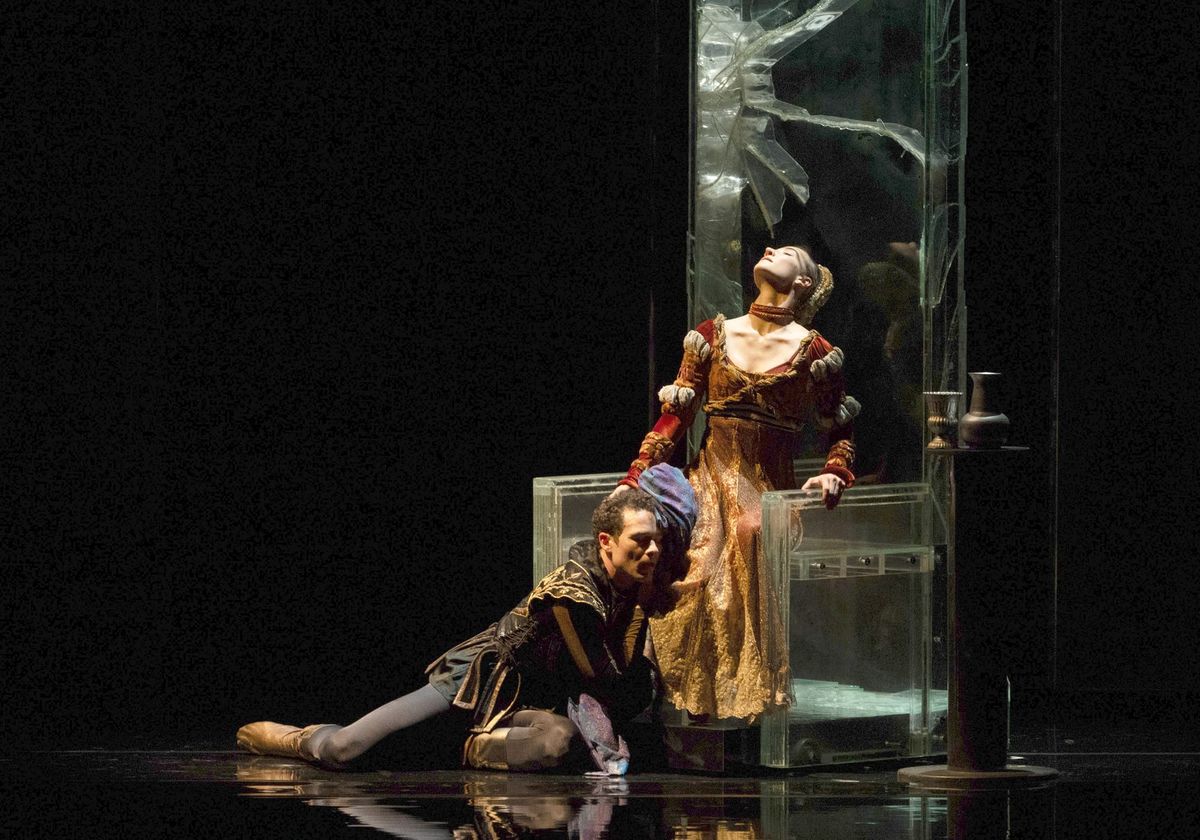
George Tsypin’s sets, though, are extremely effective, evoking a sumptuous renaissance palace, lightened with mylar panels which moved seamlessly as the scenes changed. The dancers too, Joseph Markey as Othello, Cory Stearns as Iago, Andrew Robber as Cassio, Sunmi Park as Desdemona, Christine Shevchenko as Emilia and Léa Fleytoux was Bianca, who the program primly calls “a woman of Cyprus” though she seems to be related to Kenneth MacMillan’s harlots, gave gripping, committed performances.
They did deserve more interesting and subtle choreography, as Lubovitch’s limited and repetitive steps made real character development almost impossible. Lubovitch is a modern dance choreographer (the subtitle “a dance in three acts” makes it clear that this is not a ballet). “Othello” has certainly been treated by modern dance before, and ABT has performed José Limón’s concise, powerful “The Moor’s Pavane” in the past. Limón’s work was abstract, with four characters who essentially danced their feelings. Lubovitch had to fill three acts, so had to deal with the story, requiring background, motives, secrets, and plots, not to mention the ubiquitous handkerchief of doom, is difficult to convey, especially in a mimophobic world.
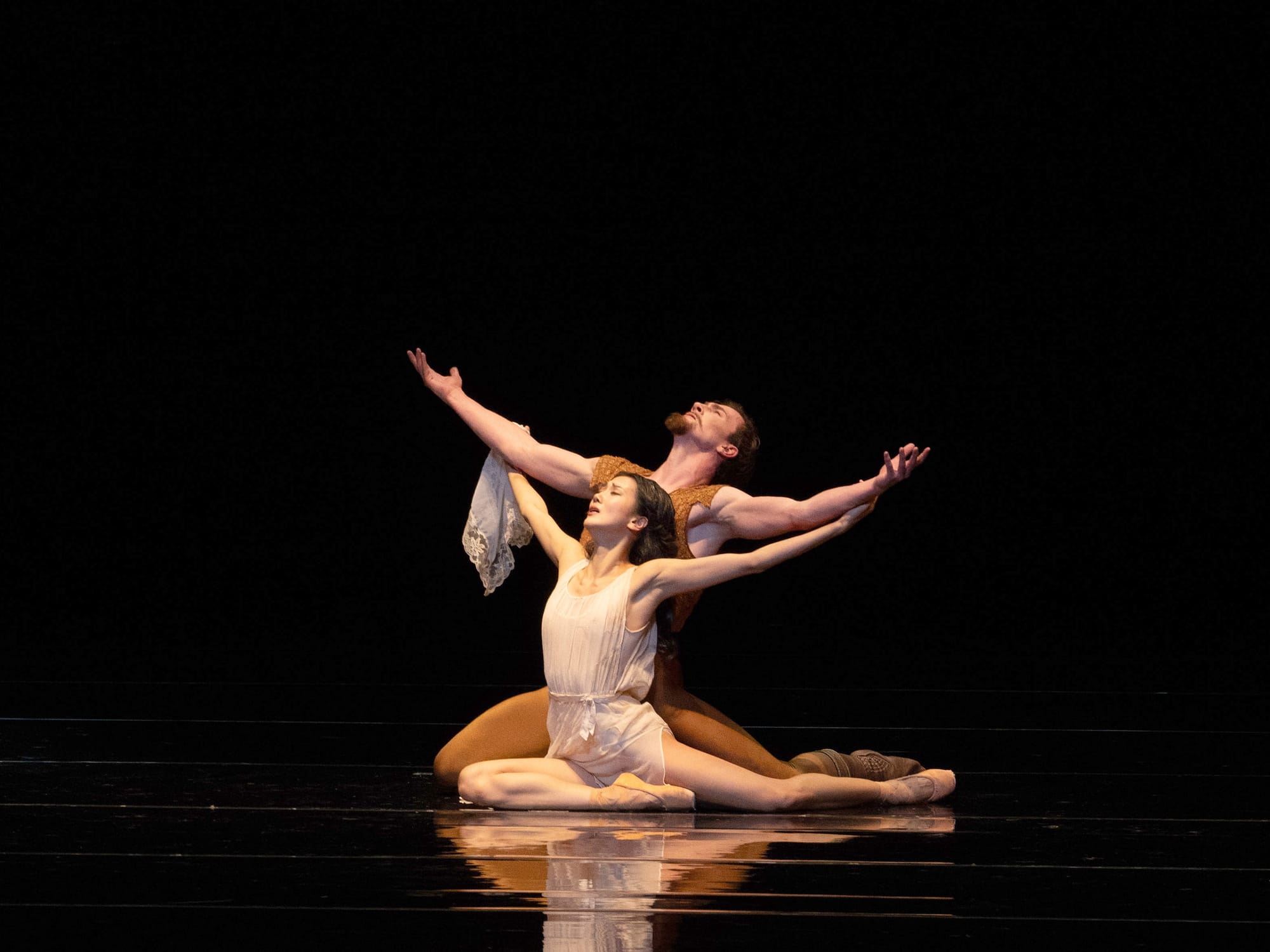
Othello spent a lot of time clutching his head and thrashing on the ground, with no opportunity to show his charismatic and powerful leadership—it was impossible to understand why he was appointed Venice’s leader (or even why Desdemona was attracted to him). He seemed agitated from the get go, glaring at Desdemona all through Act I (with lots of foreshadowing with the handkerchief), so there was little contrast in his behavior and so no tragic fall. Markey was a bit lightweight for the conflicted hero, though his dancing was strong. Park’s Desdemona was luminous and lyrical, floating through the many bourrées, and moving gracefully through the many awkward lifts.
Shevchenko, a strong and forceful dancer, could not make Emilia’s masochism believable; the choreography had her spend the evening being pummeled by Stearns while desperately clinging to him. Stearns was more believable as the evil Iago, and made the most of the quiet, sneering moments; a slow walk off stage seemed to ooze venom. The young Robare, still in the corps, was a bright, lively, and charming Cassio, flinging elegant jumps and turns with an insouciant ease. He did seem to be Othello’s Sir Dancealot, jumping into the corps dances at the drop of a handkerchief (though what a Venetian nobleman would be doing dancing with the palace entertainment and the dockyard hangers-on was not clear). His several attentive pas de deux with Desdemona did make it seem that Othello might have a good reason to be jealous, which essentially negated the tragedy.
The various corps dances took up much of the evening, and, though the costumes were colorful, the choreography was limited and had little relation to the story. The first act, Othello and Desdemona’s wedding, included five commedia dell’arte entertainers with charming costumes and odd, awkward and very repetitious moves. Using the commedia dell’arte's dramatic possibilities to tie into the story could have been an interesting way to add some complexity, but the five just danced on and on like so much filler.
The dockyard scene, set in Cyprus, where Othello was arriving on a boat (an ingenious stage design) after defending it from the Ottomans (at the time Venice ruled the island), used the corps to mimic the waves in the most interesting choreography of the evening. Once Othello disembarked, they burst into a bustling if indistinct tarantella, led by Fleytoux. (Why Cypriots were dancing a Neapolitan folk dance to celebrate a Venetian victory is a puzzle; strict accuracy is certainly not artistically necessary—no one quibbles at the eighteenth century’s “Der Rosenkavalier’s” waltzes—but balletic folk dances have a distinctive flavor that ties them specific locations.) But Fleytoux was a sultry seductive dynamo, though, like the rest of the dancers, she gave more to the ballet than it gave to them.
© 2026 Mary Cargill



