The Circus Comes to Town
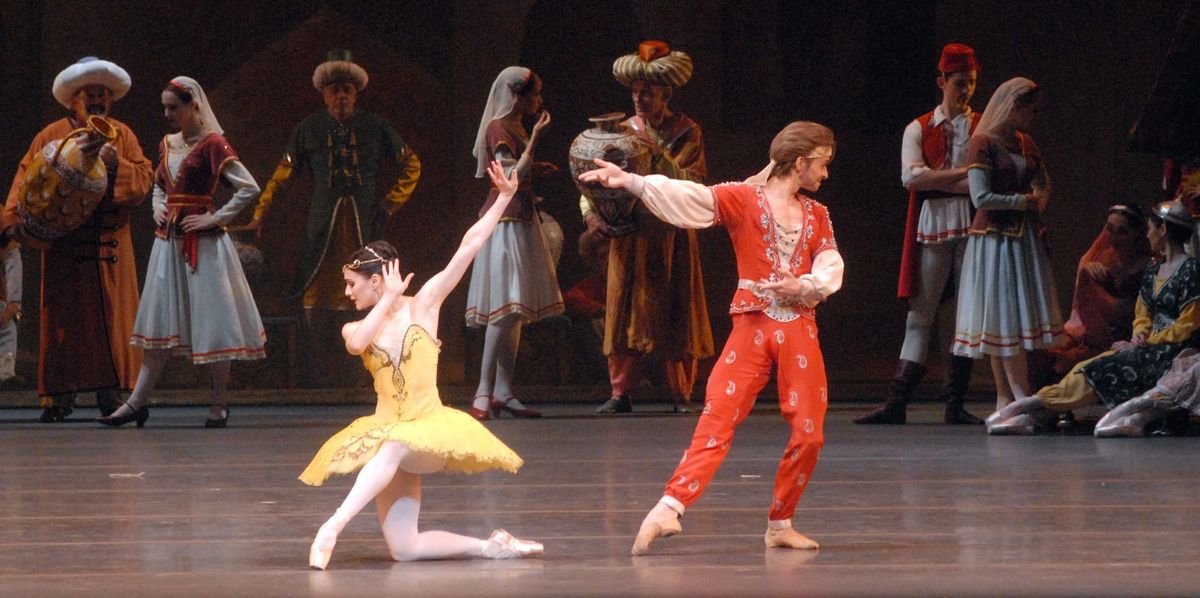
"Le Corsaire"
American Ballet Theatre
Metropolitan Opera House
Lincoln Center
New York, New York
June 5, 2017
The Ringling Brothers may be defunct but New Yorkers can still enjoy three-ringed entertainment as "Le Corsaire" is still floating, with its milling throngs of slave girls auditioning for a role in an "I dreamt I joined a harem in my Maidenform bra" advertisement, its dashing men jumping with sub-Byronic flair, and its intricate female choreography culminating in the jardin animé, one of Petipa's most glorious celebrations of female beauty.
There are many roles, both large and small, so the ballet is a boon to ABT's dancers, though there isn't a great deal of subtlety or character- ization required. Skylar Brandt, a young soloist, danced Medora on opening night, replacing the injured Maria Kochetkova on very short notice. She danced with a fine, clear precision (her soft little jumps in her Jardin solo were beautifully shaped and she tossed off fouettés, both Italian and regular (alternating singles and doubles with only a bit of traveling), with apparent ease. She gave Medora a youthful spunk, punching Birbanto with gusto before she stabbed him, but overall her Medora was wide-eyed and sweet natured. She didn't have the take-no-prisoners hauteur that can make those grand old ballets revive the past, when ballerinas might play peasants but would go home to a drawer full of diamonds, and she was a bit fine-grained and pure for the rip-roaring story. It was like being served on porcelain plates at a Fourth of July picnic. Nevertheless, it was a remarkably confident and engaging performance.
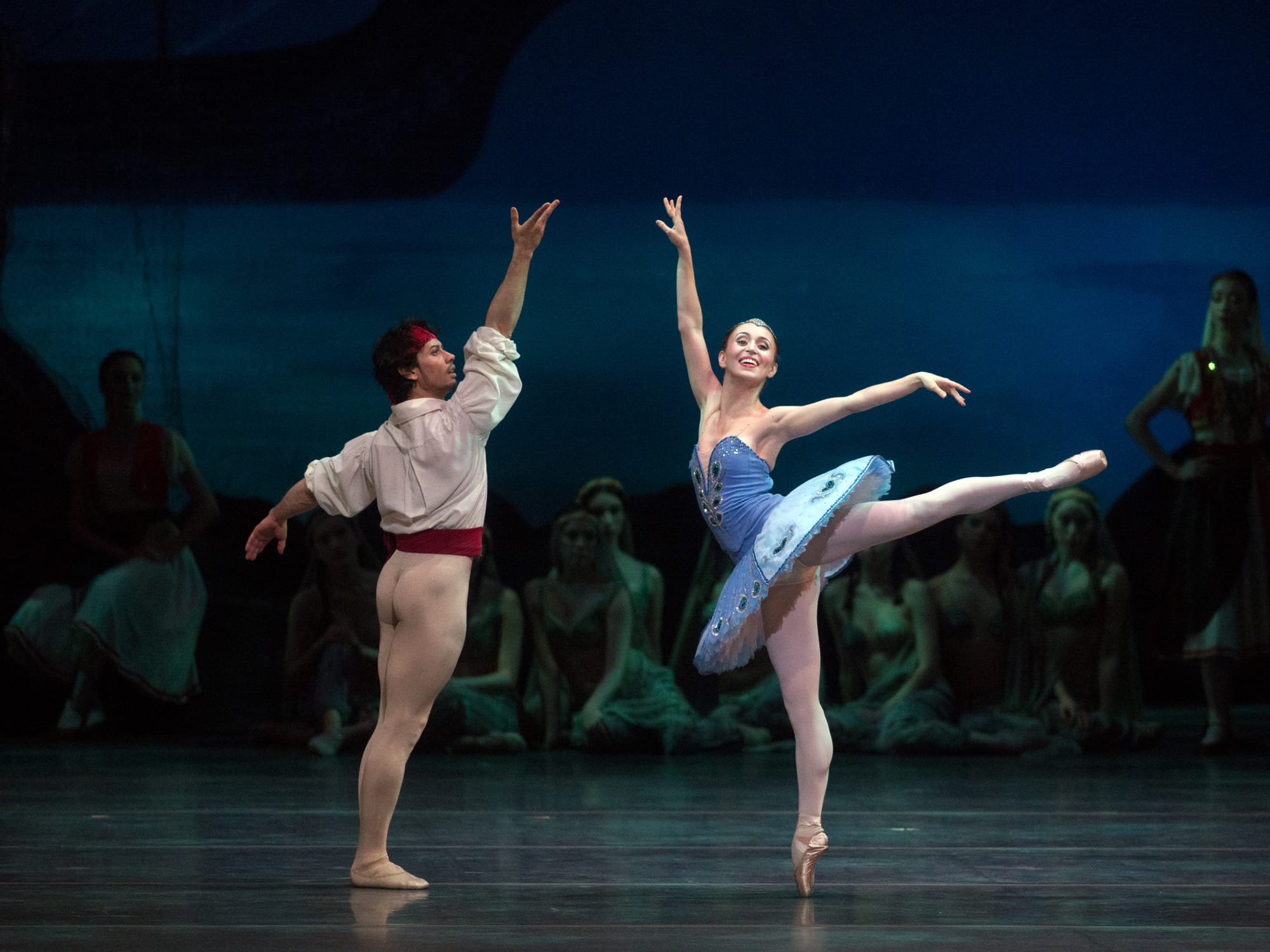
Sarah Lane was Gulnare, Medora's unfortunate friend, and she certainly did not deserve to drown. Her pas d'esclave was lyrical, musical, and gently moving, as she made it clear through the tilt of her head that she was mourning her fate. Even the fast, thrilling turns during the finale had a dramatic purpose as she seemed to be spinning at Lankendem's command. Her solo in the jardin animé was elegantly phrased and she danced with a compelling authority.
The men, unfortunately, don't generally have as detailed or interesting choreography (Conrad himself was originally a mimed role so all of his dancing was added later – there are probably more choreographers' work in "Le Corsaire" than there are composers credited to the charming mishmash of a score). Herman Cornejo was the hero, jumping with vim and swaggering with vigor, but his choreography seems to be tacked on to any scene in which he appears – a real Petipa hero wouldn't compete with his slave for applause, especially since Ali's choreography is more interesting.
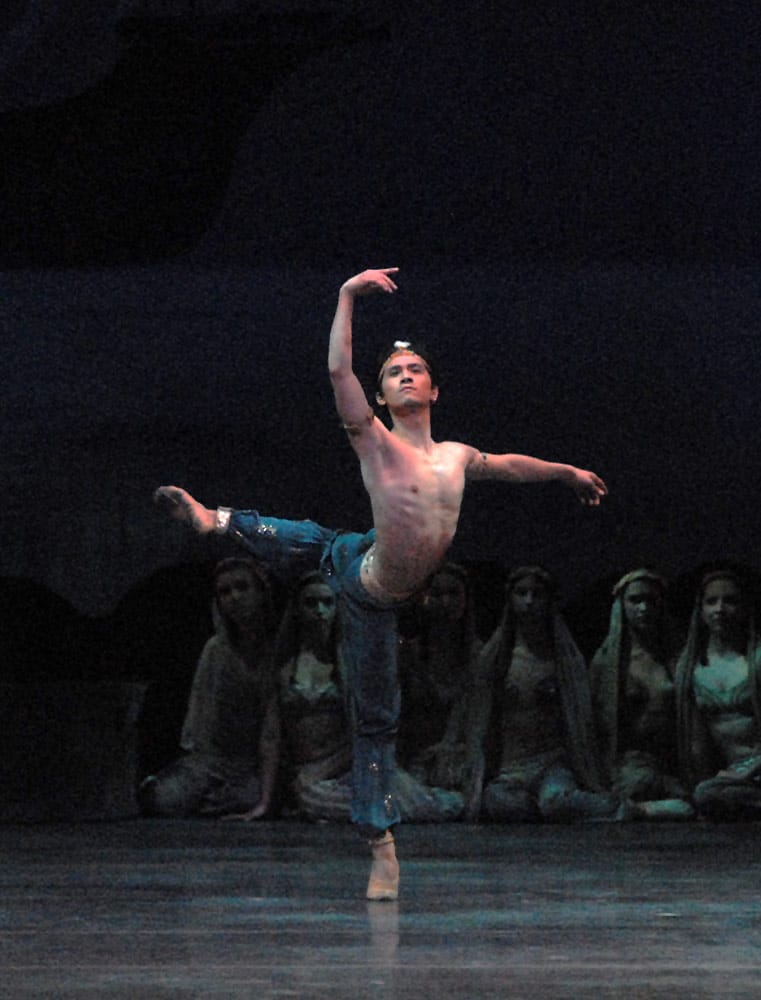
Jeffrey Cirio was a stylish Ali, and he danced with a weight that gave his smooth and secure landings an emphatic power. His turns a la second were stunning, as he seemed to speed up and slow down at will, and his dignified demeanor increased the excitement, as he didn't telegraph his preparations.
Daniil Simkin, whose Ali is equally exciting but not reserved, was an audience favorite as Lankendem, the slave trader, as he ended a smashing series of barrel turns with two consecutive revoltades. He didn't, however, manage Lankendem's expressive jumps into deep plie, which makes it seems as if the cowardly slave owner is both boneless and spineless. Simkin was a bit under characterized, as he flew from one trick to another, but his open-hearted enthusiasm had its own charm.
Craig Salstein was a sullen, brooding Birbanto, Conrad's lieutenant and traitor extraordinaire. The Forband, danced with an animated and elegant Zhong-Jing Fang, had a wonderful snap and the little traveling steps combined with their twisting, forceful upper bodies gave the dance a real character flavor and it seemed like a glimpse of the old ballet without its Sovietized acrobatics.
So, too does the Odalisques' pas de trois, danced by Cassandra Ternary, Katherine Williams, and Catherine Hurlin. Trenary was especially delicate, as she used her head to accent her sparkling little jumps in the first variation. Williams, doing bouncy emboites, made juicy work of the second variation. Hurlin's height made getting around the third solo a bit difficult, and her upper body was a bit stiff. She doubled her pirouettes down the line, but after seeing the Boston Ballet's version (based on the Sergeyev notations from the 1890s) with the tours en l'air instead of the pirouettes, the modern version does seems to cram too much into the music. But that is what a circus is for and the audience got what it came to see – thrilling dancing and lots of fun.
Copyright © 2017 by Mary Cargill



