Words and Music
Program B: American Heartbeat - County and Western
"Home (Excerpt 1)", "Deck of Cards", "Home" (Excerpt 2"), "Songs that Tell a Story", "Home" (Excerpt 3)", "Going Away Party"
Program C: American Mavericks - West Coast Composers
"Prelude and Prelude", "Jenn and Spencer", "Pacific", "Grand Duo"
Mark Morris Dance Group
The Joyce Theater
New York, NY
July 21, 2026 (Program C), July 23, 2026 (Program B)
Programs B and C of Mark Morris’s all-American music season had distinctly different approaches. Program B celebrated the country and Western genre with American stories and styles, often using songs—one dance was even titled “Songs that Tell a Story” and, in an inversion of Morris’s admirable dedication to live music, each work used country and western recordings whose down-home twang seemed to be part of the scenery. Program C was more abstract and used American composers (Henry Cowell and Lou Harrison) primarily to celebrate dancing as an extension of the music, creating moods and colors emerging through bodies moving in unison.
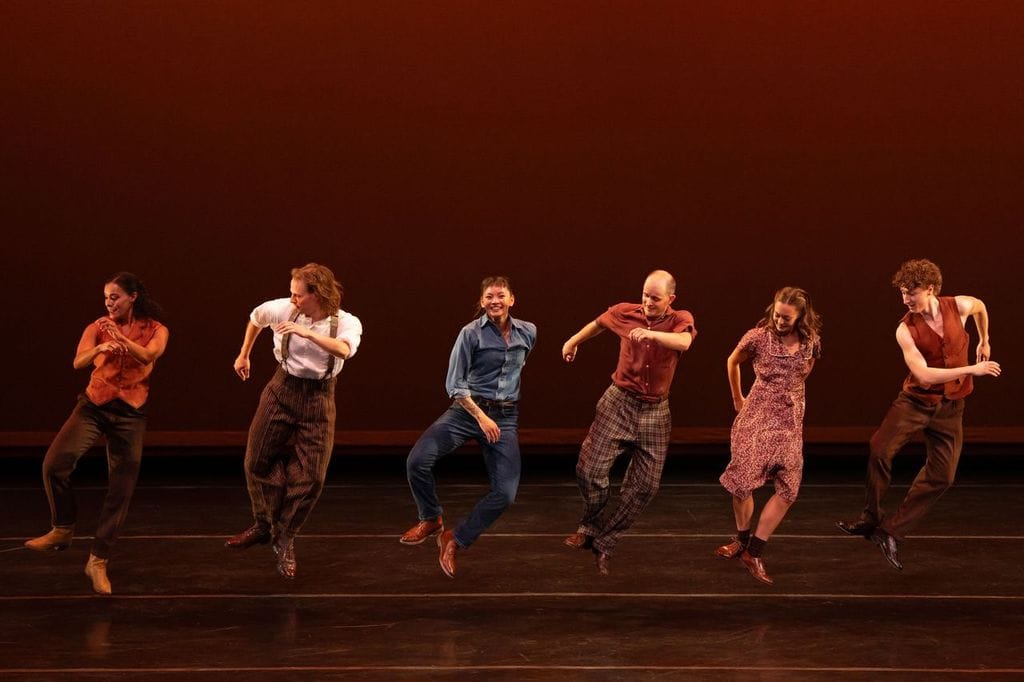
The first half of Program B had two longer works, “Deck of Cards” (1983) and “Songs that Tell a Story” (1982) which were performed in between three excerpts from “Home” (1993), a bouncy collection of folksy clogging dances that served as an introduction and entr’acte. The brief “Home (Excerpt 1)” opened with six dancers silhouetted against a golden background; they moved forward with a casual air, as if welcoming the audience, and started dancing, looking at each other as if tossing ideas around, a friendly group improvising and having fun.
“Deck of Cards” which has not been performed since 2000, was a more complex work, combining surreal comedy with pathos and hope. It had three parts, each illustrating a different country and western song. The first, “Gear Jammer”, may be the only solo performed by a toy truck, as the little mechanical contraption chugged across the stage, headlights beaming in the dark, pausing and turning as if reacting to the twang of Jimmy Logsdon singing about a faithless blonde; it was oddly fascinating, the ultimate in postmodernism—a dance with no dancers.
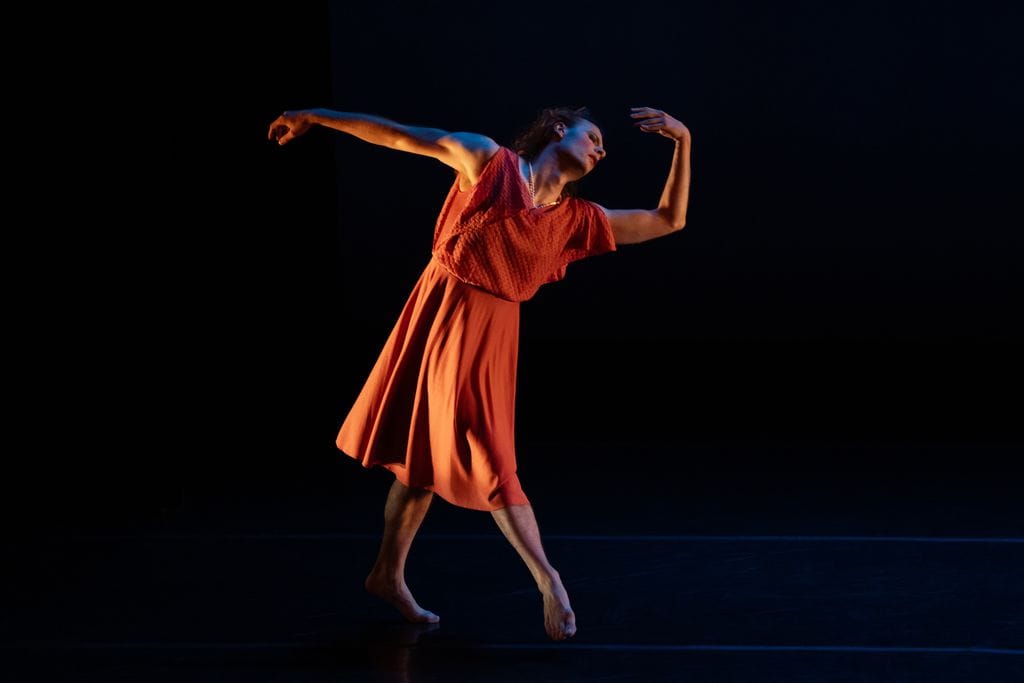
The rest of the work had real dancers, and Billy Smith performed the second song, “Say it’s Not You”, a solo previously performed only by Morris himself. It too was oddly fascinating, though certainly not comic, as Smith, in a blousy pink dress, danced the woman the singer (George Jones) realized was “spreading her love around”. Smith’s girl, with his/her slightly awkward flowing restlessness, had a pathos and a desperation with occasional glimpses of anger (trapped in an unhappy marriage, perhaps) that echoed the man’s pain. It was a wrenching duet for a dancer and a voice.
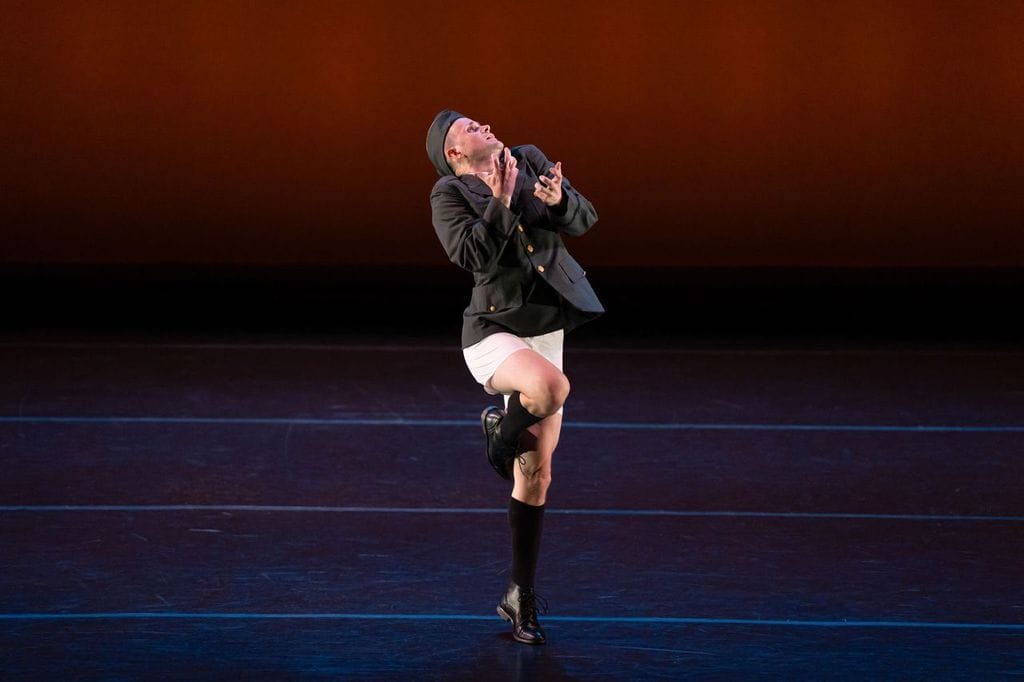
“Deck of Cards”, the 1948 song by T. Texas Tyler, is essentially a poem accompanied by music about a soldier caught playing cards in church, who explains the cards’ religious significance to a court martial. (The invaluable Wikipedia says that a similar story first appeared in the mid 1700’s.) Dallas McMurray, wearing a uniform coat with boxer shorts, danced the soldier, miming his explanation to match the song. Though there were some uneasy laughs from the audience, Morris, it seems, sympathized with the soldier, whose boxer shorts gave him a kind of ridiculous venerability. The song says the soldier was at Bizerte, a town in North Africa which in 1948 would have still been recognized as a horrific battleground, and the idea of a soldier finding comfort in a deck of cards, while sentimental tosh to modern audiences, would have been inspirational to its original listeners, and Morris much of the soldier’s innocence.
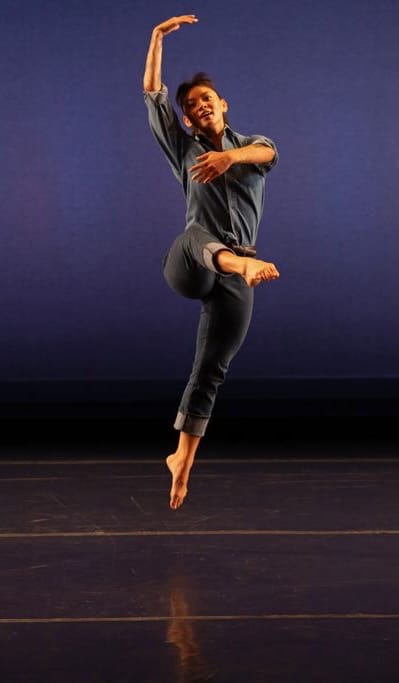
“Songs that Tell a Story”, set to country gospel songs by the Louvin Brothers, also takes the lyrics not exactly seriously, but certainly not ironically or sentimentally. Three barefoot dancers in faded denim (Brandon Randolph, Christina Sahaida, and Joslin Vezeau) bounded enthusiastically through the rhythms, occasionally suggesting the lyrics with prayerful motions, uplifted arms, or more specific gestures, such as writing a letter, without mimicking the words. The songs had their share of tragedy—a mother getting an official letter about her son’s death—and death hovered over them all, especially in final song, “The Great Atomic Power”, written in 1956 in the middle of Cold War fever. But the songs, as well as Morris’s choreography, had an underlying cheerfulness, the songs in a fervent belief in ultimate salvation as the best insurance policy, and the choreography in Morris’s vibrant community.
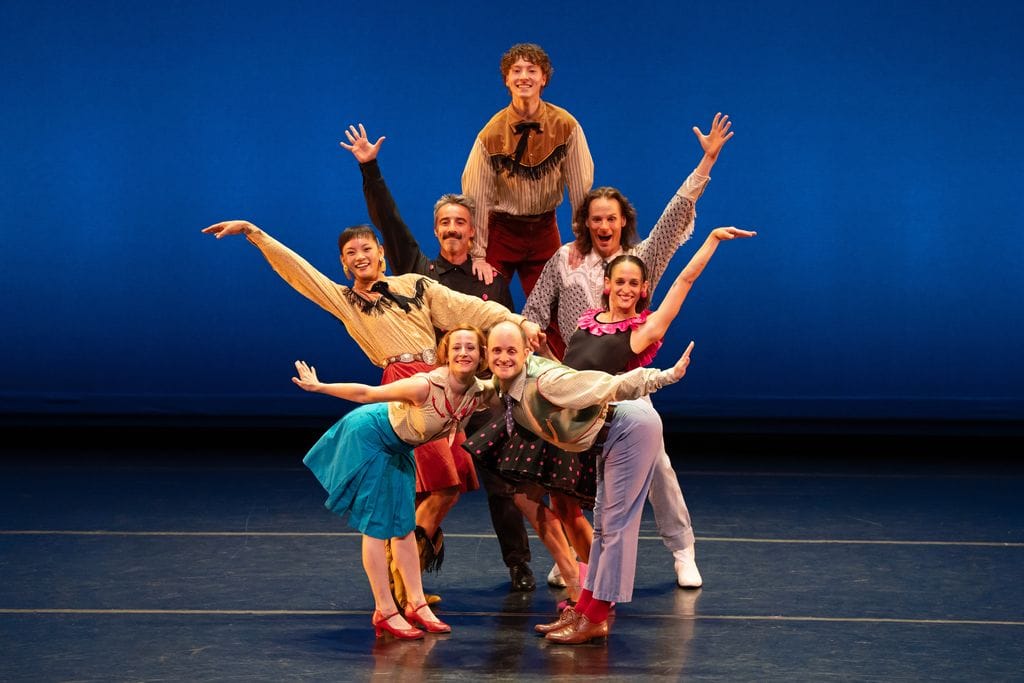
Community was at the heart of “Going Away Party” (1990), set to songs by Bob Wills and his Texas Playboys. The seven dancers, in their cowboy togs, entered waving at the audience and posing with slightly fixed, shallow smiles, as if they were entertainers who had done a few too many shows but were determined to give the audience their best. The three couples formed an asymmetrical square dance, bounding through the rhythms with occasionally raunchy moves (the women were sometimes carried head high with their legs spread wide) performed with an enthusiastic innocence.
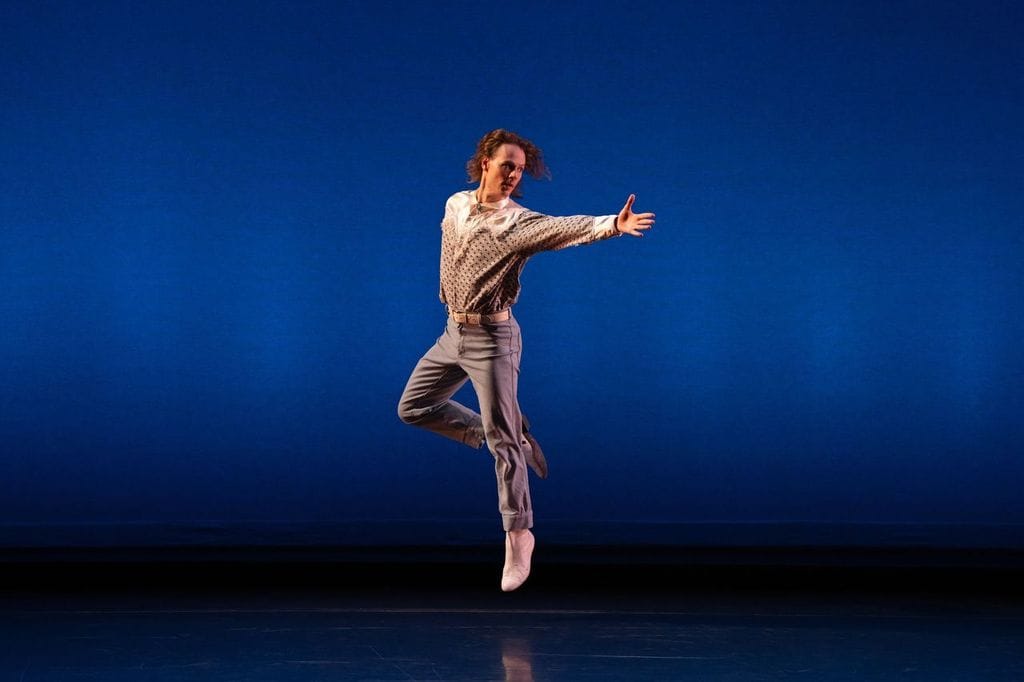
Billy Smith, in silvery white, was the occasional odd man out and danced to the lonesome twang of “When You Leave Amarillo, Turn Out the Lights”; as Noel Coward would say “Extraordinary how potent cheap music is”.
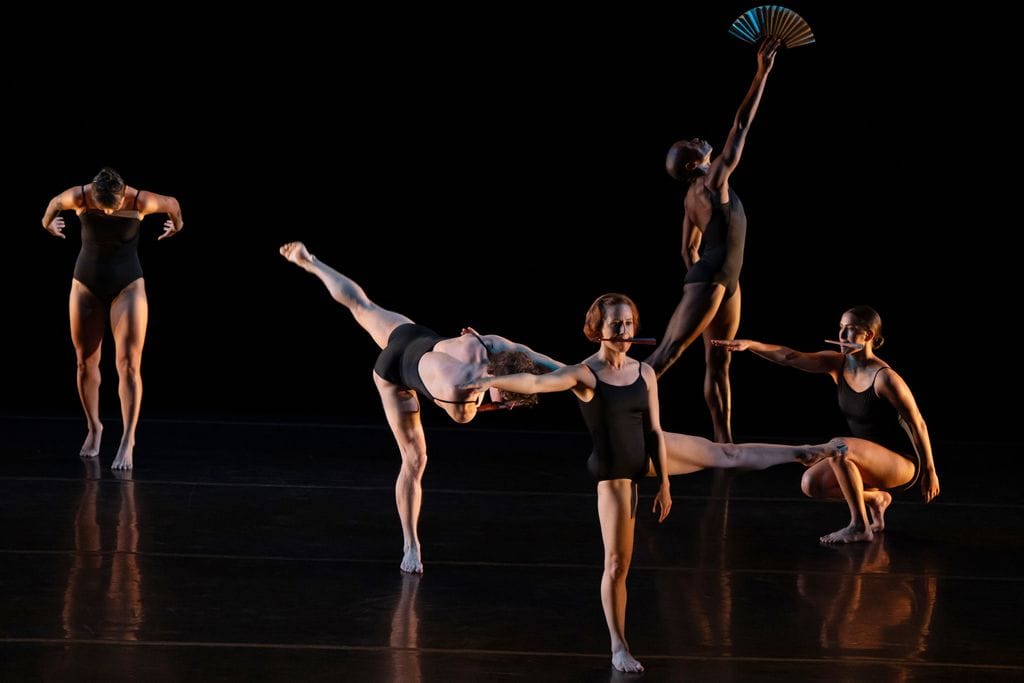
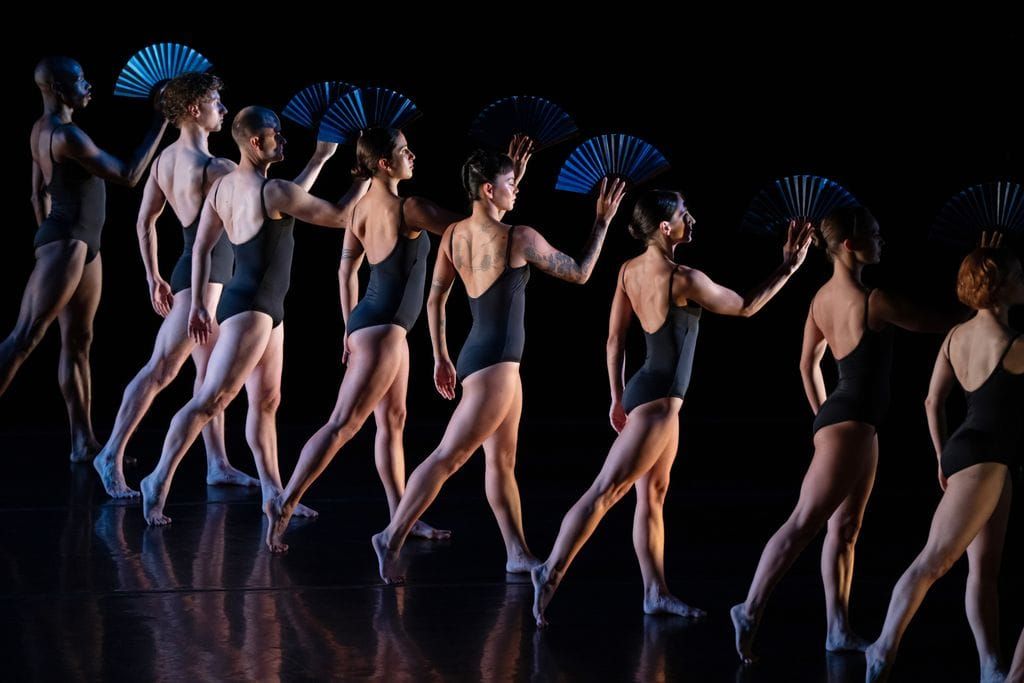
There was no cheap music in Program C, with its live music and works by Henry Cowell and Lou Harrison; the works had mood and atmosphere without narrative, and a more rarified and abstract atmosphere than the juicy honky-tonk of Program B; the dancers seemed to melt into the music. It opened with the obliquely titled “Prelude and Prelude”, 1984, set to Henry Cowell’s “Set of Two for Violin and Harpsichord,”, with Abi Fayette, violin and Colin Fowler, piano. The simple black background highlighted the slight diagonal line of the nine dancers, men and women wearing the same swimming suit style leotards, and holding silvery fans that caught the light. Robert Rubama emerged and danced a twisty, athletic, stylized solo full of lunges and nonchalant balances, holding the fan in his mouth. The other dancers played with their fans, catching the light which seemed to echo the music, and eventually moving through different and complex shapes, full of muscular arabesques and 90° développés to the side. It was hauntingly beautiful.
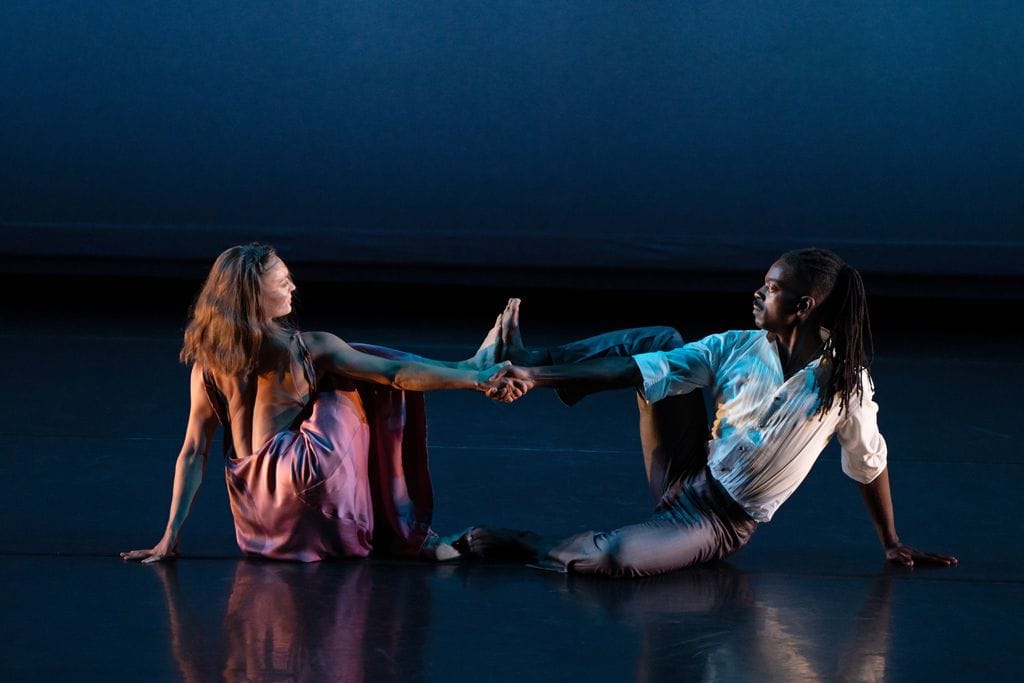
There was little beauty but much power in “Jenn and Spencer” (2013), set to Cowell’s “Suite for Violin and Piano”, played again by Fayette and Fowler. The pas de deux was named after its original dancers, Spencer Ramie and Jenn Welded, strongly danced here by Karlie Budge and Brandon Randolph, and shows a fraught, sometimes violent relationship, which matches the strident, dissonant music. The two dancers circled each other with eyes locked, each appearing to need each other, yet pushing away. They did have their moments of happiness, as Randolph seemed to show off, and Budge had a brief bouncy dance, but at the end, she gave up, hit out, and both ran off in different directions.
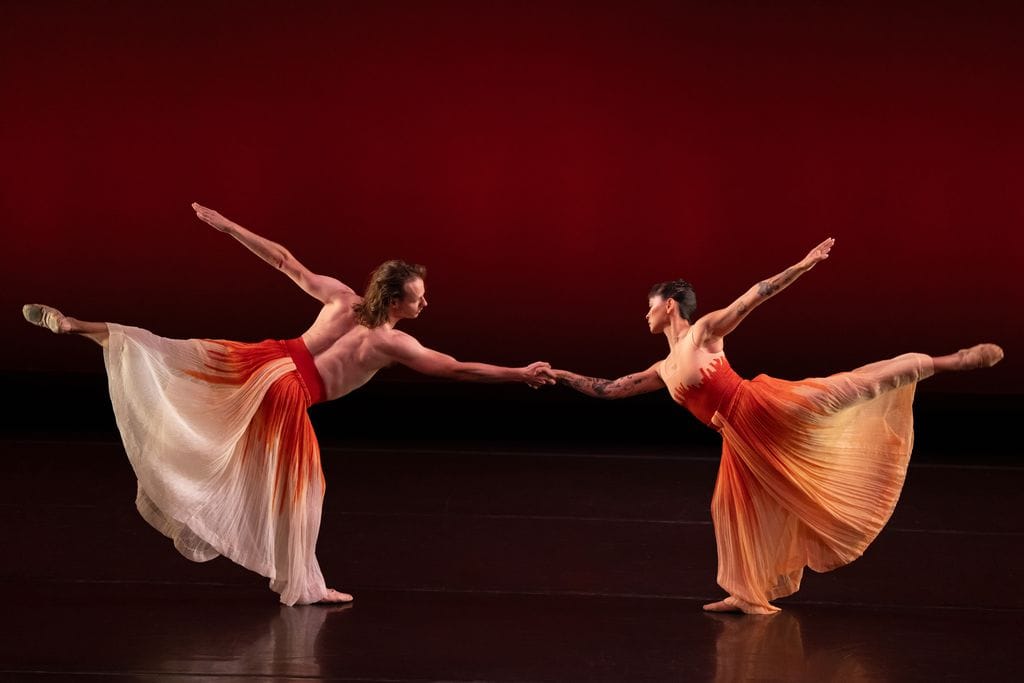
“Pacific” (1995) was, well, more pacific; Morris originally choreographed it for the San Francisco Ballet but reworked it in 2015 for his own company, removing the point work. It is set to the third and fourth movements of Mr. Harrison’s Trio for Violin, Cello, and Piano (with Fayette, Fowler, and Andrew Janss on the cello). The nine dancers wear gorgeous long full pleated skirts (the women’s with tops) designed by Martin Pakledinaz, which shimmer and swirl gloriously in the light, and give the work the air of a magical Pacific Island, reinforced by the ritualistic low squat jumps and stylized outstretched arms. There are balletic echoes the many jumps and in the languid formality of the pas de deux danced with lyric intensity by Billy Smith and Joslin Vezeau, but the grounded power of the Morris dancers is unique.
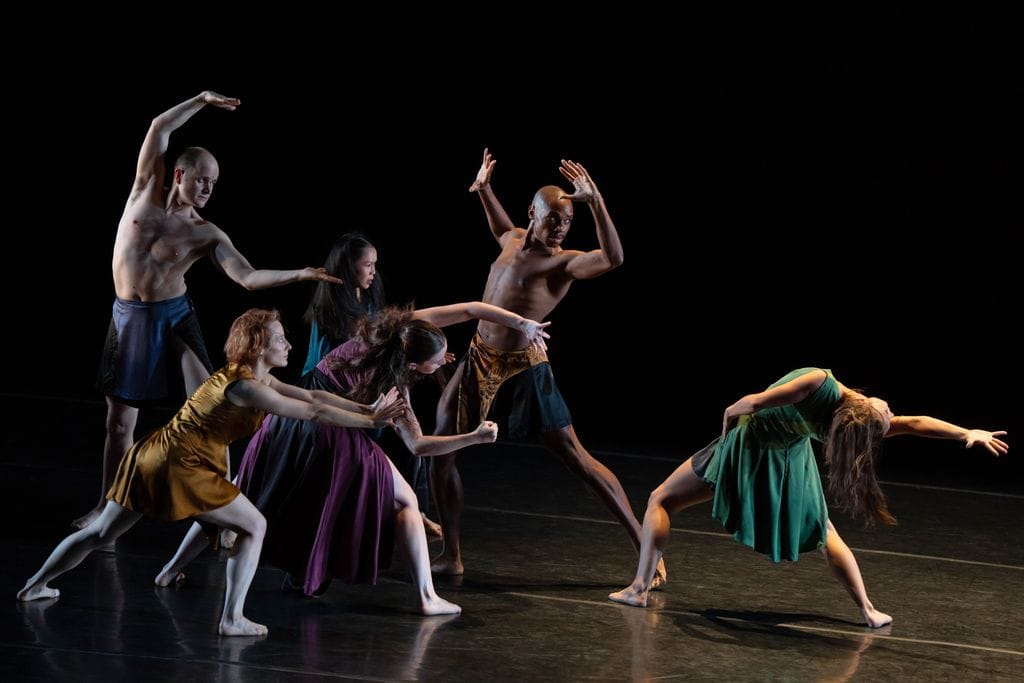
“Grand Duo” (1992), also to music by Lou Harrison (his “Grand Duo for Violin and Piano”, again with Fayette and Fowler), is one of Morris’s most popular works. Its four movements, ending with a rousing polka, give it a symphonic structure, and each movement has its own flavor. Like “Pacific”, the costumes have an Eastern tinge, though without their luminous luxury; the tunics and sarongs seem like work clothes which glowed in the light. And those dancers do work. It opens in the dark, with a group women pointing, arms held high; the lighting made it seem as if they were holding torches for some secret, fierce ritual.
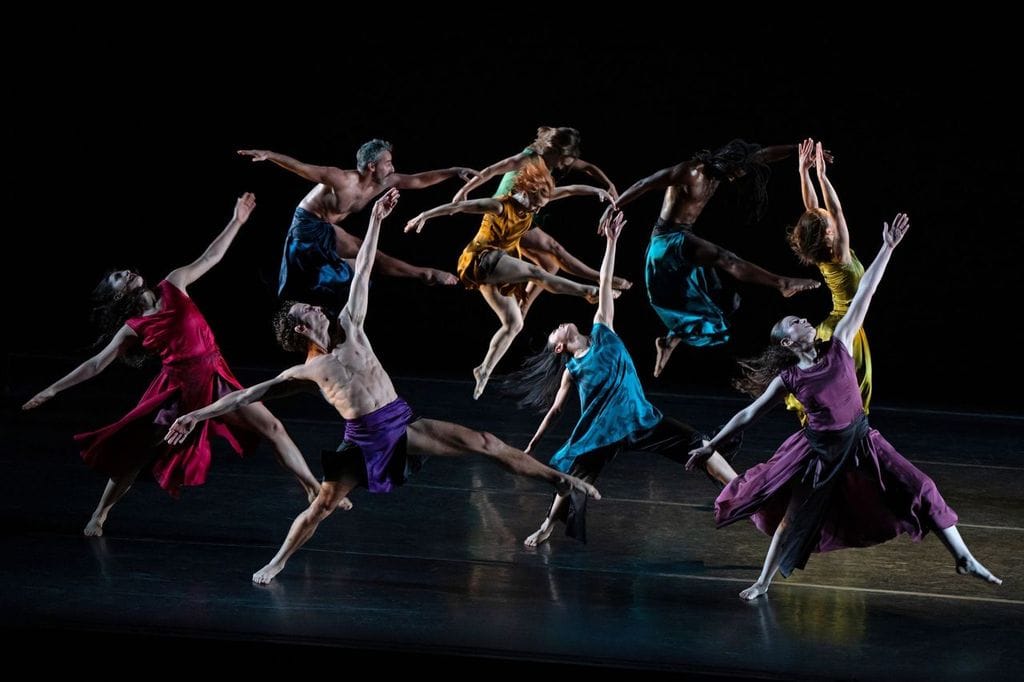
The fierceness continued through the second movement as the dancers broke into two groups and seemed to hurl curses as one another through the pulsing rhythmic music, until a calmer couple soothes them. There was more ominous pointing in the third section, with dangerous balances and intriguing shapes. The raucous polka began in a circle, and ended with the cast almost submerged in the bouncy, infections rhythms, slapping their thighs and calves and stomping their fee in a complex pattern with such energy and power that it was almost impossible to stand still. The dancers, it seemed, were sweeping the audience into its own exalted orbit with a generosity that was beyond words.
© 2026 Mary Cargill