Strauss's Forgotten Treasure
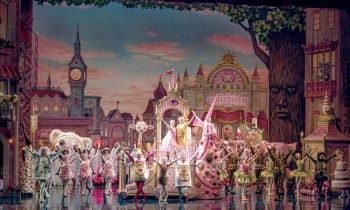
“Whipped Cream”
American Ballet Theatre
Opera House
The John F. Kennedy Center for the Performing Arts
Washington, D.C.
February 1, 2018
Alexei Ratmansky's “Whipped Cream” stirred up a concoction of whimsy and merriment that lifted the mood and lightened the spirit of balletgoers on Thursday. The production’s fast-paced frenzy of activity was both delightful and dizzying. Danced assuredly by a stellar cast, this ballet is less a showcase for the dancers than a platform for Mark Ryden’s fetching costumes and visual designs. The audience’s warm reaction made it hard to believe that the ballet upon which “Whipped Cream” is based — "Schlagobers,” that premiered in May of 1924 at the Vienna State Opera with music by Richard Strauss and choreography by Heinrich Kröller — was a total failure. Ratmansky is no stranger to resurrecting old works. His “Whipped Cream” underscores the value in doing so, including the re-discovery of Strauss’s largely forgotten musical score played with care by the Kennedy Center Opera House Orchestra. If not a masterpiece, the music is lighthearted and melodic, layered and complex. Ratmansky’s imaginative, musical choreography revealed the score’s danceability, bringing to fruition Strauss’s hope for “Schlagobers”: to create joy at a time when joy is needed.
Pop surrealist painter Ryden designed visually stunning sets and costumes that framed the ballet's simple story with fantastical imagery. Act I opened with a flock of children (convincingly danced by company members) gleefully hopping down the front steps of a gold-adorned, white church after their first communion, soon to be whisked away in a life-size, ornately decorated horse-drawn carriage to a pastry shop where a delicious celebration awaited. Once arrived, they romped and frolicked, hoping to taste the decadent treats being whipped up by a jovial bakery Chef (Alexei Agoudine), one of several adult characters portrayed by dancers wearing Ryden’s enormous, caricaturesque heads with uncannily human-like expressions. A Boy (Daniil Simkin), overcome with desire, scampered away to devour whipped cream from a large mixing bowl. He quickly fell ill and was swept off on a stretcher, while brightly dressed brigades of marzipan, sugarplums and gingerbread sprung to life, dancing with athletic aplomb.
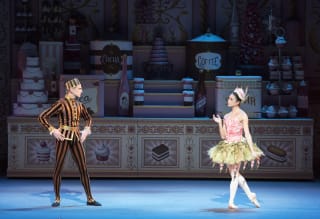
Some of the ballet’s most nuanced music and choreography followed in the second half of Act I, when Princess Teaflower (Stella Abrera) and Prince Coffee (David Hallberg) emerged from larger-than-life coffee and tea canisters to dance a pas de deux to Strauss’s haunting violin solo, sensitively conducted by ABT conductor Charles Barker. Before meeting Prince Coffee, Princess Teaflower introduced herself with a whimsical solo accompanied by the mysterious melodies of a flute. Abrera’s radiant dancing was fragrant with a hint of spice, illuminating the music with breadth and gesture. When the saucy, gallant Prince Coffee (Hallberg) appeared from his canister, the two danced a flirtatious and expansive pas de deux that had plenty of textured movement for both; this Prince certainly was not just a prop, and the two had a natural, reactive rapport. She finally succumbed to his charm despite the efforts of the buoyant Prince Cocoa (Joseph Gorak) and the cunning Don Zuccaro (Blaine Hoven) to distract her. Act I concluded with the entry of a corps de whipped cream: sixteen white-clad dancers whooshed one-by-one down a giant slide onto the stage and into a swirling waltz (could this be “The Nutcracker’s” Waltz of the Snowflakes gone awry?), finishing Act I as dreamily as it began.
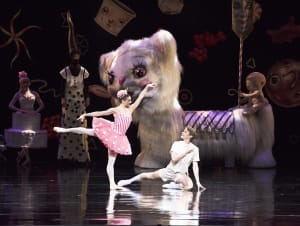
Act I’s levity was contrasted by Act II’s descent into the depths of the Boy’s hallucinations as he awoke alone in a hospital bed under the care of a menacing Doctor (a reincarnated Alexei Agoudine, previously the Chef) wearing one of Ryden’s gigantic heads. An army of nurses with enormous syringes hovered over him; above him the atmosphere was pitch black with a weird, brooding eyeball looking on. To his great relief, a dainty and elegant Princess Praline (Sarah Lane) arrived out of nowhere with a procession of wonderous companions: large furry creatures with strangely discerning eyes, frolicking cupcake children, and even a red and white slivering snake-person on wheels. Princess Praline invited the awestruck Boy to join her for an innocent, spontaneous pas de deux that showed off Lane’s pristine footwork and Simkin’s easy jumps. Soon thereafter, the Doctor returned, but this time he was more concerned with the bottle than the Boy. Three liquor bottles: chartreuse (Catherine Hurlin), brandy (Duncan Lyle) and vodka (Roman Zhurbin) distracted and seduced him, dancing a pas de trois full of slapstick without being too silly. Their technically spot on and surprisingly melodic dancing drew the audience in. Hurlin was a particularly quirky and convincing bottle with sharp bourrees, crisp attack and a natural sense of comedy.
The ballet ended happily ever after with a raucous celebration that grew larger in scope and intensity until golden confetti burst from the heavens, showering all creatures large and small. The crowd-pleasing send-off, albeit thrilling, left me wondering if Ratmansky’s earth-bound choreography and Srauss’s sensitive musical score could be better served by a smaller scale setting all around. Classically based but laced with human-like gestures and pleasing spontaneity, the choreography and music don't possess the grandeur of Petipa or Tchaikovsky and at times seemed understated. Their expressive impact might flourish with less fanfare.
copyright © by Ashley McKean



