Love Stories
"Trois Élegiaque", "Flight", "The Dream"
American Ballet Theatre
David H. Koch Theater
New York, NY
October 28th and 30th, 2026
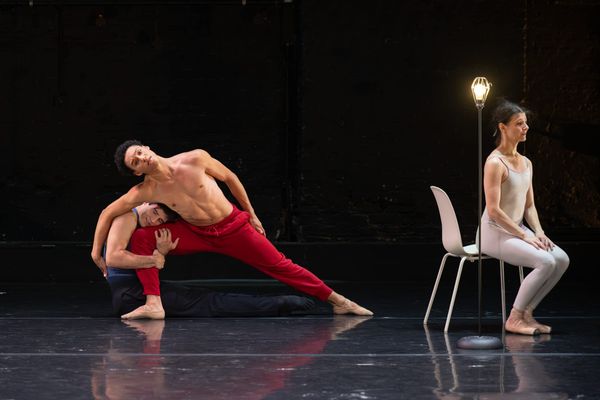
ABT’s program celebrated three different types of love stories, beginning with the premiere of the young corps dancer Brady Farrar’s “Trio Élégiaque”, with three couples weaving through Rachmaninoff’s music. “Flight”, choreographed in 2012 by the South Korean choreographer Jae Man Joo, honored the love the audience had for Herman Cornejo, via Bach cello music, and “The Dream” is Sir Frederick Ashton’s brilliant translation of “A Midsummer Night’s Dream”, with all its complicated love stories illuminated by Ashton’s love for his characters, for his dancers, and for his art.
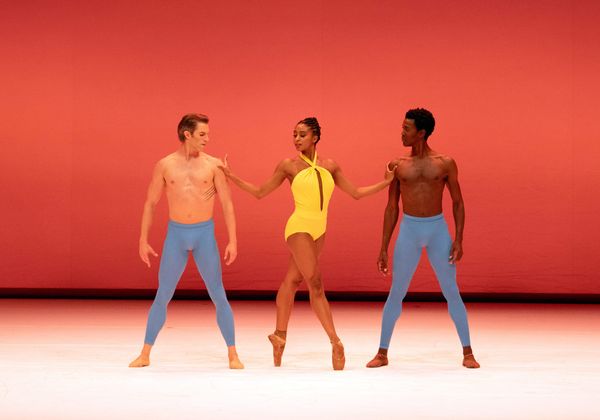
Farrar’s “Trio Élégiaque”, named after its Rachmaninoff music, a trio for piano, violin, and cello, had fine casts (Devon Teuscher with Aran Bell, Léa Fleytoux with Carlos Gonzalez, and Sunmi Park with Thomas Forster in the first performance and Chloe Misseldine with Jarod Curley, Catherine Hurlin with Michael de la Nuez, and Sierra Armstrong with Calvin Royal III on October 30). The staging was simple, a large swag at the rear of the dark stage opened to the light. The costumes, by Marc Eric, a young designer who has worked with many ballet companies, were in lovely autumnal shades and the women’s soft mid-thigh dresses wee beautifully cut and very flattering while the men looked distinguished in dark tights and loose shirts.
Susan Jaffe’s introductory remarks explained that the work was about different kinds of love felt by the three couples—a story that has certainly been used before; the sequential pas de deux, the romantic lighting and the sophisticated outfits resembled Robbins’ “In the Night”. Robbins’ couples, though, were more clearly delineated; Farrar’s tended to go through apparently similar on-again-off-again relationships. There was a great deal of rapturous head-flung back partnering involved, and many smoothly danced complicated lifts; the women, with some exceptions, were handled like either rare china or laundry to be spun dry, rarely getting a chance to stand on their own.
Though somewhat diffuse, the work flattered the dancers; I especially liked the way Farrar created an uninterrupted flow by having one or two dancers enter as the previous couple were still dancing, which meant applause didn’t interrupt the music or the mood. The dancers in the opening pas de deux (Teuscher and Bell on October 28th and Misseldine and Curley on October 30th) had a quiet air of longing. Misseldine, with her rich backbends was especially eloquent, and both Bell and Curley gave a lyrical poignancy to the moment they stood quietly, their backs to their partners. Fleytoux bourréed with exquisite delicacy through her brief moments alone and Hurlin and de la Nuez sparkled as the more vigorous couple in red. Farrar clearly can use dancers well, and isn’t afraid to explore emotions—no sullen blank faces to be seen.
“Flight” had no sullen faces either, but it has little interesting choreography either. It was originally created in 2012 f by Jae Man Joo, the Complexions Contemporary Balletresident choreographer. It was a rather simple minded solo for a man with no shirt who in the opening section struggled on a black stage with a narrow vertical strip of light forming a box on the stage, until the strip closed up, and he got the whole stage to run in. Cornejo made the most of the repetitive moves, looking at his hand, feeling his arm, struggling with gravity as he held a deep arabesque, and rushing from side to side, until he ran off with his arms outstretched with a “why me?” gesture.
Cornejo, with his commitment and his charisma, is always fascinating to watch, and his powerful gestures and obvious sincerity elevated the work. The audience, grateful for this opportunity to thank him for so many wonderful performances, cheered loudly.
One of those wonderful performances was his Puck in Ashton’s “The Dream”, which he first danced in 2002 and last performed 20 years later. Fortunately for ABT, and its audiences, there are fine Pucks currently performing in that most perfect of ballets, and this season’s performances, though there were some issues, were another opportunity to marvel at Ashton’s skill at compacting Shakespeare’s play into an hour long balletic poem..
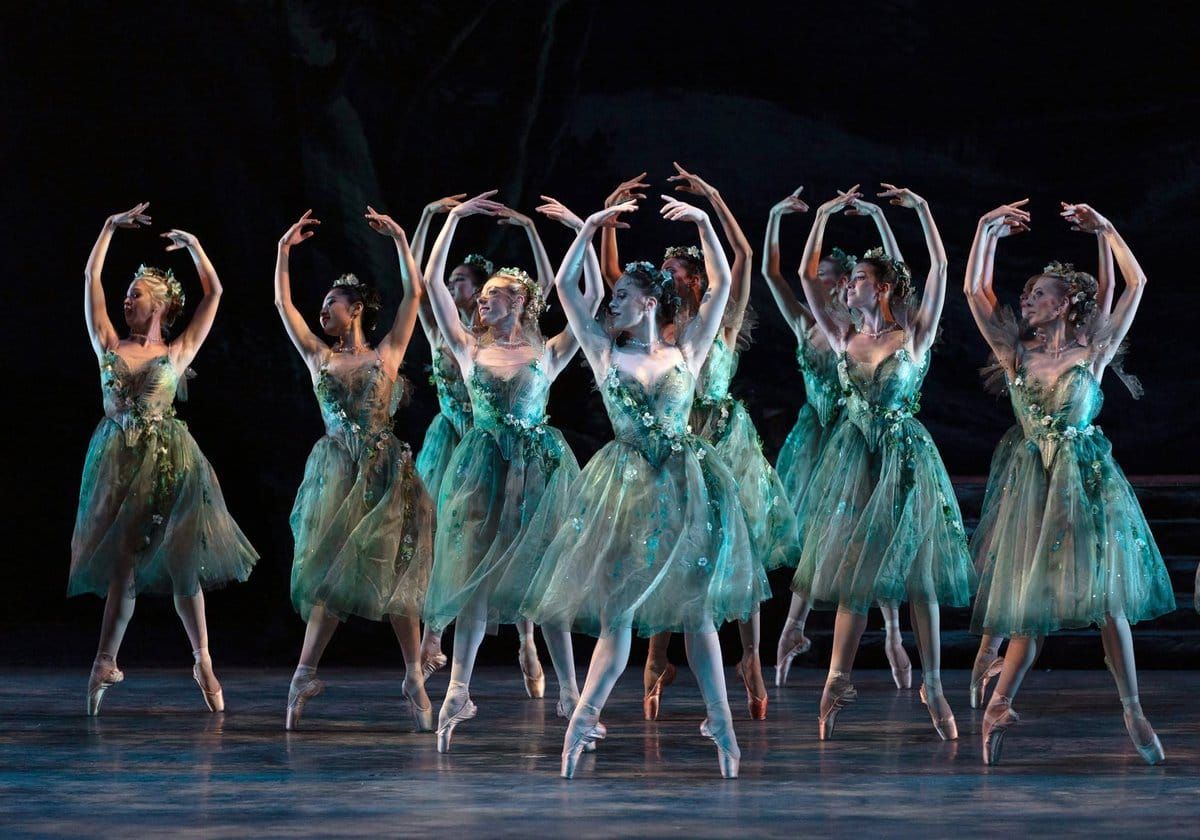
The skittering corps of fairies opened the work; though the wonderful geometry of the choreography was clear, they did seem to be dancing on cobblestones rather than moss, and their torsos were a bit stiff—the soft, pliant bends with the music appearing to move through their bodies, so noticeable in earlier years, seems to have been smoothed out and I missed the delicate romantic flavor the choreography can have.
There were two new Titanias and one new Oberon, Catherine Hurlin with Daniel Camargo (October 28) and Hee Seo and with Isaac Hernandez, his debut, (October 29). Titania, even with her frilly costume and luxuriously long hair, is not a Disney princess; she has her share of tinsel, but it is wrapped around barbed wire. Hurlin had plenty of tinsel; she looked gorgeous in that costume, but she also had a fine proud, willful air, defying Oberon’s attempt to capture the little Changeling with her eyes glittering and her nose confidently in the air. Seo was a softer, more lyrical Titania, pretty but a bit too passive, though she gave the tug of war with Oberon over the Changeling a fierce determination.
Seo also difficulties with her lullaby solo with its crisp, sharp footwork—it was made for Antoinette Sibley who danced like she could cut diamonds with her points. Seo had an unusual bashful luminosity in her dance with Bottom and she seemed hesitant in her footsie game with the poor ass. Hurlin, though rapturously smitten, made sure that she was in charge pointing her foot in front of his with a “she who must be obeyed” determination. This pas de deux, for all its ridiculous aspects, is one of Ashton’s most subtle as he lets the audience see Bottom from Titania’s eyes, using Mendelssohn’s piercingly sweet music straight, as it were, and its humor is more wry than broad—Titania isn’t the only person who has looked at an ass and seen a knight. And poor Bottom isn’t the only ass who has dreamt of a princess.
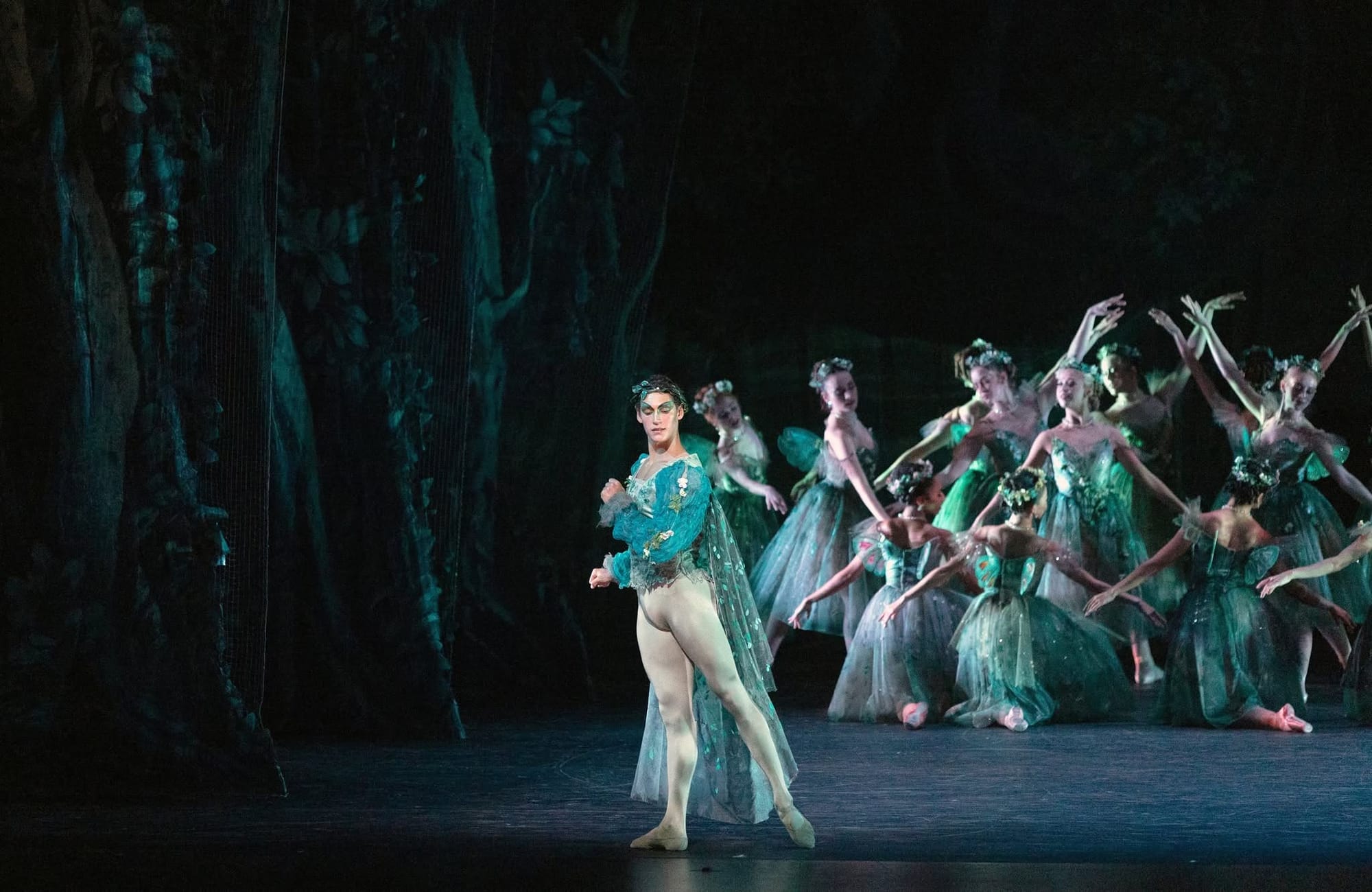
Camargo was a bit shaky at the beginning, with some issues holding his poses, but he gave a detailed and vivid performance, making all of Oberon’s thoughts clear—I loved his smoldering anger during the opening quarrel and his ironic little smile when thinking about Bottom. His Oberon had a feeling of mystery and a quality of command that did make it seem as if he were living in a different world. Hernandez was more of a swashbuckling matinee idol with a slight air of contempt for those silly mortals. Both were fine partners in the pas de deux, and the difficult inside out turns and the lovely moment when Titania and Oberon balance on one leg with their arms forming an extended diamond went smoothly. Hurlin’s melting arms were especially eloquent, a poetic metaphor for her surrender, though Ashton gave her plenty of air time to show that she still had a mind of her own.
The lovers thought they had minds of their own, though love’s power did mess them up a bit. Claire Davison (October 28) was very funny as the prissy, proper Hermia, forcing the obedient but disappointed Lysander (Roman Zhurbin) to behave like a gentleman. It was a very funny scene, tied so perfectly to the music it seemed that Ashton and Mendelssohn had developed it together, but it also explained why Puck found them sleeping separately which started the mixup; a fine example of Ashton’s storytelling genius.
Poor Bottom had no mind of his own, but he did have feelings, and Ashton made him much more than a comic stooge, funny though his prancing on point is. The mime scene, when he was alone in the forest with his memories is very funny, of course, as his eyes gleam at the memory of Titania, but there is a wistful air, too. The frightened awe in the final glance round the forest as he senses the power of unseen forces to mock him can be intensely moving. Both Tyler Maloney (October 28) an Melvin Lawovi (October 30) had some very impressive point work, though Lawovi did seem at times to be dancing to his own rhythms rather than Mendelssohn’s. Lawovi’s final glance round was especially poignant as he seemed to freeze in fear before running off.
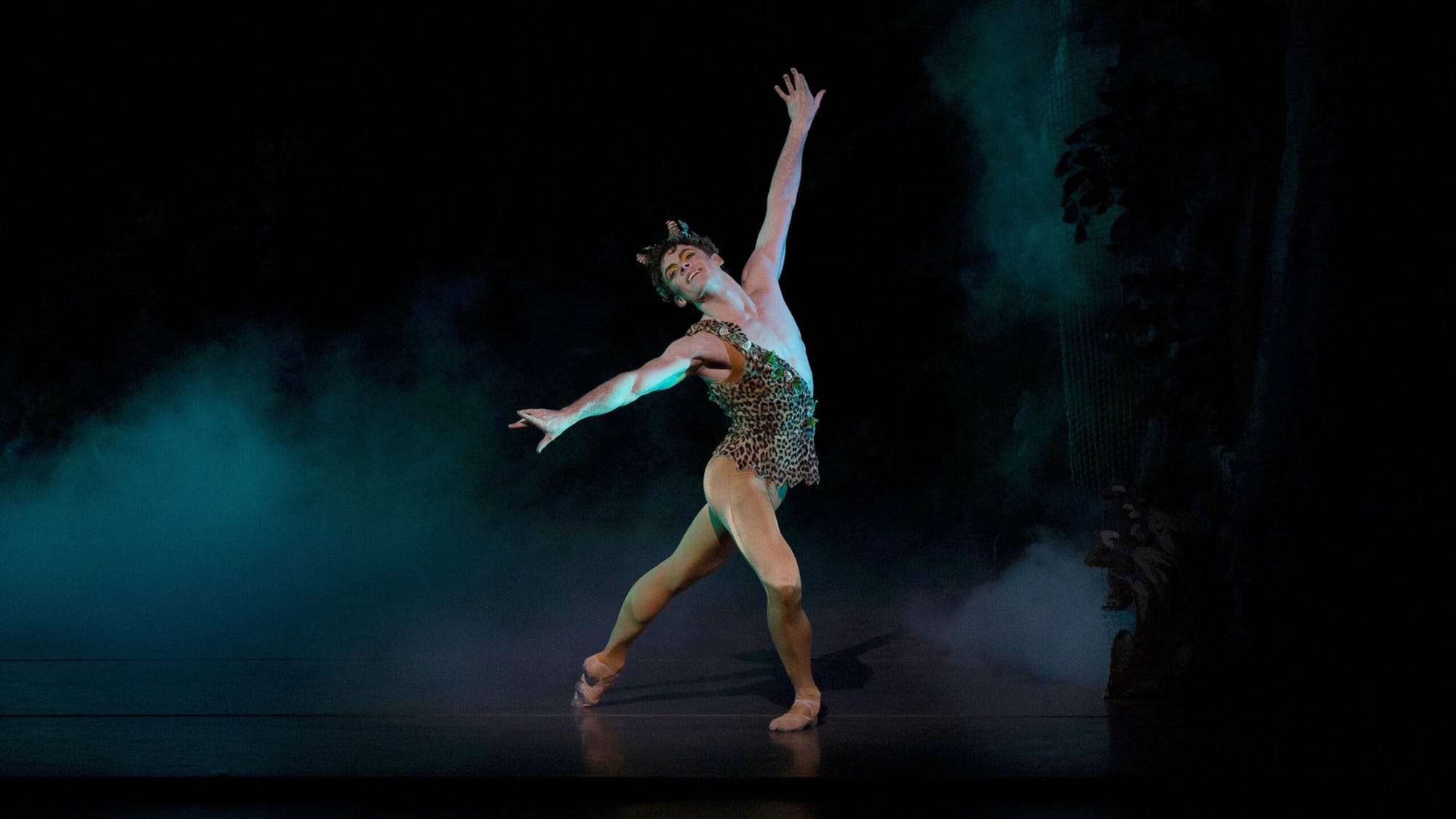
The Pucks they were running from (Jake Roxander on October 28 and Takumi Miyake, his debut, on October 30), had crystal clear mime and their powerful jumps, made the stage look like a trampoline. Roxander’s shapes were a bit sharper and his Puck was a little more cunning—his satisfied little smile and shrug in the ballet’s closing scene really did seem to say “Lord, what fools these mortals be!”. Miyake’s spins and jumps were more flamboyant, and his hang time defied gravity. It did seem, though, that at times he was having a dance off with Oberon, competing with him rather than working as his servant to control the magical fog. But Ashton, I expect, would have loved both performances as much as the audience did.
© 2026 Mary Cargill