Kings Behaving Badly
"The Winter's Tale"
American Ballet Theatre
Metropolitan Opera House
New York, NY
July 1, 2025
ABT has added Christopher Wheeldon's “The Winter’s Tale”, based on the Shakespeare play, to its repertoire. Wheeldon is quoted in the program as saying that he got the idea to choreograph the work, often categorized as a “problem play”, from the theatrical director Nicholas Hytner, who said it might work better “if there’s no one actually talking” which is rather like saying “The Marriage of Figaro” might be more understandable without all those notes. There is actually some talking in the Wheeldon version, as the corps occasionally shouts “hurrah”, as well as a number of scene changes, and a complicated story, which Wheeldon, as in his “Like Water for Chocolate”, explicates with admirable clarity.
It is a story of friendship, jealousy, anger, madness, regret, forgiveness, and redemption. Two kings, Leontes of Sicilia (Aran Bell) and Polixenes of Bohemia (Cory Stearns), grow up together as children, becoming close friends. Leontes marries Hermione (Devon Teuscher), they have a son, Polixenes visits them, and before he leaves, Hermione is going to have another child—this is all illustrated in a brief prologue. In Act I Leontes become insanely jealous of Hermione, thinking that the child is Polixenes’, arrests her, orders her baby Perdita (who grows up to be Catherine Hurlin) killed, and Hermione apparently dies. Perdita is saved and grows up as a shepherdess in Bohemia, and falls in love with Florizel (Carlos Gonzalez), the disguised son of Polixenes, who disapproves violently, so they run off to Sicilia, where Perdita’s heritage is discovered. Leontes recognizes her, and Polixenes, who has followed them, is now satisfied and the couple marries. In addition, it turns out that Paulina (Christine Shevchenko), the moral center of the story, has been keeping Hermione alive, and she emerges from her statue, forgives Leontes, and all is well.
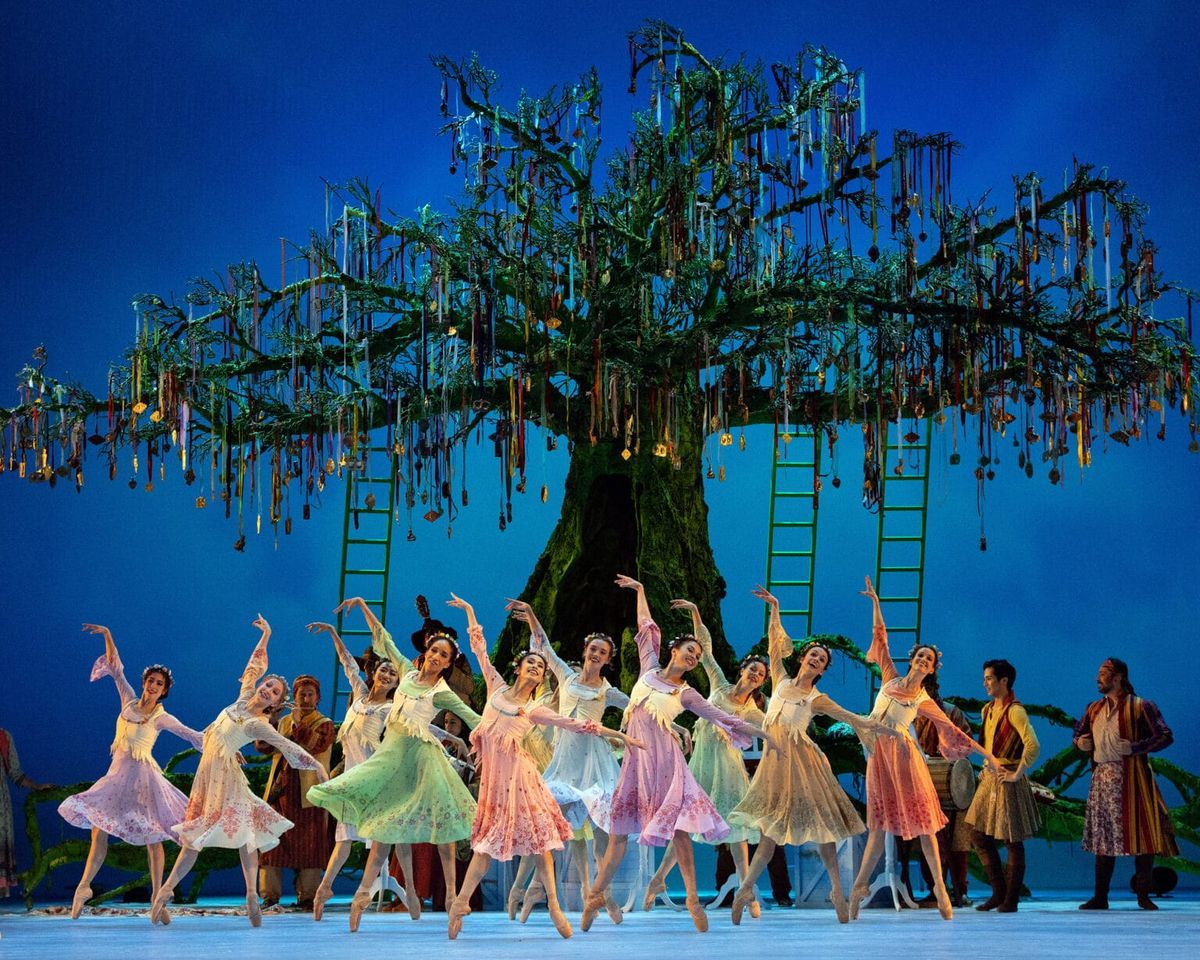
The modular sets, by Wheeldon’s frequent collaborator Bob Crowley, which include a monumental magical tree in the imaginary bucolic paradise of Shakespeare’s Bohemia, make the frequent scene changes seamless. The puppeteer Basil Twist devised some impressive video effects on flowing silk scrims, merging storms into sailing ships (there are several trips between Bohemia and Sicilia), and, most impressively, a giant bear emerging from the clouds to chase Antigonus, who was taking the baby Perdita to safety. This, accompanied by crashing chords, closed the first act. This minor character and Shakespeare’s stage direction (“exit, pursued by a bear”), though, had no emotional or dramatic importance, and many of the high tech visuals seemed to be effect without content. It has been said that opera audiences often leave humming the sets; Wheeldon’s audiences often leave humming the videos.
They certainly were not humming the music. Joby Talbot’s commissioned score is effectively cinematic, but has little variety other than loud or soft, and is short of rhythm and melody. Even the folk elements in the second, Bohemian act, stop and start, and the dancing cannot really connect to the score. Wheeldon’s choreography veers between realism and expressionistic gestures, sometimes with disconcerting effects; in Act I Hermione has a very visible baby bump, which makes her dancing seem awkward, especially when Leontes repeatedly throws her to the ground. The dancers semaphore a great deal, holding their arms like goal posts or at sharp angles, as if miming in a foreign language, a rather jerky language, as Wheeldon’s choreography, even for the fake-folk dancing of Act II, often comes in short repetitive bursts, with fussy arms and oddly flexed feet.
The ballet, though, does have a number of leading roles (three women and three men, as well as several soloists), and the dancers looked phenomenal. Bell, in his debut, gave a powerful performance; his innate likability and subtle acting gave some dimension to Leontes and kept him from just being a deluded bully. His descent into jealous madness started in his hands, which seemed to move on their own, as if he has lost control but was trying to stay sane. It was a losing battle, and he ended up attacking Polixenes with a quite realistic knife and tossing Hermione around with some dramatic lifts, before descending into a creepily vivid solo with frantic jumps and broken arabesques while, Lady MacBeth like, rubbing his hands. It was quite moving to see this tall, handsome, princely man brought so low, and he gave the final scene, when he begs Hermione’s forgiveness, a rich gentleness.
Teuscher was also making her debut as the put-upon Hermione. Despite the awkward baby bump, she had a calm nobility, and her pained, puzzled reaction to Leontes’ outbursts, signified by many backward bourrées, would have melted anyone but a madman. Stearns in his New York debut was a stalwart, loyal friend in Act I. In Act II, as the King of Bohemia, he turned into another bully, berating his son for cavorting with a shepherdess, and threatening to knife the shepherd who raised Perdita. Stearns’ cold hearted fury was economically underplayed (he is no scenery chewer) and thoroughly convincing, as was his gracious change of heart and joy at seeing his old friends together again in the final scene.
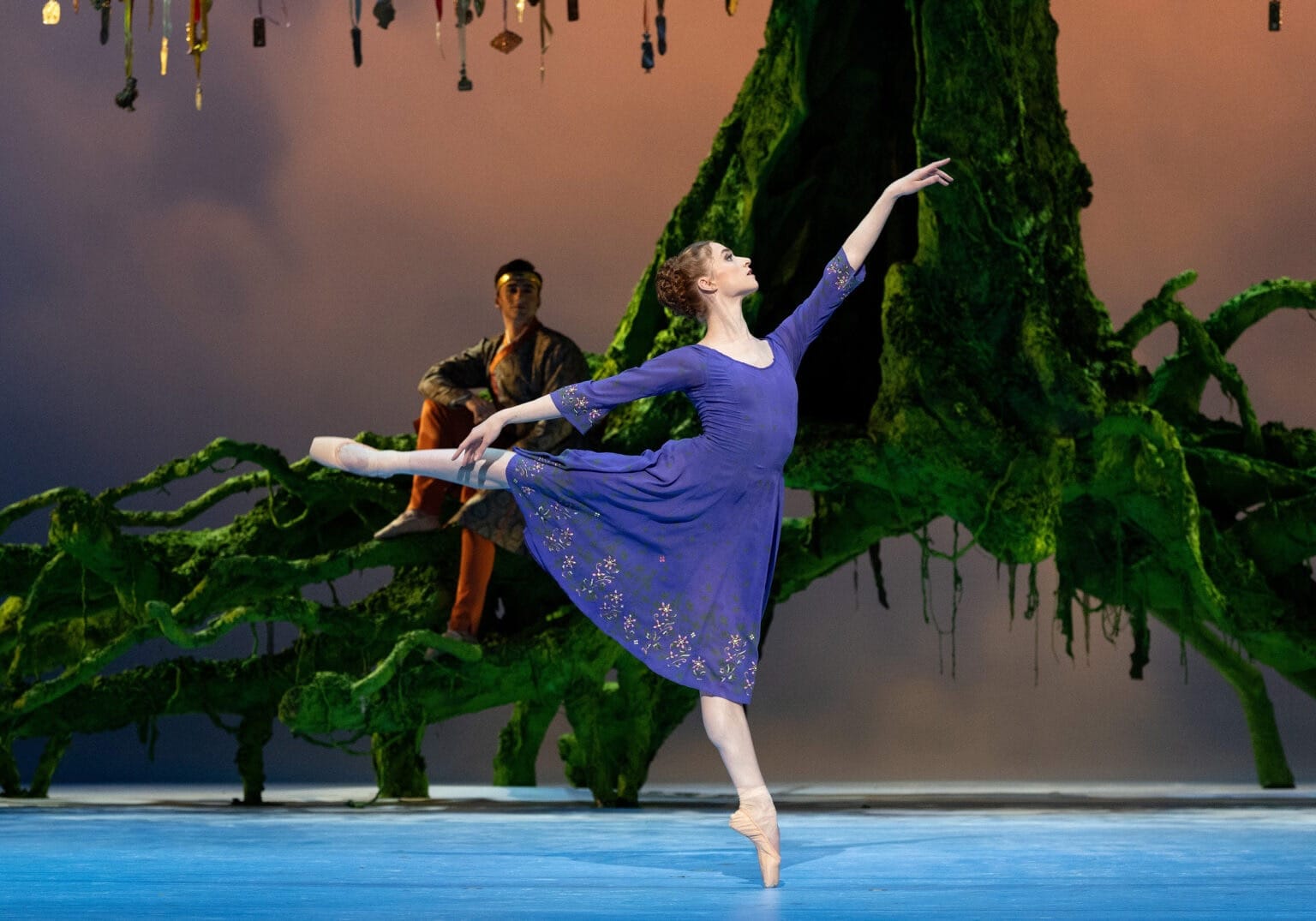
Act II belongs to Perdita and Florizel, as they danced energetically with the shepherds and shepherdesses. Hurlin and Gonzalez were both making their New York debuts; Wheeldon’s many ungainly lifts did trip them up a bit (at one time he had to hold her upside down with her head almost scraping the floor). Though Hurlin had a irresistible sweetness, it was hard to really develop any character as she threw herself at Florizel with many open legged poses from the first moment and there was no arc or development in their relationship. Gonzalez flew through his many jumps and gave the imitation folk moves as much flavor as possible. (The men wore short, full skirts which looked vaguely Greek, though the dancing had only hints of genuine folk dancing.)
The couple did get a rest when an unnamed duo, Breanne Granlund and Takumi Miyake, emerged from the crowd to astonish the audience with fast, elegant, and thrilling dancing. Miyake gave a lovely lilt to his jumps and his grand pas de chats seemed to hover in the air.
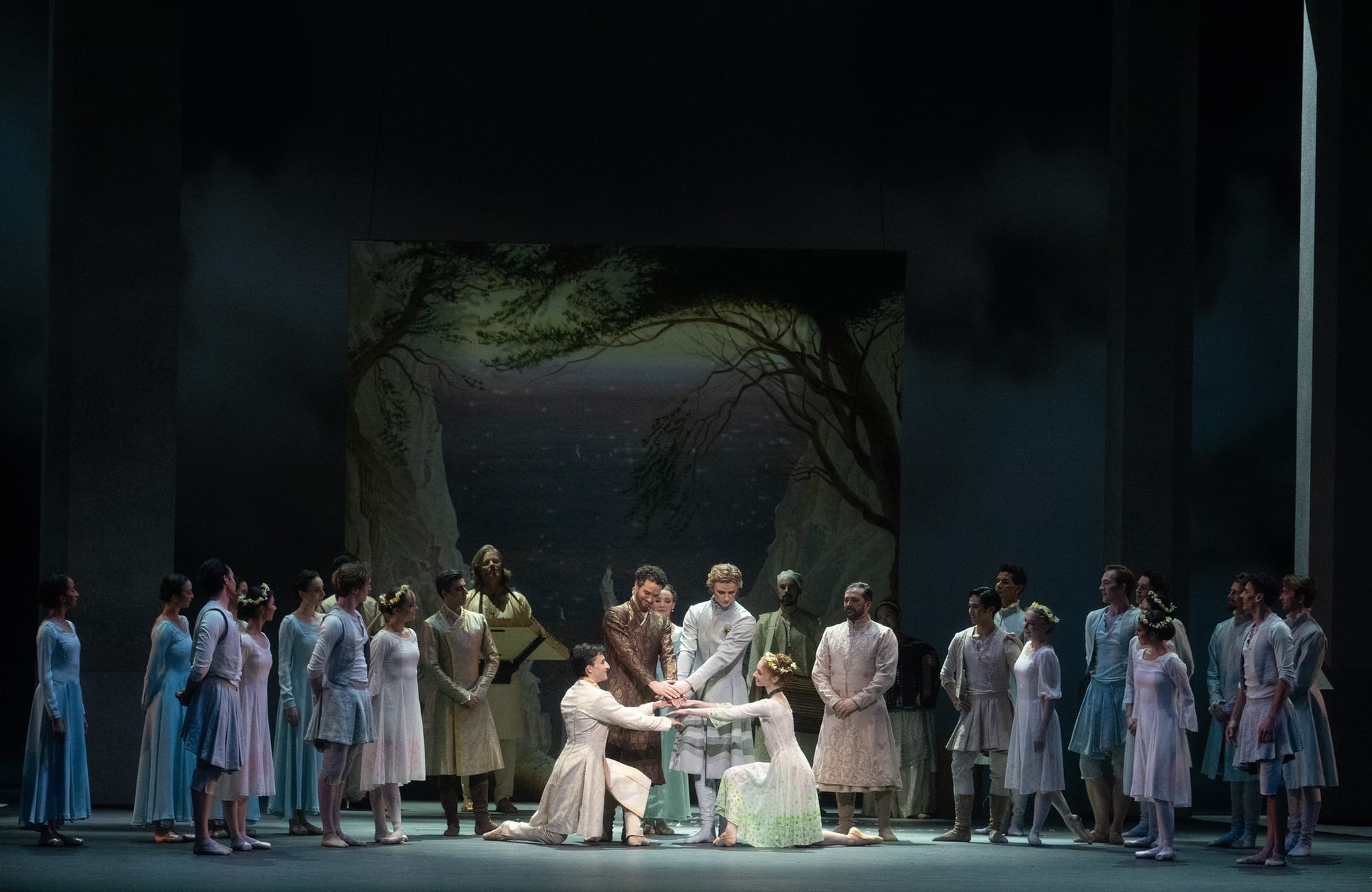
Shevchenko, in her New York debut, gave Paulina a steady maturity, and was a constantly hovering presence comforting, protecting, and watching; she danced with a quiet modesty, with some flashes of anguish or anger. She had a warm triumph during the revolution scene, when she showed Leontes that Hermione was still alive and all would be well. And with dancers like this, things did go well.
© 2025 Mary Cargill



