It's His Company Now
“Songs of Bukovina,” “Symphonic Variations,” “Other Dances,” “Serenade after Plato’s Symposium”
American Ballet Theatre
David H. Koch Theater
New York, New York
October 21, 2017 afternoon
The two ballets by Alexei Ratmansky on the program, including his newest work, were vibrant and full of life. Meanwhile iconic works by Ashton and Robbins were more or less dead on arrival. On Saturday afternoon at ABT, if you needed proof positive that it’s Ratmansky’s company now, the dancers his, their contemporary techniques molded primarily for his material, you needed but open your eyes.
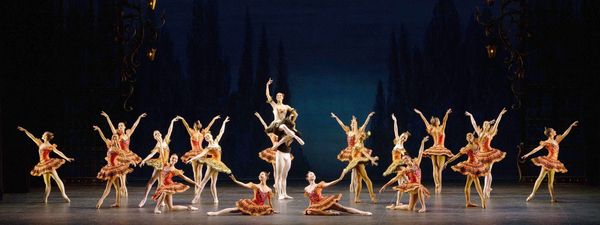
“Songs of Bukovina” – Ratmansky’s latest work that premiered earlier in the week – proved to be one of his most immediately accessible and also most classical compositions, particularly in how it featured a single principal couple and provided them with material that, while based on character dance in its global sense of rhythm, was realized in a strict lexicon of classical dance. Where the principal couple, for example, introduced a wonderful section of dance with an extended side-by-side duet of hops forward and back, holding each other’s hands while performing Czardas-like thrusts of their hips, the dance ended with the ballerina circling the stage in a magnificent manège of pas de chats volé of a scope that recalled the ballerina’s second variation in Balanchine’s “Theme and Variations.”
Curiously, because Ratmansky made the ballet on Isabella Boylston (ABT’s most accomplished ballerina at the moment, who blew the proverbial roof off the theater dancing it on Friday night), the opening night cast that repeated on Saturday afternoon featured not Boylston, but the company’s recently promoted principal dancer Christine Shevchenko partnered by soloist Calvin Royal III. They struggled with the material, dancing carefully but without much brilliance or scope. Yet the ballet proved well able to withstand even their lackluster attack. Relating strongly to Ratmansky’s 2014 “Pictures at an Exhibition” for New York City Ballet, and like it a suite of piano dances to Slavic themes, the composition here is simpler, without a program, and less assuming; the simple arrangement perfectly matches Leonid Desyatnikov’s deceptively humble score of simple Ukrainian melodies spiced by harmonic assonance and occasionally percussive technique.
The corps de ballet of four couples, where Jose Sebatian and Catherine Hurlin particularly distinguished themselves, tore into the material with extraordinary relish.
Sebastian, a young member of the corps de ballet, also made the strongest impression ending the evening as one of the seven leading men in “Serenade after Plato’s Symposium,” a ballet also danced by the ensemble with mesmerizing intensity and focus. Thomas Forster, Joseph Gorak, Alexandre Hammoudi, Tyler Maloney, Aaron Scott and Zhiyao Zhang completed the cast, in a ballet whose idiom was as based in character dance as the initial work was classical.
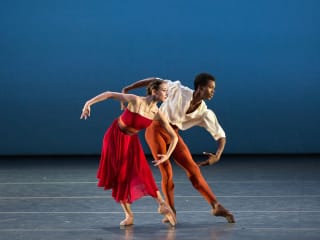
The problems that beset Ashton’s “Symphonic Variations” and Robbins’ “Other Dances” in the middle of the program are almost too many to enumerate.
On the most general level, the orchestra took the César Franck score of the Ashton at much too slow a pace, depriving the performance at the outset of any possibility of flow. The dancers then accentuated the problem by treating the material with a pious air that took the remaining life out of it. The cast that had Devon Teuscher in the central role, flanked by Betsy McBride and Cassandra Trenary, was ill thought out. Hyperextended arms and readjustments of pose were everywhere among the women, in a ballet where the slightest mistake in placement or aplomb shows. The men – James Whiteside, Cameron McCune and (again) Gorak – did a much better job, with Whiteside particularly giving a weighty and appealing performance, but couldn’t rescue the work from the general sense that the company was totally ill at ease in it.
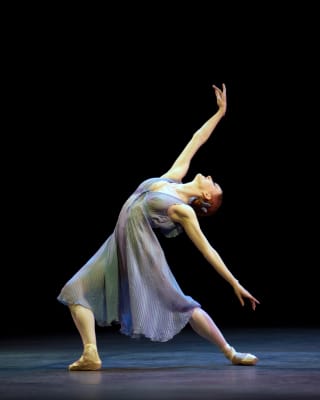
“Other Dances” – a ballet originally made on Mikhail Baryshnikov and Natalia Makarova – was danced by Gillian Murphy and Corey Stearns. Merely listing the casting begins to account for what was wrong, but the performance was not only weak on personality but also lacking in sass, wit, and theatricality. Somewhat as the company had with Ashton’s choreography in the prior ballet, the dancers here treated Chopin’s music like it was precious china, handling it oh-so-carefully and dancing in the ballet equivalent of a singer’s sotto voce. While at times they succeeded in coming across as sensitively beautiful, it wasn’t bold and certainly wasn’t Robbins. The sense of two divas being divas while taking the piss out of their mannerisms, essential to the original, was lacking.
copyright © 2017 by Michael Popkin