Greek Fire
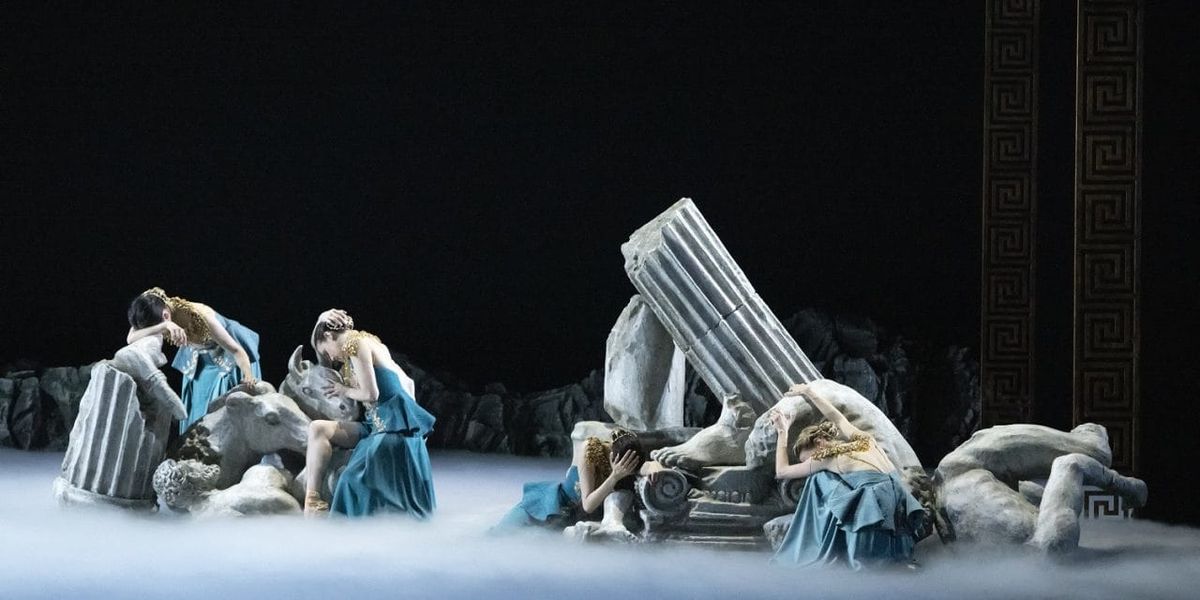
"Of Love and Rage"
American Ballet Theatre
Metropolitan Opera House
Lincoln Center
New York, New York
June 22, 2022, matinee
"Of Love and Rage", Alexei Ratmansky's newest work for ABT, may never become a second "Romeo and Juliet", able to fill the Met with its name alone, and audiences new to it will always have to study the synopsis with devoted attention. Nevertheless, with the luminous settings and elegant costumes (Jean-Marc Puissant), the robust Khachaturian score, and the many choreographic delights (including lots of male jumping) it should find its audience. I certainly hope so, because Ratmansky has provided a fine vehicle to show off ABT's many newer, younger, and very interesting dancers.
.Calvin Royal III, made a principal in 2020, and who obviously has not performed a lot in the past two years, made his debut as the energetic hero Chaereas. He bounded n with his athletic Syracusian cohorts with commanding confidence, looking as if he had been dancing leads for years. His tall, rangy body doesn't have perfect classical proportions and his hands can be a bit fly away, but his noble carriage and and raw power helped convey the hints of a young Greek god in the opening scene. His acting was detailed and nuanced, youthful and loving, but impetuous. His quick, blazing anger at one of the failed suitors made his blind fury when he suspected poor Callirhoe of being unfaithful seem perfectly in character, and his horrified reaction to her supposed death was gripping. This go-for-broke determination made his assuming command of the Egyptian army an obvious choice.
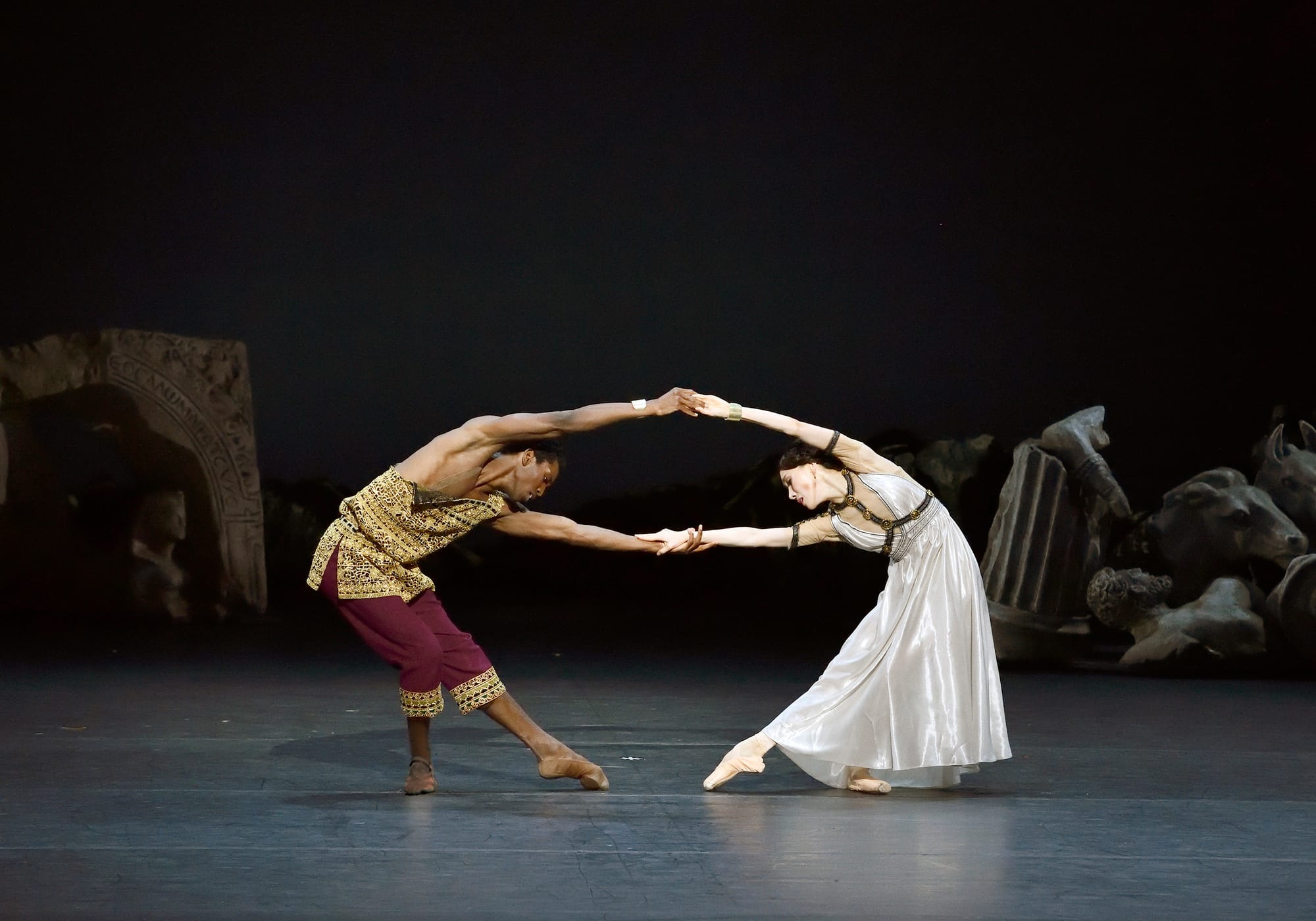
His partnering was strong and generous, using those two torch lifts (one in each act) as a chance to let Callirhoe (Hee Seo) soar. Seo was a lyrical, delicate, but inwardly strong heroine, and her dancing clearly showed Callirhoe's many moods, beginning with the rapturous innocence of her first meeting with Chaereas, through despair when she was sold to Dionysius, to contentment as a wife when realized his virtues (bigamy apparently wasn't a really big deal to her) and finally to a generous serene maturity as she forgave Chaereas and returned to him. Seo did have a few minor technical mishaps, coming off point a couple of times, but the lush lyricism of Ratmansky's choreography suits her long, beautiful line and pliant back, and she gave a richly satisfying, emotionally detailed performance.
Joo Won Ahn, another 2020 principal, was Dionysius, one of the most interesting and sympathetic characters in the ballet. He made every gesture tell; his weighty, stretched arabesques in his first scene, as he was mourning his wife, were elegiac, his gentle, almost shy offer of his coat to the distraught Callirhoe, and his commanding generosity in freeing his female slaves clearly showed why Callirhoe would marry him.
Dionysius wasn't just a softy though, as his determined fight to keep Callirhoe from Mithradates showed. Patrick Frenette made his debut as Mithradates, dancing that rather one-dimensional old bully with a menacing power. Jonathan Klein, as Chaereas's faithful friend, was especially engaging, bounding and eager, and it did seem a shame that somewhere in that complicated plot, he couldn't have found a girlfriend too, specially since it seemed he was the only man not to be driven wild with desire at the glimpse of Callirhoe's face.
Zhong-Jing Fang, also in her debut, made the most of her Queen of Babylon, glaring daggers at Callirhoe before she, too, vanished from the story. But no matter how many loose ends flutter around, the finale, as Dionysius nobly returned his stepson to his rightful parents, was almost as moving at the end of "The Sleeping Beauty", where love, generosity, and forgiveness triumph. And quite rightly, Ratmansky's shimmering corps showed up to celebrate.
Copyright © 2022 by Mary Cargill



