Corps' Night Off
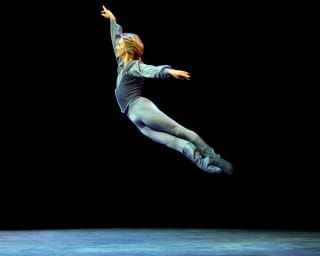
"Her Notes", "Symphonic Variations", "Other Dances", "Serenade After Plato's Symposium"
American Ballet Theatre
David H. Koch Theater
New York, New York
October 19, 2017
American Ballet Theatre has long had a dual identity in New York. In the spring at the Metropolitan Opera, the company presents itself as the guardian of 19th century imperial Russian tradition. Spectacle, scale, hierarchy rule. The fall season, at the home theater of the New York City Ballet, is more egalitarian. Mixed bills provide dancers throughout the ranks with more opportunities to show who they are and what they can do and, for those of us who often find seven weeks of "Swan Lake", Minkus and Macmillan stultifying, the season is a welcome contrast. At this performance, the company took on another identity: a top notch contemporary chamber ballet company with four works, two from the last century, but ageless; two from last year, none with more than a cast of ten, the evening requiring only twenty dancers in all, among them most of the available principals and soloists and only two members of the corps de ballet which otherwise had the night off.
"Her Notes", choreographed by Jessica Lang, asks more questions than it answers. What does the title refer to? The fact that the music is by a female composer, Fanny Mendelsohn Hensel, sister of the much more famous Felix? The choreographer's intentions or discoveries while working with these dancers? And what is the meaning behind the scenery, moving geometric scrims with cut outs evoking doors and windows, also by Lang? Why does Gillian Murphy make her entrance by climbing through one? Is she escaping from someone or something? Is she a burglar? And why does the ballet end with that scrim lowered parallel to the floor with Murphy standing (trapped?) in the same space through which she entered? Is this a comment on the condition of women?
There are no clear answers. There are hints of the pastoral, the nocturnal, the blinding turquoise of a summer sky, nods to young love and mature love, poetic allusions, scraps that never gel into a complete verse. But Lang (and costume designer Bradon McDonald) know how to make her dancers look good. A short solo of quick bouncing jumps upstage to down showed off Cassandra Trenary's piquant precision, speed and delicacy. Thomas Forster, in a debut, was more relaxed and fluid than I had ever seen him, moved at a superhuman scale, but modestly, quietly. Gillian Murphy, whether carried and turned like a kayak or standing in rock solid attitude with her arms lifted, in both cases without a wobble, showed the same modesty, with a message: this is my world, this is my turf and I belong here.
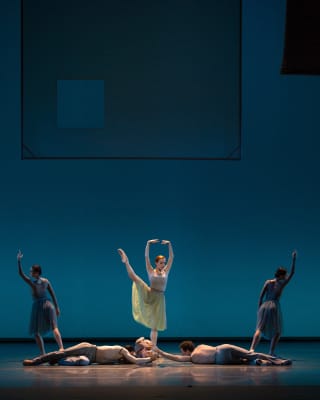
It is exactly that sense of possession, of belonging that was lacking In the first performance this season of Ashton's "Symphonic Variations". Ashton's classicism did look less alien than it did a year ago. Misty Copeland caught the folk inflections in a quick solo. Skylar Brandt's high spirits suited a little jig with medieval overtones. Christine Shevchenko brought soft-edged serenity to her central role. All three men looked less dutiful, less overwhelmed. Yet that sense of possession, of ownership that anchored "Her Notes" was lacking here. This is perhaps not surprising. The style is foreign; the training on which it is based (Cecchetti) is not pervasive on this side of the Atlantic. The ballet is brutally difficult, requiring that the cast remain on stage its full eighteen minutes, dance with the assurances of principals while moving, breathing and thinking as one, like the closest of friends or a well-drilled corps de ballet. Coaching might help (Michael Somes spent ages getting the placement of a knee right when the ballet was first set in 1992) but coaching requires time and money, both at a premium in the arts these days. But it would be worth it to see the dancers raise their torsos to the spring warmth of Sophie Fedorovitch's set, loosen their shoulders, and gain the confidence to bring "Symphonic Variations" closer to Ashton's ideal.
It was a shock that this performance of "Other Dances" was so far from what Jerome Robbins' pas de deux could and should be. Made for ABT superstars Natalia Makarova and Mikhail Baryshnikov in 1976, it has been in the repertory for decades, and David Hallberg is a veteran of the male lead, though paired with a debutante, Hee Seo. The staging is credited to Isabelle Guerin, who danced "Other Dances" in New York, during Robbins' lifetime and at her home company, the Paris Opera Ballet. So why didn't this performance work – at all? Seo and Hallberg were physically mismatched, she fine-bones and small; he tall and imposing; he towered over her. Perhaps Hallberg's injury was acting up. Perhaps Seo, based on this and on her performance of Balanchine's "Valse Fantaisie" a few years ago, isn't sympathetic to the rhythms of 20th century American neoclassicism. Robbins wanted his dances to perform as if marking in the studio, to dance for themselves, and each other, as though no one were watching, with, in "Other Dances," a certain legato cantilena underpinning the whole. This was a performances of percussive extensions, glances at contradictory angles, dance phrases ending before the music, a celadon vase delivered in jagged shards. Ouch.
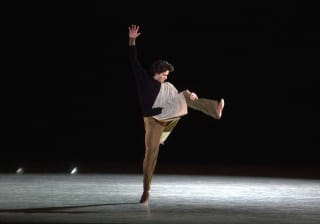
The evening ended on a much brighter note. Having celebrated its first birthday, Alexei Ratmansky's "Serenade after Plato's Symposium" now fits its original cast (with the exception of Marcelo Gomes, off touring in "The Red Shoes" and replaced by Alexandre Hammoudi, replacing in turn the injured Alban Lendorf) like a pair of broken in shoes. Both Herman Cornejo and Daniil Simkin in the most virtuosic solos have toned down their attack. Cornejo's beats skimmed the stage as delicately and naturally as a hummingbird in flight. Simkin's solo seemed lighter than ever but he gave equal weight to a final handshake with Blaine Hoven, a moment of acknowledgement between two members of the symposium but between the two dancers as well. James Whiteside, bearded, dances with a level of anger alien to the princes and porteurs he most often plays. Blaine Hoven, Calvin Royal III, and Gabe Stone Shayer were all made dancers to watch by there solos in this ballet. Now we can watch them, settled in, dig further. Devon Teuscher, expertly partnered by Alexandre Hammoudi, channelled Grace Kelly as Hera in a columnar dress of Mediterranean turquoise, the unattainable temptress incarnate. "Serenade after Plato's Symposium" isn't a perfect ballet. The pas de deux doesn't register and the final movement is far to long, but there is no question that the ballet belongs to the dancers and that they relish it.
copyright © 2107 by Carol Pardo



