A New, Young Cast Delights in "Harlequinade"
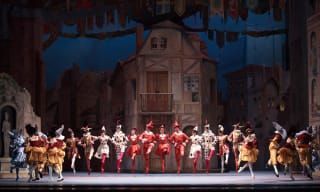
“Harlequinade”
American Ballet Theatre
Metropolitan Opera House
New York
June 6, 2018
American Ballet Theatre is offering four casts in eight performances of Alexei Ratmansky’s reconstruction of Marius Petipa’s “Harlequinade” this week at the Metropolitan Opera House. The cast I saw was particularly interesting because nearly all the major roles were taken by dancers from the company’s lower ranks. This gave them a chance to prove themselves, and they more than met the challenge. Harlequin was portrayed by corps de ballet member, Gabe Stone Shayer, while his love, Columbine was soloist Cassandra Trenary, and Pierrot was soloist Blaine Hoven. The only principal dancer in the cast was Christine Shevchenko as Pierrot’s wife, Pierrette.
Shayer has only been in the company a little more than five years, but is likely to have promotions in his future. He dances with both technical virtuosity and elegance, and he has a stage personality that is outgoing, attractive and sure. As Harlequin he was mischievous on the one hand, but heartfelt in his love for Columbine. When he pleads for help from the Good Fairy in order to win Columbine’s hand, you never doubt his sincerity.
Trenary has been a dancer to watch for some time. She came into her own here, dancing with joy and humor. She was especially impressive in the last act pas de deux, an allegory in which she impersonates a lark, with Harlequin as the hunter who pierces her heart to earn her love. This formal pas de deux, intertwined with a corps of twelve women, is the climax of the ballet and is one of the few places in which Petipa showed real choreographic imagination. The lark duet is replete with fluttering, wing-like movements and a series of dramatic lifts and swooping catches. Most of the rest of the ballet, excepting a few group dances and a double duet in the first act, is devoted to pantomime and other stage business.
Pierrot and Pierrette are the second leads among the commedia dell’arte characters. Shevchenko as Pierrette was porcelain-like in her dancing and appropriately strong willed in her acting. She had no qualms about browbeating Pierrot in the cause of uniting Harlequin and Columbine. But in the end, husband and wife were reconciled. As Pierrot, Blaine Hoven was quite wonderful. In this narrative, Pierrot is the servant of Cassandre, Columbine’s father, who has ordered Pierrot to keep Harlequin and Columbine apart (Cassandre plans to marry off Columbine to Léandre, a rich fop). Blaine was a sleepy-eyed sad-sack as Pierrot, preposterously ineffective in carrying out his duties. Blaine was hilarious in one particular bit of action when, in a tussle with Harlequin, he inadvertently shoves the unwelcome lover off a balcony to his death. The look on Blaine’s face was fleeting but priceless, a combination of emotions that spoke at once of triumph, catastrophe, and realization of impending punishment. When Harlequin’s body, in the form of a life-size rag doll, is discovered on the pavement below, Pierrot rushes out to collapse in effusive lamentations, as if he hoped by doing so he could deflect any beating likely to come his way. It should be added that Harlequin’s death is short. Thanks to a bit of magic he is up and running again in no time, despite an interlude in which he is torn to pieces by a gang of Cassandre’s henchmen who have been ordered to dispose of the body.
Keith Roberts, a ballet master with the company, was amusing as the silly Léandre, especially in his futile attempt to sing a love song, which sends his two lackeys into paroxysms of laughter. Alexei Agoudine was effectively blustering as Cassandre, and executed his extensive mime passages with clarity. The large cast included numerous town people, officers, soldiers, friends, and a Good Fairy, performed with pretty dignity by Claire Davison. There were also an abundance of children in the second act who depict various commedia characters in miniature form. They danced a good deal, perhaps too much. Of necessity children’s steps have to be simple, and no amount of shifting patterns can make up for that lack of complexity.
As for the production as a whole, I will only say that in my view, the ballet is a minor Petipa work with a banal Drigo score. Certainly there are charming moments, but there is very little real dancing and what there is, for the most part, is not particularly inventive. I wonder, too, how the ballet will fare in the future, without the meticulous care that has gone into the pantomime that consumes so much of the work. Today’s dancers and coaches have little experience in formal pantomime and this ballet needs absolute clarity of mime to make any sense at all. Ratmansky has reconstructed several important nineteenth century ballets with great success. Why he chose this one is something of a mystery.
copyright © 2018 by Gay Morris



