A Fresh and Appealing “Coppélia”
“Coppélia”
New York City Ballet
David H. Koch Theater
New York
June 2, 2018
“Coppélia” is among the nineteenth century ballet classics, but compared to others, such as “Giselle” and “Swan Lake,” it is presented much less often. This may be because it is a comic ballet and therefore taken less seriously. But even when it is performed, its dances often look fusty, and its humor outdated. So it was a pleasure to see New York City Ballet’s version looking fresh and appealing when it was staged last week. Of course, this is not the usual “Coppélia,” in which the dances have been revised so many times they are vague shadows of what may have once been Petipa’s choreography. New York City Ballet’s production, first presented in 1974, had Balanchine’s guiding hand. He staged the ballet with Alexandra Danilova, who had danced the leading role of Swanilda many times. They cast their memories back to their youth at the Mariinsky Theater for the structure and some of the choreography, but it is really Balanchine’s ballet, particularly Acts I and III.
There are a number of memorable moments in Act I, including the character dances — the czardas and mazurka — which usually seem like fillers until an interesting classical variation comes along. However, here the dances are full of exciting steps and unusual patterns, including circles within circles that evolve into lines and back to circles. The program notes state that these dances are the most authentic, which I take to mean closest to what was done in Saint Petersburg. If that is the case, they make damning evidence for all those dull numbers that have been handed down to us in Act III of “Swan Lake.” Were those national dances also inventive and rousing when they were created?
Balanchine devised lovely dances for the leading couple, Swanilda and Frantz, and Swanilda’s friends in Act I. Throughout the ballet, Swanilda’s variations are marked by virtuosic terre à terre choreography that reflects her piquant personality. Her dances in Act I are intertwined with those of her friends, showing her as integral to village life and leader of the local girls, who she will soon convince to invade Dr. Coppelius’ workshop in search of the mysterious woman who has stolen Frantz’s heart. Balanchine also gave Frantz a variation in this act, which did not exist in the nineteenth century incarnations of the ballet. His bravura solo also is an indication of his personality, which is energetic and extraverted.
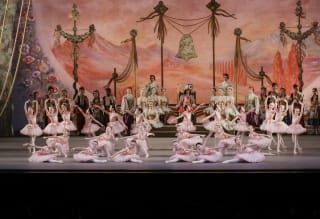
Act II is set in Dr. Coppelius’ workshop, where Swanilda discovers that the mystery woman is, in fact, a doll, and reveals her discovery to Frantz, who quickly transfers his affections back to Swanilda. if I were her, his easy change of heart might give me pause, but Frantz isn’t supposed to be the most sensitive soul and in the final analysis marriage and maintaining the status quo is the point of the story. For Act III Balanchine created a divertissement that includes dances for Dawn, Prayer and other soloists plus twenty-four very sweet little girls as the hours. Appearing, too, are the discordant forces of war, overcome by peace in the form of Swanilda and Frantz, representing family and tradition. Their formal pas de deux is the culmination of the ballet.
Saturday afternoon’s performance featured debuts for Erica Pereira and Anthony Huxley in the leading roles. The ballet ultimately belongs to Swanilda, and Pereira was more than ready for the challenge. She is a soloist in the company and is usually capable and charming while not making a vivid impression. Here, though, she excelled in every aspect of the role. Her acting was comic when it should have been, but was never exaggerated. She was by turns angry, mischievous, and touching. In her dancing, she reached an altogether new level, blazing her way through every difficulty, and there are many in this choreography. Her technique was as crystalline as a spring day and she danced with a musicality that was marked by subtle and exciting phrasing.
Huxley was long known as a soloist with a highly refined technique, who was usually cast in roles that called for beautiful dancing but no acting. Then, after a surprising, strong performance as James in “La Sylphide,” he was promoted to principal dancer in 2015. Since then he has been working his way through a number of new roles. However, it’s not clear why Frantz should have been one of them. The program notes for the ballet describe Frantz as a bumpkin with loutish friends. If not exactly that, he should certainly be an extraverted mischief-maker who is not beyond whirling an old man (Dr. Coppelius) around until he can barely stand up, then treating the cruel prank like good natured fun. I doubt Huxley could be an extraverted mischief-maker if he tried for ten years. His realm is the dreamer or star-crossed lover, the melancholic or idealist. Although as Frantz his solos were as pristine as ever and his partnering fairly steady, his acting was way off. For most of the ballet he looked slightly puzzled, as if he didn’t know what to do with himself. Casting against type in this case wasn’t the best decision.
Guest artist Robert La Fosse, once a principal dancer at NYCB, appeared as Dr. Coppelius. La Fosse invested the role with a poignancy that gives the character some dignity. After all, the old man, foolish though he might be in trying to bring a doll to life, doesn’t deserve the humiliating treatment Swanilda, Frantz and the rest of the town’s young people heap upon him. In solo roles in Act III, Indiana Woodward, Emilie Gerrity and Meagan Mann were especially noteworthy, while Clotilde Otranto conducted the ballet orchestra in a vivid performance of the Delibes score. The sets and costumes by Rouben Ter-Arutunian add much to the ballet’s sense of freshness. His set of an Eastern European village is light and charming in its folk art details, matched by the costumes, many of them in hues of blue, apricot and white.



