Youth is Served
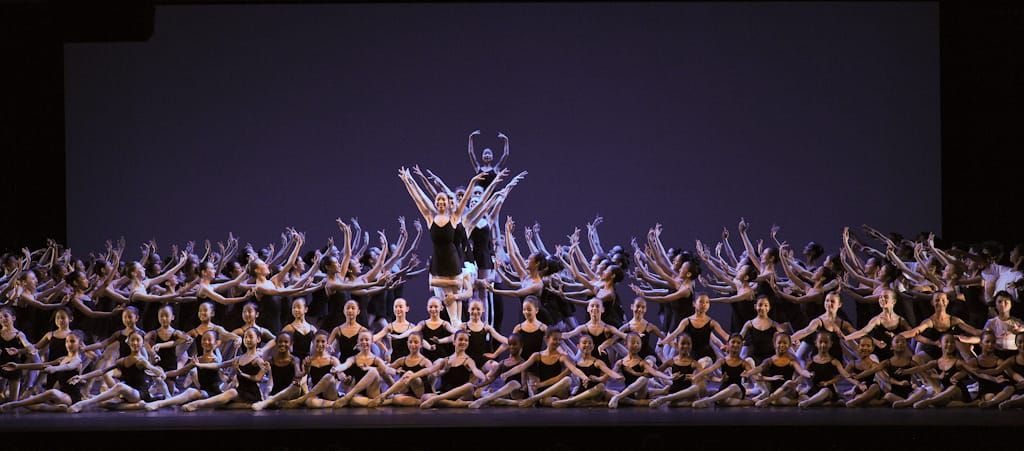
"Stars of Today Meet the Stars of Tomorrow"
YAGP 2011 Gala
New York City Center
New York, NY
March 22, 2011
The Youth America Grand Prix ended its season with its traditional celebration of prize winners and current dancers. The first half featured the young scholarship winners in a variety of dances--this was not a traditional fouette-fest gala, but rather a vaudeville-like selection of various styles and groupings, from solos to groups. The dancers were astoundingly accomplished, and coped with the unfortunate sound malfunction of the massive finale, and danced their variations in silence, accompanied only by the audience's applause. Indeed, applause, whistles, and cheers accompanied most of the variations, as anything from a pointed foot to a prolonged balance or flashy turn generated enthusiastic reactions. There is, of course, a place for audience participation, and the generous good will of the adoring audience was certainly winning. But time will tell if these dancers can develop from performing steps to actually dancing.
Some clearly have, and Wang Li, from the Beijing Dance Academy, the winner of the contemporary dancer award, made his solo ("Nobody Knows" by Zhang Di Shen), a sort of reverse "Dying Swan", lying on the ground and struggling to get up. His performance was committed and subtle. Sung Woo Han of Korea, the male gold medal winner, was dignified, understated, and gloriously unflashy in the "Sleeping Beauty" variation. One a completely different note, twelve-year old Gaya Bommer Yemini, from Israel, the junior gold medal winner in contemporary dance, was completely winning as a cartoon doll whose batteries seemed to be winding down. Hannah Kulas, the senior women silver medal winner, and a cool, blond beauty, gave a vivid performance of Makarova's version of Gamzatti's final act variation, winding and twisting in regal agony, an interesting choice, given the flashier wedding scene solo.
There were flashy solos to be had, of course, and they were performed with aplomb, to great cheers. Tyler Donatelli, the junior women bronze medal winner, seemed fearless in attacking the variation from "Le Corsaire", and the 12 year-old Aran Bell flew through his "Don Quixote" solo, with elegant and precise landings. Yes, there was a wind-up toy feel, but also awe and respect for their dedication.
The grown-ups got the second half, and unfortunately, the choreography was generally second-rate. It was fine to limit the usual gala fare, but the material shown was generally meandering and unmusical, and in the case of the couple from the Paris Opera Ballet (Myriam Ould Braham and Karl Paquette) sloppily danced. Daniel Ulbricht deserved a more subtle work than his turn at wowing the audience, though wow them he did in "Piazzolla Tango", coming down from a jump into a somersault, among other unbelievable tricks.
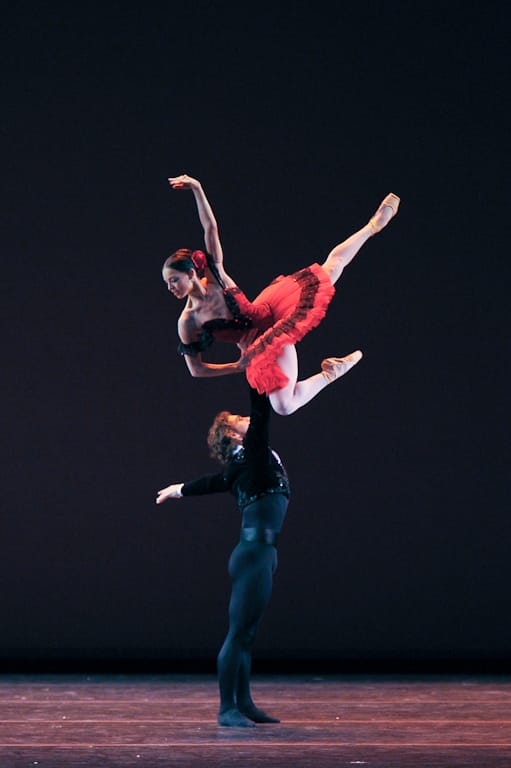
The inevitable "Don Quixote" pas de deux has its share of tricks, but is also has solid and interesting choreography, and was danced to the hilt by the National Ballet of Cuba's Viengsay Valdes and the Bolshoi's Ivan Vasiliev. Valdes is a charmer, and seems to make it her mission to squeeze every ounce of flavor out of her steps. She can hold a balance til the bulls come home, but still managed to bring her arm graciously down--she is not a dancer to balance through gritted teeth. She and Vasiliev seemed to have a great rapport, urging each other on, and managed to make the audience feel as if there were nowhere else they would rather dance. It was exhilarating and well worth the wait.
copyright © 2011 by Mary Cargill



