"World's On Fire"
"World's On Fire"
ODC Dance
Yerba Buena Center for the Arts
San Francisco, CA
March7, 2019
Every arts institution, particularly one over forty years old, has to face the future. Most of them do it rather later than sooner. ODC Dance, still under the leadership of its founding members Brenda Way, KT Nelson and Kimi Okada, is planning more openly than any other I can think of. Currently, Oakland-born Kate Weare now heads her thriving Kate Weare Dance in New York. She has also been a local presence for some years; she's now ODC’s first Choreographer in Residence. For the new “World’s on Fire,” Way and Weare signed as co-directors and Weare as choreographer. The Crooked Jades with whom Weare had already worked for her “Bright Land” offered inspiration (I didn’t see the work when it came through town on tour.) The musicians agreeably performed on stage; periodically ODC’s fine dancers participated in the music making.
My major disadvantage with “World’s” were the musicians, The Crooked Jades, fascinating as the employment of complex instrumentation was. I couldn’t find my way into either into the lyrics or the score. They take “old-time music” and present it through their own filters. With but a few exceptions, I felt liker the stranger in a strange land, in a world that seemed dark and murky. The program notes said that this piece was an attempt to explore “middle America.”
Yet Weare’s choreography was anything but uncommunicative. Her movement language is focused, sometimes fragmented as if cut off mid-sentence: it is ambivalent, almost impersonal yet with emotional subtexts. Floating through a murky sea between abstraction and passion was a tiny thread of a narrative in the person of Brandon (Private) Freeman. In the opening image — after the raucous band had taken its place on stage -- we see a bent-over Tegan Schwab in an upstage corner sitting on the supine Freeman. You didn't recognize a what or why. Yet the two of them would be the last thing we saw in a shockingly telling final moment
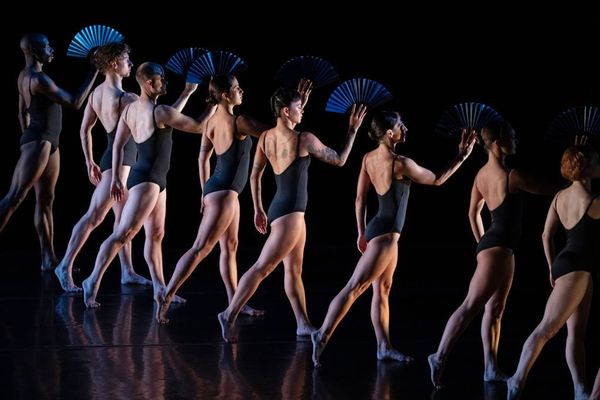
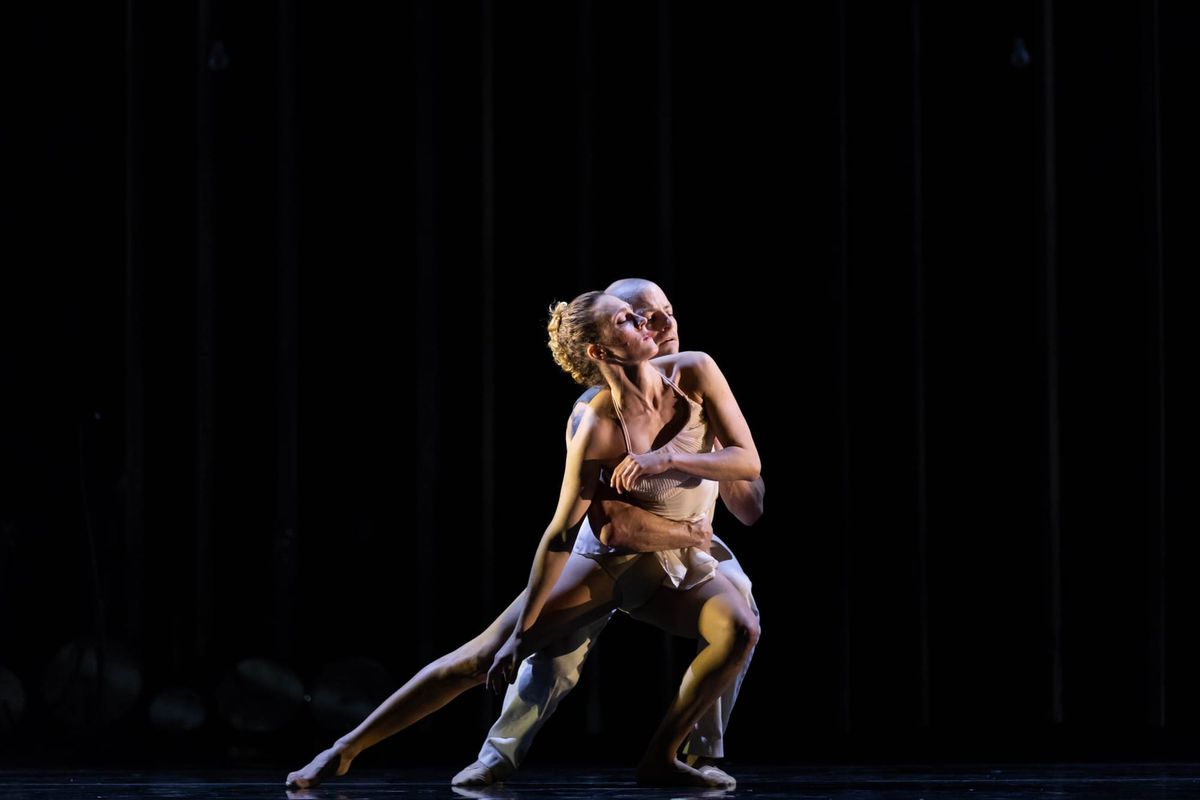
Striking is Weare’s fascination with doubling, with pairs that are connected yet different. Phrases were clipped. It was mostly male/female dancing; Natasha Addorlee Johnson/Kendall Tegue, Rachel Furst/Jeremy Bannon-Neches come to mind. They knitted and re-arranged each other bodies as if trying to make something new. The dance might be erotically sensuous — trying to be absorbed by a partner — but also assertively demanding. Sometimes it could have been both. Mia J. Chong and Schwab, despite their physical separation, also were a couple. Gleefully skipping and gently swaying their hips, their hands spoke the secret language of fans. Striking also was the majestic James Gilmer who twice got carried overhead as if to his own funeral. (I wish it had been someone else.) When the much shorter Daniel Santos approached him for, perhaps, a two-some Gilmer just walked away.
I also wish Freeman’s role as the observing “outsider” could have been woven more deftly into the work’s trajectory. Everyone wore casual worn work clothes (costumes by Sarah Cubbage); for Freeman that meant a black business suit jacket. It looked like a costume on him. He was the first to be stripped of this accoutrement; eventually all the dancers removed their modestly differentiated clothes, ending up in neutral beige. If that was an attempt to shed and throw around those discarded “skins” and in the process become more commonly human, it was bathetic: it just looked trashy.
The duet between Tegan and Freeman is “World’s” longest sequence. As such, and for its imaginative power, it offered the evening’s most accessible (in a good sense) choreography. Yet it also looked as not having grown organically enough from what had preceded it. Surprises are good in the theater, someone has said, but they are best when prepared for. We needed more of that. The duet, however, was a spectacular tour de force that pulled the dancers apart one moment and then interlocked them in elaborate limbs, twisting lifts, crawls and stretches over and away from each other. It felt like one mighty struggle. So when the relationship returned to “World’s” opening image, its violence was theatrically shocking yet emotionally plausible.
copyright © 2019 by Rita Felciano