Windmill Keeps on Turning
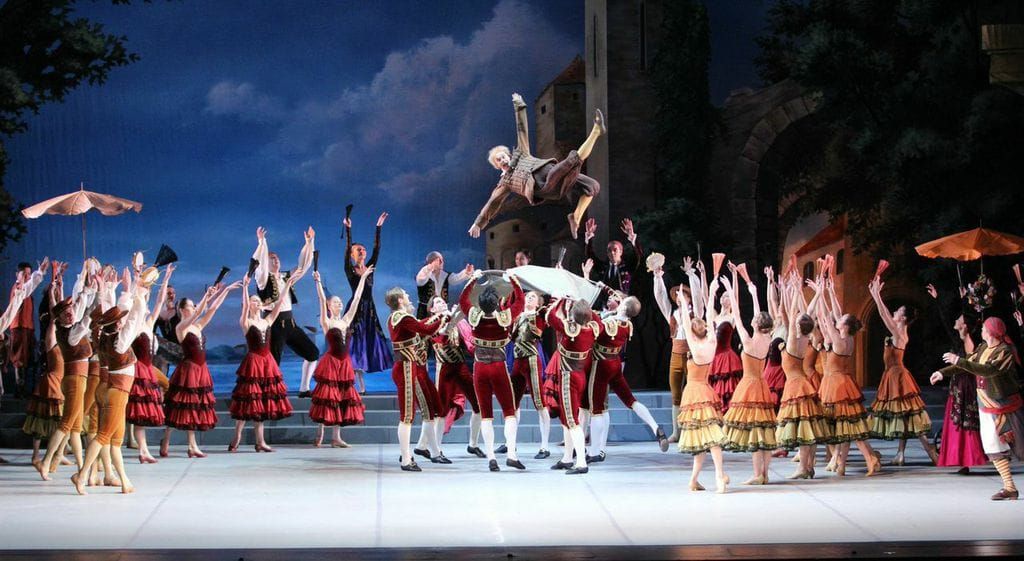
"Don Quixote"
Mikhailovsky Ballet
David H. Koch Theater
New York, NY
November 22, 2014, matinee
The Mikhailovsky Ballet's production of "Don Quixote" lists seven choreographers (Petipa and Gorsky, of course, but also Fyodor Lopukhov, Kasyan Goleyzovsky, Nina Anisimova, Igor Belsky and Robert Gerbek) plus one stager (Mikhail Messerer). It would probably take a dance archaeologist to sort out the different layers and figure out who actually did what, but the outline and choreography of this production is very similar to the one the Bolshoi brought last summer which only gave Petipa and Gorsky credit. Like the Bolshoi version, this one has a rather bewildering cast of characters, most of whom have almost nothing to do with the story.
In the midst of these various dances, Kitri (Oksana Bondareva) and Basilio (Leonid Sarafanov) cavort energetically, watched over by the Don (Marat Shemiunov) and Sancho Panza (Alexey Kuznetsov). Bondareva danced the first act with a calculated vivacity, hitting all the high spots without making Kitri anything other than a very talented dancer. Her vision scene showed off her soft and elegant upper body, though she did tend to exaggerate her extensions, distorting her line at times and throwing her balance off center. The famous pas de deux began uneventfully, but the wire stiffening her tutu came unstuck and soon it was dragging on the floor like a metallic jump rope. The first impulse, I am sure, would be to stop the ballet, remove the wire and start over again, but Bondareva, with impressive aplomb, danced on, finishing with a brief, modest and very sweet acknowledgement of the support the audience and Basilio gave her. The mishap seemed, in a way, to relax her, and her fouettes were fast, accurate and doubled, exciting and fun.
Sarafanov was a charming Basilio, sunny and boyish, who combined youthful vigor with classical restraint. There were no exaggerated "Olé" flourishes; he clearly came from Spain by way of the Maryinsky. His Act III pas de deux included a magnificent series of double tours as well as crisp and clean tours a la seconde, technically impressive, but made more so by the feeling that he was having so much fun.
Poor Sancho Panza does not have much fun in the Russian versions, which treat him as a buffoon--short, fat men are around for people to make fun of, and the villagers toss him around with abandon. There is an old-fashioned innocence to this approach, and Kuznetsov was game. The ballet begins with a prologue showing the Don in his study, clumsily setting out on his journey. Shemiunov, a tall, rangy dancer, looked the part, though his actions were a bit cartoonish as he loped around; there was little of the underlying oddness or hopeful idealism that some Dons have, but this also tended to give the ballet an older, more stylized air which for me has a distinctive charm.
Much of the charm of "Don Quixote" comes from the character dancing, and the production is full of stomping, swirling villagers and swaggering gypsies. Espada (Andrey Kasyanenko) struts around flashing his cape at a sultry Street Dancer (Valeria Zapasikova) in Act I, then turns his attention to an equally sultry Mercedes (Victoria Zaripova) in Act II who gets to dance on a table and show off her impressive back bends; none of them seem really interested in Kitri or her plight. There are some energetic gypsy solos, watched vaguely by the Don, and a languorous fandango in Act III watched by the audience.
Unfortunately, this production has adopted the recent Russian practice of having the classical dancers in Act I perform barelegged, an uneasy and unsightly mixture of realism and artifice. The beautifully designed vision scene (set in a tropical paradise), though, was unalloyed classicism, with the Don wandering through the dancers to set them off. Ekaterina Borchenko was the Dryad Queen. She is a tall, beautifully controlled dancer, but she seemed a bit cold and didn't have all the graciousness some dancers give the role. Cupid, Veronkia Ignatyeva, stood out in her solo, showing off elegant little backwards flicks. I also enjoyed Anna Naumenko's classical variation in Act III, full of powerful and beautifully shaped jumps. The ballet, for all its silliness and anachronisms, has been entertaining people for years, and this production, bursting with energy, color and variety,
copyright © 2014 by Mary Cargill



