Who Could Ask for Anything More?
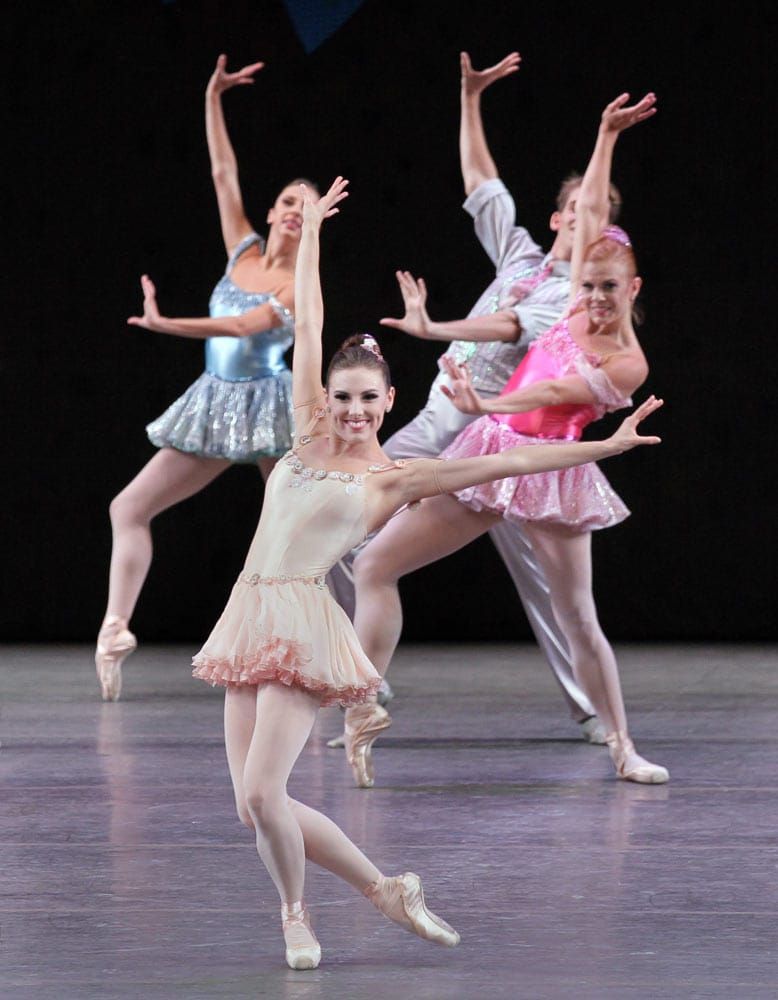
"The Steadfast Tin Soldier", "Le Tombeau de Couperin", "Tschaikovsky Pas de Deux", "Who Cares?"
New York City Ballet
David H. Koch Theater
Lincoln Center
New York, New York
January 17, 2012
The New York City Ballet's winter season opening night had no gimmicks, no so-called theme, no major debuts. It was "just" an all-Balanchine evening, and pretty pink-and-white Balanchine at that. But it had some enjoyable, entertaining, and magnificent performances. The evening opened with a belated Christmas ballet, "The Steadfast Tin Soldier", danced by Megan Fairchild and Daniel Ulbricht. These dancers, always technical marvels, found ways to give a hint of depth to their characters. Fairchild's first solo was danced with a rather deadpan face, without any eyebatting cuteness, but her sweeping movements hinted at the human feelings underneath the celluloid. This made her gleeful smiles while dancing with the little soldier so much more moving, because we could see her heart come to life. Ulbricht was crisp and clean, landing in beautiful fifths. He also slightly modulated the exuberance, so that his jumps gradually became higher and grander as if his heart, rather than his legs, were propelling him. There were moments of incredible delicacy too, when he landed softly on his knee from a jump while extending his arm to the doll. This delicacy gave the often coy ballet its true place in the Balanchine canon of lost love.
There is nothing lost in "Le Tombeau de Couperin", a delicate kaleidescope of corps couples winding in and out to the lilting, rather undramatic Ravel music. The corps looked very well-rehearsed, with open and engaged torsos making the wafting arm movements look as if they were emanating from deep within. The 8 couples also concentrated on each other, sharing little secret looks and smiles, which gave the piece a contented, sunny feel.
There was a great deal of sun in Ashley Bouder's Tschaikovsky Pas de Deux, once she got over a slip during her solo. She played with the rhythms and her dancing was especially juicy. I did miss, though, the connection with her partner that can turn this powerhouse pas de deux into a real conversation. Even in the final pose of the the opening pas de deux, when most dancers glance up at their consort with a grateful smile (for not dropping them, I suppose), Bouder only had eyes for the audience. Andrew Veyette, her partner, is a strong dancer, and supported her well, though the flamboyant role doesn't really suit him. He generally has a quiet elegance and beautiful beats, with a stiff upper body. He danced as if he had decided to wear a Bolshoi mask, which exaggerated his faults and hid his virtues.
There were virtues galore in "Who Cares?" This frolic is not to everyone's taste, and given the choice, I would probably rather just listen to the Gershwin songs, and it might be improved by giving the men less shiny costumes. But the inventive froth of the opening dances is pure exhilaration. These were very well danced, and obviously cast with care. In the case of the men, perhaps a bit too much care, as the five were arranged carefully by height, with the very tall Ask la Cour centering the balanced group. This gave the feeling of watching a dancing pediment rather than a group of guys out on the town.
Tiler Peck, with Robert Fairchild, danced the Patricia MacBride role, and in my memory bank this will be filed up "P" for perfect. From the moment she boureed on, head down, lost in thought, she was magical, the incarnation of the yearning, and ultimately triumphant music. She has the ability to move as if the floor isn't solid, and seemed to float above it in the adagio parts, and turn it into glass for her scintillating turns. Robert Fairchild was her deferential partner, supporting her so completely that their dancing was seamless; she seemed to flow into his arms as he caught her from a turn, and the often iffy jumps on his back looked effortless.
His other two swains, Sara Mearns (in the Karin Von Aroldingen role) and Teresa Reichlen (in the Marnee Morris part), weren't as perfectly cast as Peck. Mearns, who always dances with a unique musicality, seemed to be pushing a bit too hard, and the costume did not flatter her. Reichlin danced with an interesting astringency, but her persona seemed a bit pale next to Peck's blazing performance. But it was a glorious beginning to the season.
copyright © 2011 by Mary Cargill



