When Worlds Collide
"A Few Worlds"
Nancy Havlik's Dance Performance Group
Dance Place
Washington, DC
March 3, 2018
As an anthology of performance, “A Few Worlds” encompassed a diversity of works from Nancy Havlik’s Performance Dance Group. These pieces, while introducing a variety of movement quality, subject matter, and auditory accompaniment, were all thoroughly enriched by assorted approaches to artistic collaboration. The evening celebrated the intricacies of dance and human interaction, and included video projection, spoken poetry, and multiple live musicians. These elements contributed as inspiration behind movement and made for a fully enhanced and enjoyable performance.
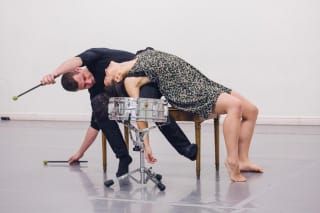
Since 1989, Nancy Havlik and her performance group have been creating work through improvisation-based discovery and has nurtured strong relationships between dancers and musicians in order to cultivate an all-encompassing performance experience. The collection of works presented this past weekend included a duet titled "Space Between Dreams,” performed by Juliana Ponguta Forero and Nate Scheible, a dancer and percussionist respectively. The duet was a fascinating portrayal of dance, as each performer seemed to fight for the ability to lead the other. They began with Scheible introducing a beat, which then Forero mirrored with her own interpretation through movement. When Scheible increased his rhythm, Forero’s quality became more chaotic and rushed, clawing at her hair with increasing ferocity until a silence permeated the space. Scheible decided to stop, so Forero stilled as well. The two revealed how easy it was to reverse the routine when Forero transitioned into leading the performance. Her movement became a muse for Scheible’s drum, and all of a sudden the visual was conducting the sound. Scheible also identified as a mover in this piece, at times copying the dance that Forero supplied. It was compelling to witness how Scheible adapted the dance to his own capabilities, since there is an organic, natural quality to an untrained body’s movement that traditional dancers are often incapable of producing. Scheible’s performance as a nondancer contributed to the resonance of the work, in which the performers uncovered how music can influence dance, and reciprocally how dance can inspire music.
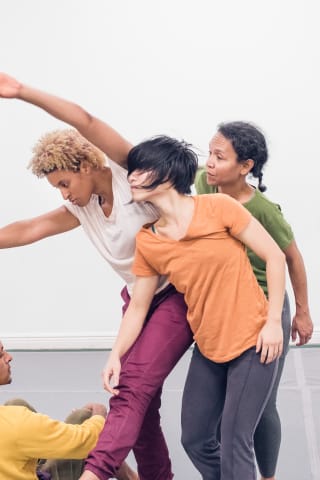
In “the waters all of light and of the west” five dancers took to the stage accompanied by the pianist Jessica Krash and the voice of the poet Ellen Roche. Roche’s five sonnets on her experience traveling by car to Austin, Texas served as the motivation behind the work, in which dancers explored and defined a human tendency to resort to movement for the sake of finding purpose. A dichotomy of themes immediately became apparent through their work, in which the dancers experienced instances of freedom through locomotion eclipsed by conditions of sedentary struggle. Many of these struggles emerged from situations of contact, which exemplified how human interaction played a significant role in the meaning of the piece. For instance, one dancer grasped the balancing foot of another, supporting their partner’s suspension, yet also rooting them into the floor and keeping their movement stationary. Another performer rolled and pushed against another dancer’s body, torso balanced precariously atop the other’s head and neck. This almost suffocating moment resolved when their weight pushed both dancers to the floor, and they were permitted to continue. Not all interactions were physical, such as when the performers raced circles around each other, as if establishing a line and daring their fellow dancers to cross it. These instances of interaction among dancers were key to expressing the nuance within the piece’s message.
All the while, Jessica Krash’s piano composition seemed to weave effortlessly through the dancers and their movement, complimenting their established flow and adding another level of relationship and sensation to the choreography. The audio recordings of the poems had a similar effect. With Roche’s words, Havlik and her dancers were able to create a work which realized the propensity people have to either support and inspire or stifle and restrict.
The night also included performances by Arts for the Aging’s Quicksilver Senior Dance Company, which were playful in nature and genuinely portrayed the joy evident in performance. Their work incorporated a video projection filmed by Denise Seals, and the musical complements of a charming and light-footed violinist by the name of Anthony Hyatt.
The dancers of “A Few Worlds” were lovely to watch, but what made the event truly inspired and worth seeing was the wealth of artistic partnership clearly associated with the performance’s development and production. This event is a prime example of the beauty of human and artistic interaction, and exemplifies the significance of collaboration in order to create community, understanding, and meaningful art.
copyright 2018 by Arielle Ostry



