Westward Ho
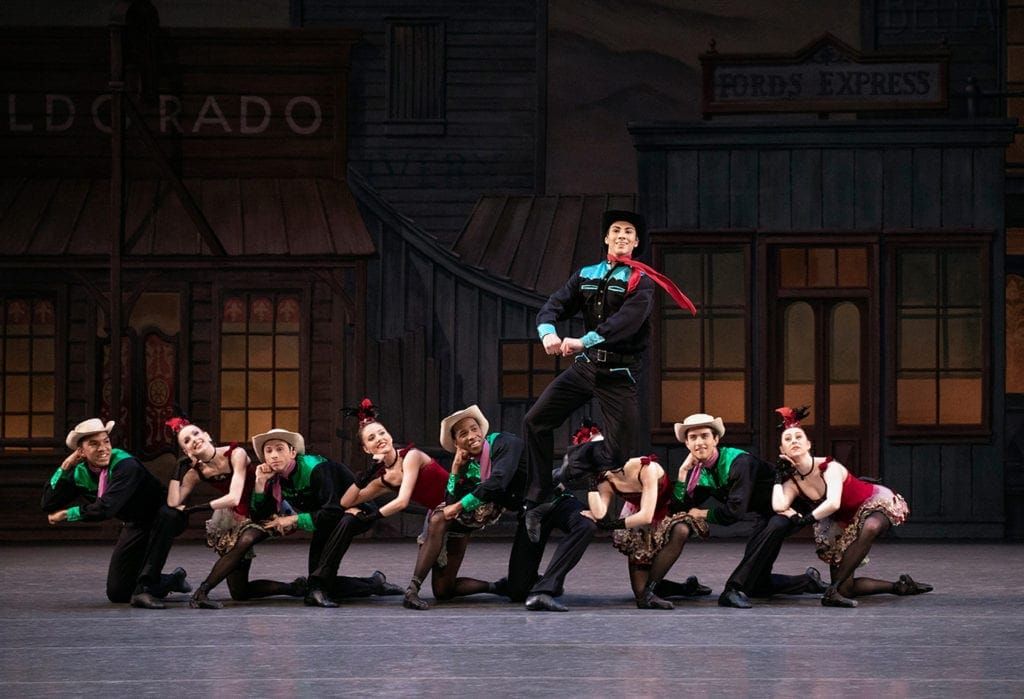
"Western Symphony", "The Unanswered Question", "Tarantella", "Stars and Stripes"
New York City Ballet
David H. Koch Theater
Lincoln Center
New York, New York
October 3, 2023
The bright, generally upbeat program of Balanchine works choreographed to American music was conducted with a brisk, precise, and infectious verve by Andrews Sills, who made the folk songs of “Western Symphony” and the familiar marches of John Philip Sousa used in “Stars and Stripes” seem irresistibly fresh and infectiously bouncy.
“Western Symphony”, for all its frivolity—it could be called “Petipa on the Prairie”, with its formal corps evoking sagebrush and tumbleweed instead of roses and fountains, is a rigorously constructed ballet, and got a rousing performance. The opening movement, danced by Olivia MacKinnon and Gilbert Bolden III, was a kaleidoscope of color and pattern and the frisky pas de deux had a real arc, as MacKinnon’s frisky dance hall girl grew more and more confident. Bolden is a remarkable dancer, who is both a self-effacing, devoted partner and a swaggering bravura dancer. He was wonderful as the soaring cowboy, twirling his invisible gun while almost winking at the audience.
Indiana Woodward and Jovani Furlan danced the Reader’s Digest version of “Swan Lake” with a deadpan obliviousness which was very funny; Woodward’s attitude turns which replaced the Italian fouettés were smooth and creamy, fortunately without the wobbles of the previous performance. Woodward’s little jumps into Furlan’s arms were bouncy and absolutely fearless, and Furlan was a magnificently pragmatic Siegfried, happy with the four little swans when Odette disappeared.
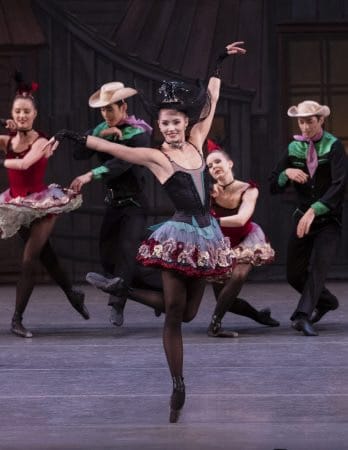
Fortunately, they both reappeared, happy at last, in the glorious finale, led by Unity Phelan as the woman with the gorgeous hat and Roman Mejia as the hottest cowboy on the plains. Phelan looked like she was having the time of her life as she roared through the choreography, showing off some magnificently centered fouettés. Though she danced with her usual elegance, her cool refinement vanished in the flurry of that infectious music and the fast, joyful choreography. Mejia was in his element, tossing off some seemingly impossible jumps and turns with an irresistible warmth; even a turn that didn’t quite make it became a joke to share with the audience. He turned hIs pure physical joy into a gift to the audience.
There is little joy in “The Unanswered Question”, where a desperate Everyman (Harrison Coll) vainly tries to reach the unattainable in the form of a mysterious woman who never touches the ground (Sara Adams). Coll was powerful in the weighted, crawling movements Balanchine made for the modern dance trained Todd Bolender. Adams was impassive rather than mysterious, but the eerie, uneasy music and the mysterious darkness cast their spell and the impressively coordinated partnering of the four men in black (Bolden, Preston Chamblee, Christopher Black, and Alex Knight) made her seem to float. They certainly deserved their separate curtain call.
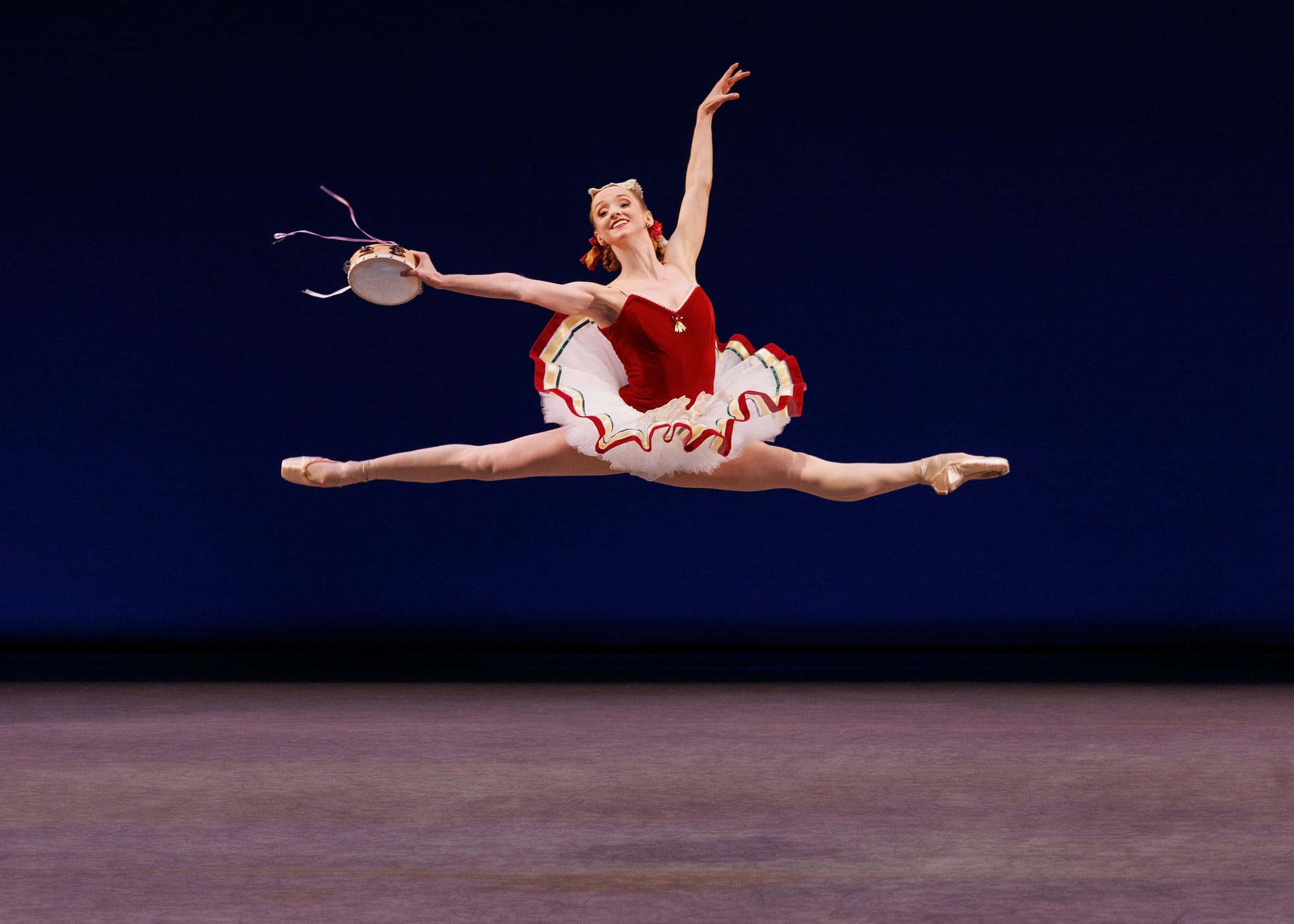
Emma von Enck and Sebastian Villarini-Velez certainly deserved their curtain calls in “Tarantella”, Balanchine’s non-stop romp to Louis Gottschalk. Von Enck, who had such a memorable debut in “Rubies”, brought the same bounding joy and crisp articulation to “Tarantella”; her pirouettes with her tambourine and her insouciant head kicks were pure adrenaline. Both dancers had a wonderfully witty timing, and seemed to enjoy their dance-off.
“Stars and Stripes” was yet another shot of adrenaline, but the audience never flagged, as the dancers charged through it. Erica Pereira, in the first movement had a lovely jump, though the usually show-stopping hops on point with one leg held above her head, barely made an appearance. Emily Kikta danced with a luxurious authority in the second movement, pawing the ground and almost caressing the air with her trumpet, and leading her corps in the series of triumphant emboîtés; they looked as if they had pranced over from one of Petipa’s glorious constructions.
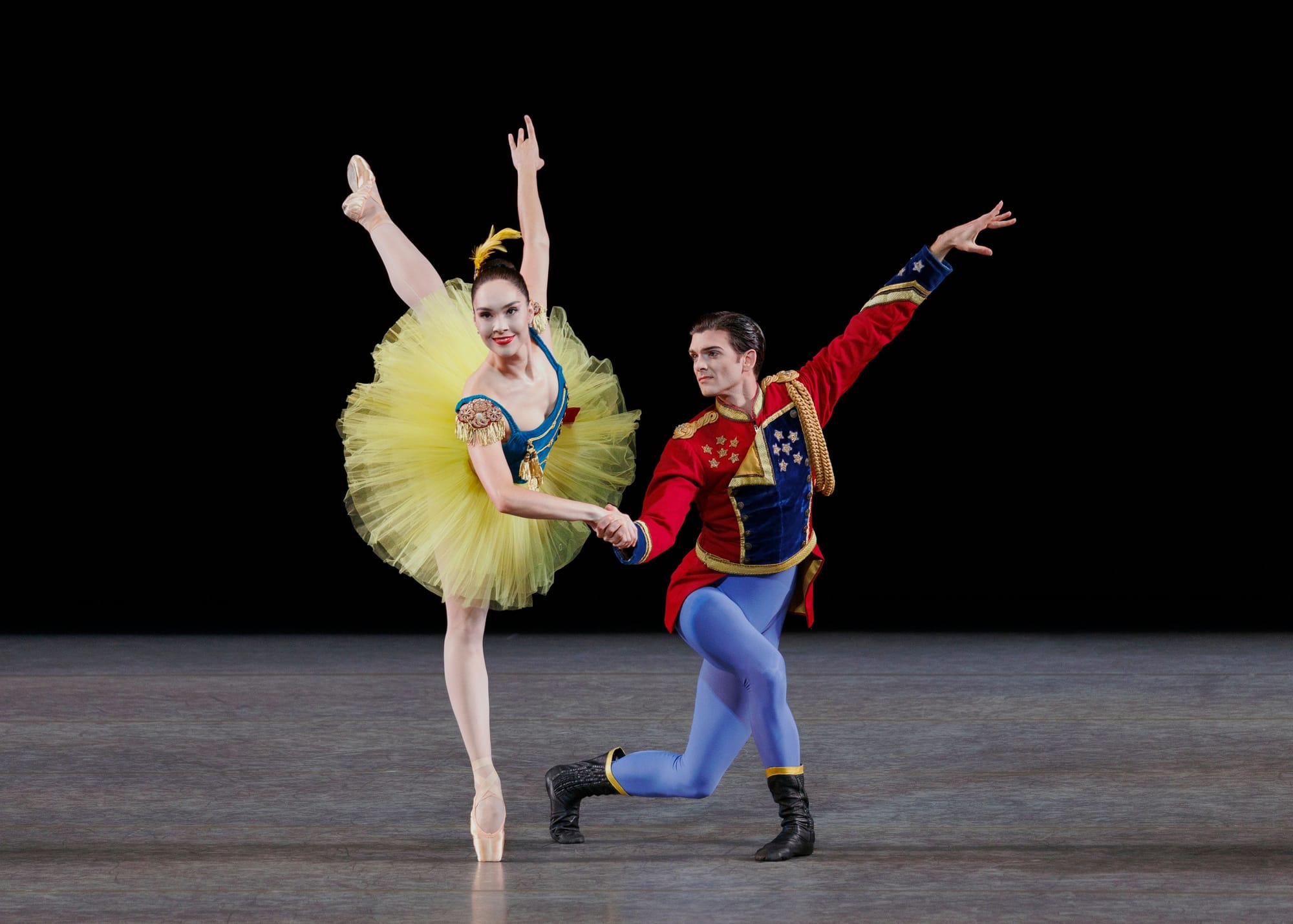
Daniel Ulbricht led the male cohort, as he has for almost twenty years. His jumps have lost a bit of height, but his entrechats and turns into plié were as precise and fast as ever. He has gained a snappy authority and seemed to relish being in charge; his final salute to the audience seemed to have a tinge of farewell, but that may only reflect my concern that I may never see him dance it again. That fear certainly doesn’t apply to Mira Nadon or Peter Walker, both dancing the pas de deux for only the second time. They are both tall dancers, and the fast footwork and the partnering was a bit careful, but both danced with a fine mixture of seriousness and wit without being copy. Walker, especially, seemed to enjoy the chance to romp.
© 2023 Mary Cargill



