Welcome Back
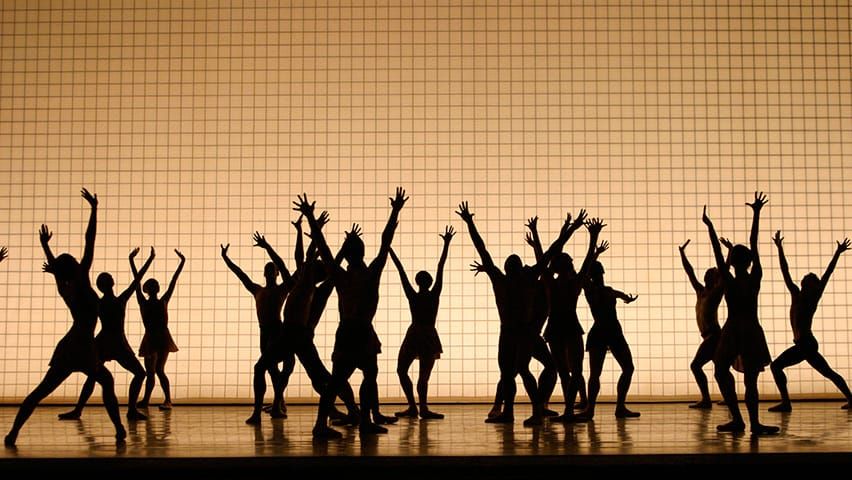
"Tschaikovsky Piano Concerto No. 2", "Duo Concertant", Glass Pieces"
New York City Ballet
David H. Koch Theater
Lincoln Center
New York, New York
September 17, 2024
NYCB’s opening night, called “Masters at Work” featured ballets by Balanchine and Robbins and could have been called “Masters at Play”, since the choreography (and the dancing) looked effortless, as if it just poured out of these masters while listening to the music. The oldest work, “Tschaikovsky Piano Concerto No. 2”, began life as “Ballet Imperial” in 1941. It has shed its regal trappings, though the majestic music and the formal choreography can't help but hark back to St. Petersburg. The shiny newish costumes though (designed by Marc Happel in 2019) seem to look forward to a more modern commercial approach, since they were created, to quote the program “with with generous support of Swarovski”, and sports thousands of crystals.
The dancers, Tiler Peck, her cohort Chun Wai Chan (a debut), and Olivia MacKinnon needed no artificial glitter, and the corps looked eager, engaged, and very well rehearsed, dancing the opening promenade with a relaxed yet regal air. Unfortnately, the thousands of rinestones the dancers wore couldn't stop the grey-blue costumes from disappearing into the grey-blue background so the white and gold aura of the choreography didn’t gleam as much as it can in different surroundings. This misty atmosphere, however, worked well in Balanchine’s haunting homage to Petipa’s many vision scenes, as the lone male caught glimpses of his beloved among those undulating beauties. It gave the scene a mysterious underwater feel, as if the corps were water nymphs hovering around their male visitor, nobly danced by Chan.
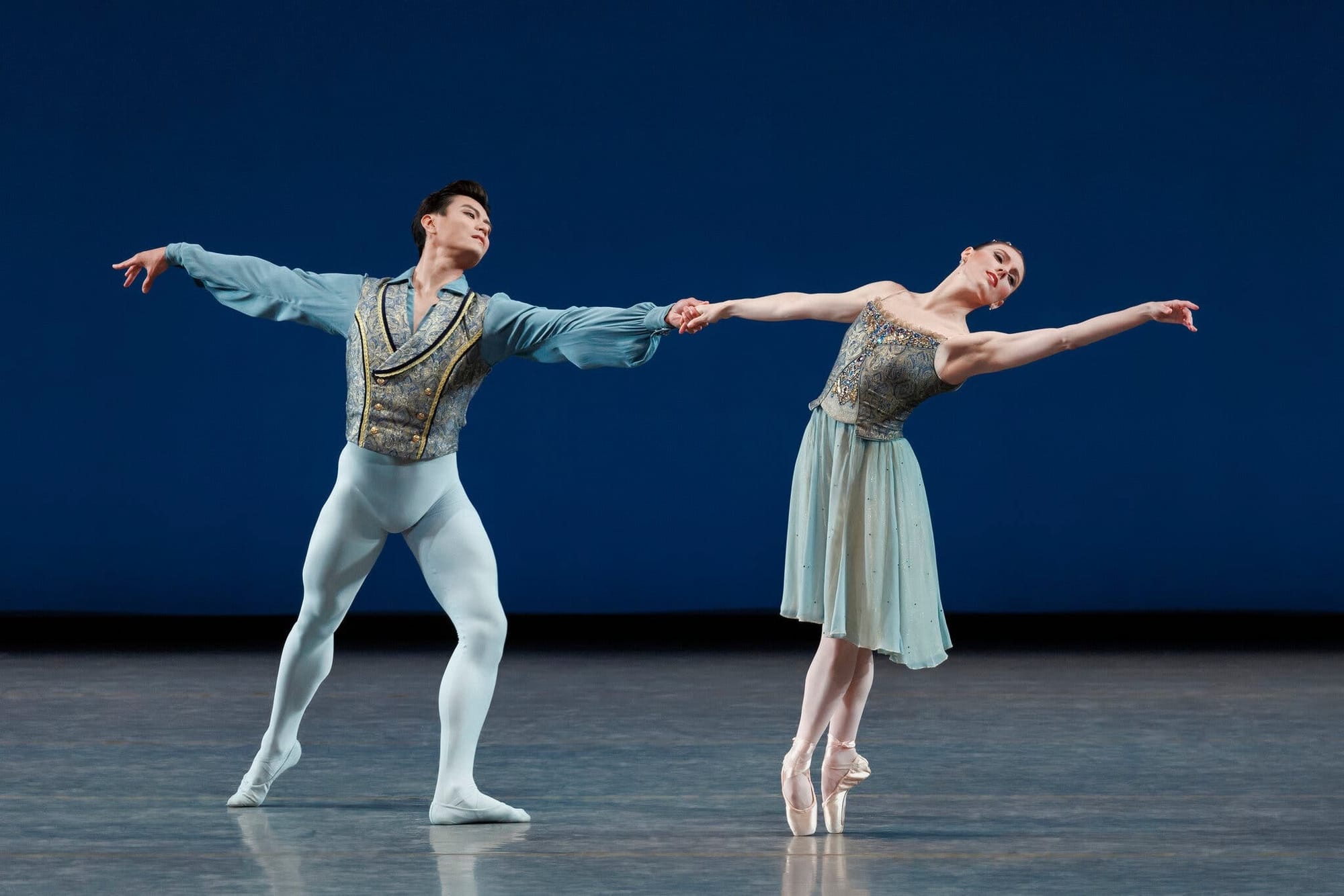
The ballet, of course, has no narrative; it is a like a series of lyric poems inspired by the memory of all those great Petipa ballets. The dancers are not characters but evocations of moods and their job is not to tell a specific story but to embody the grandeur of those magnificent old ballets. Peck danced the breakneck entrance, with those turns stopping on a dime, fast footwork, and triumphant arabesques, with a quiet, unexaggerated authority, riding on the music, her arms floating effortlessly into perfect shapes. She danced with her usual clarity and deceptive speed; she can move into a position so quickly it registers like a photograph which merges into another shape with ease. Her fouettés in the finale were almost inhumanly controlled, as if she could stop at any time to listen to the music.
Chun was equally elegant and his dancing, full of fast little beats and floating entrechats which he tossed off with ease, was smooth and gracious. But his stage presence was even more impressive; he is a generous dancer, focusing on his partner, and able, with a glance or a gesture, to bring that noble, imaginary world, full of impossible visions and grand celebrations, to life.
Olivia MacKinnon danced the soloist role. She is smaller and sprightlier than the “I’m the Lilac Fairy’s cousin” types usually cast, and lacked some of the command more imposing dancers can give the role. She had a quiet confidence though, and sailed through her tricky opening turns effortlessly, and the pirouettes whipped back and forth with ease. Davide Ricardo and Jules Mabie were solid in the pas de trois, as they supported MacKinnon’s arabesque while leaping around her. They looked immaculately rehearsed, jumping in unison and landing as if they were dancing on cushions. Their deferential and generous nobility echoed Chun’s and reinforced the exalted world the ballet created.
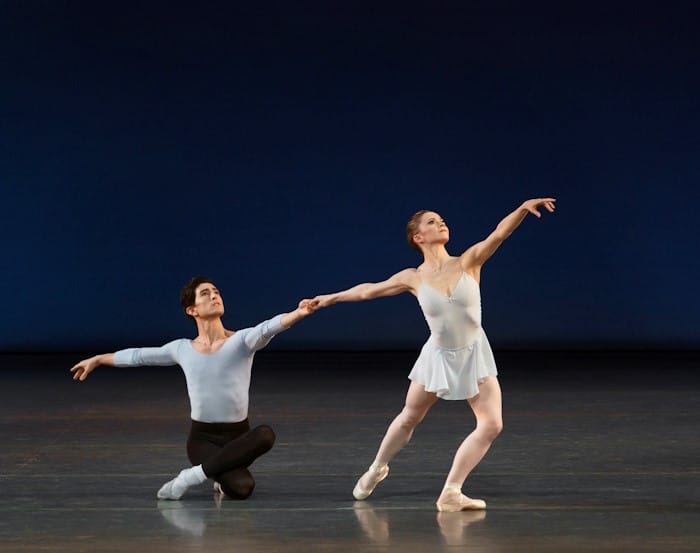
Balanchine’s “Duo Concertant”, with its focus on the Stravinsky music, has its own rather odd world, where the two dancers must emerge from the music, played on stage by the violinist (Kurt Nikkanen) and the pianist (Elaine Chelton). Megan Fairchild and Anthony Huxley were the anonymous couple; the opening, where the dancers stand behind the piano listening to the first movement, is a special challenge, as the dancers have to project their thoughts and feelings without a “One, two, three, turn head right” approach. Fairchild projected a cheerful, uncomplicated air, as if she loved listening to the music, which Huxley seemed to be trying for a more complex approach, but tended at times to look down, as if he were waiting to dance.
Once the dancing started, Huxley shimmered, skimming through the steps with a light and airy ease. Fairchild, too, was at her best in the playful, “let's pretend I am a violin” bits, and moved with an expansive grace. Their youthful cheer, however, couldn’t merge into the odd melancholy of the ending, where the woman disappears into the darkness, leaving only her hand as a symbol of some lost ideal. Huxley’s polite reticence did not open up into the almost painfully exposed emotions of a man reaching for his impossible dream, and most of the eerie melancholy came from Nikkanen’s plangent, piercing violin.
There is nothing plangent or piercing about Jerome Robbins’ “Glass Pieces”, the energetic 1983 exploration of selections of Philip Glass’s minimalist music. Its pulsating energy is always invigorating, though the opening, so bracing and new in its early performances, with the dancers striding back and forth in mismatched practice clothes, has become almost a cliche. The three angelic couples emerging from the mass (Dominika Afanasenkov with Aarón Sanz, Sara Adams with Davide Ricardo, and Meaghan Dutton-O’Hara with Preston Chamblee) floated through the music; Afanasenkov and Sanz were especially impressive with their expansive, effortless extensions.
Unity Phelan and Adrian Danchig-Waring were the middle couple, rather anonymously oozing through the music as the dark shadows of the dancers behind them cast their usual hypnotic spell. Danchig-Waring’s intense concentration set off Phelan’s cool control, though the dance seemed a series of beautiful, unconnected shapes. There were plenty of unconnected shapes in the final scene, as the cohorts of the predominantly male corps merged and separated to pounding drums; the stage seemed awash in testosterone.
© 2024 Mary Cargill



