Voices and Visions
"Voices", "In Memory of...", "Diamonds"
New York City Ballet
David H. Koch Theater
New York, NY
May 8, 2026
The evening’s performance had works by Ratmansky, Robbins, and Balanchine, and though none showed them at their finest, it did show that craft and imagination, plus very good dancing, can be rewarding. Ratmansky’s “Voices” is rather austere opening work, an experiment in movement to pure sound without melody or clear rhythm; ironically the biggest applause went to the men dancing standard show off steps to silence. “In Memory of …” is Robbins’ 1985 meditation on death with lots of girls in chiffon doing chiffony things, which avoids sentimentality thanks to the astringent Alban Berg score. Balanchine’s “Diamonds”, the third act of “Jewels”, also has a lot of girls who wear longer Maryinsky tutus and move in elegant if not always interesting patterns, surrounding one of Balanchine’s lushest and most luminous pas de deux.
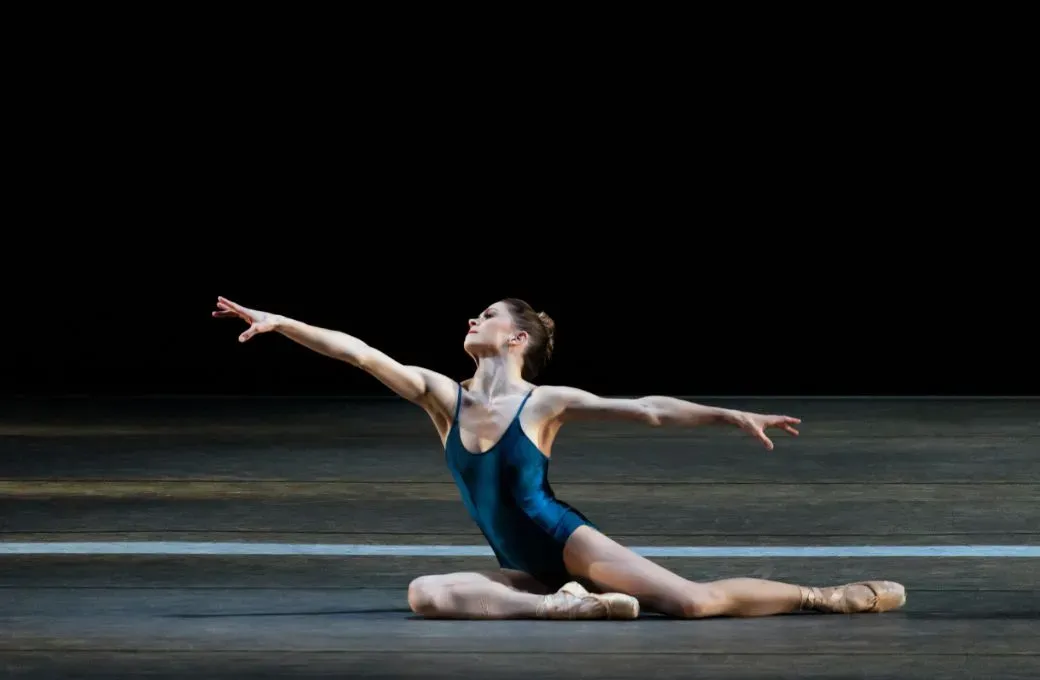
“Voices” is set to the experimental music of the Austrian composer Peter Ablinger, and uses a piano to match the cadence of recordings of six female voices; the actual words can rarely be heard or understood; the choreography is inspired by the sounds, not the text. Five dancers (Emily Kikta, Megan Fairchild, Kloe Walker, Ruby Lister, and Lauren Collett) have solos, and there are five men (Owen Flacke, Charlie Klesa, Davide Riccardo, Sebastián Villarini-Vélez, and Peter Walker) who maneuver the women on and off the stage and provide a jolt of male power in brief interludes between the solos.
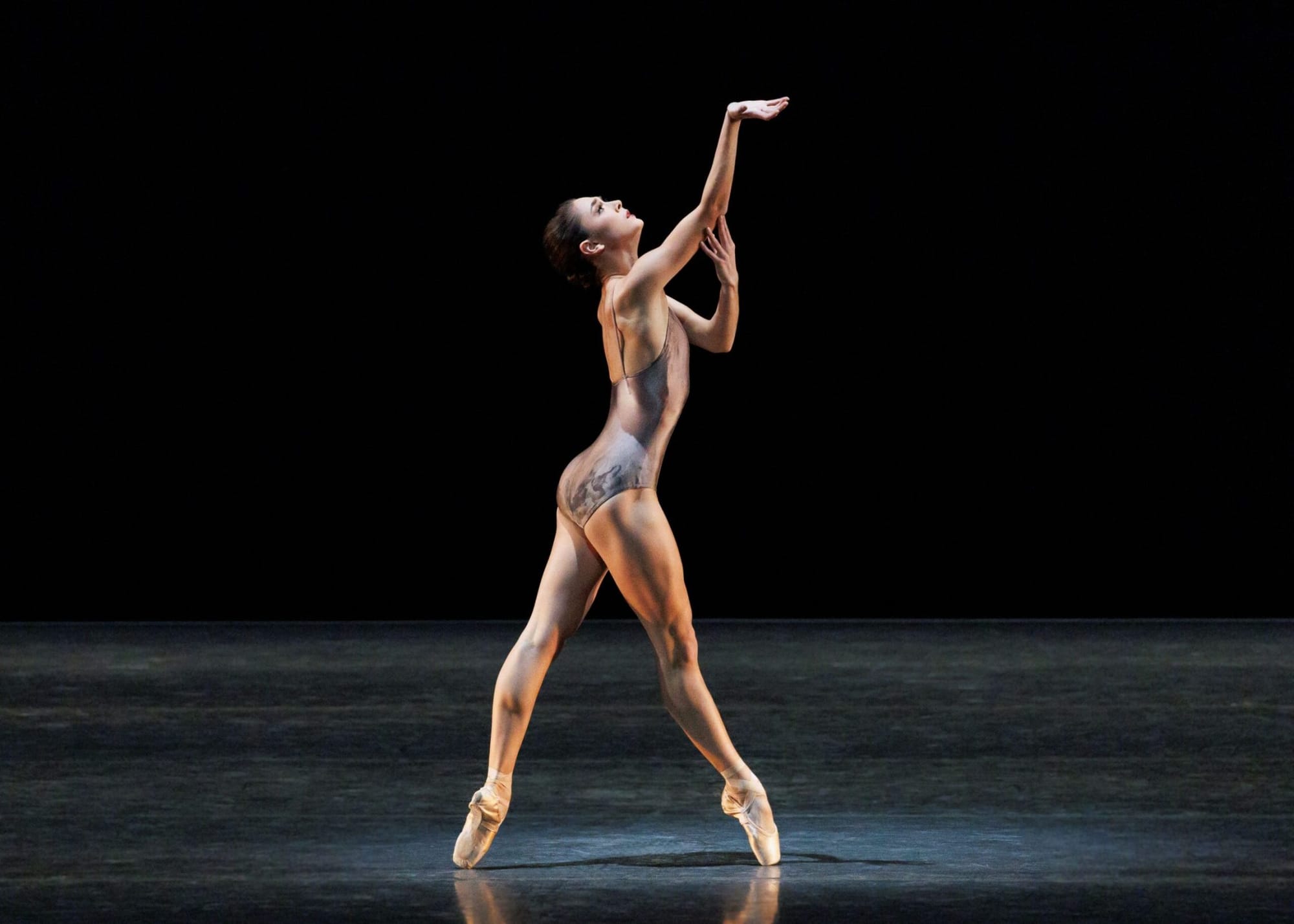
The solos are jagged, choppy, and full of odd movements, and yet coherent, tied to the sounds of the voice and piano. Kikta, in the first solo, danced with strong leg kicks and expansive arabesques. Fairchild, in the role she originated, had a piquant quality, with little sideways jumps and skipping moves, alternating with limp, floppy arms; she seemed to enjoy the chance to experiment with non-classical steps. Walker and Lister danced the next two solo, each with a fierce abandon. Collett’s final solo had a wary, fragile quality, matching the wavering tones of the speaker, the Japanese actress Setsuko Hara. She ran, crouched down, curled into a ball, and finally sank into Villarini-Vélez’s arms.
The final voice, the abstract painter Agnes Martin, pulled together all the dancers, who formed shifting shapes, like moving sculptures, and ended with her saying clearly “I object to being called a mystic. You’re not a mystic when you respond to beauty.” “Voices”, with all its sharp, brittle, unconnected moves, and astringent sounds, is not a beautiful work nor an easily accessible one, but its complexity, and even its remoteness, are fascinating to watch.
“In Memory of…” is not remote, though it does seem to aspire to complexity, especially with the rather coy “…” in the title. Robbins choreographed it in 1985, just two years after Balanchine’s death, to Alban Berg’s “Violin Concerto”, which he wrote to honor the death of the 18 year old daughter of Walter Gropius. Robbins’ work alludes to this; a youthful girl in pink chiffon (Alexa Maxwell) dances with a young man (Gilbert Bolden III) and a frisky group doing casual folk dances until a more menacing man appears (Ryan Tomash) and takes her to a part of Heaven full of ballet dancers.
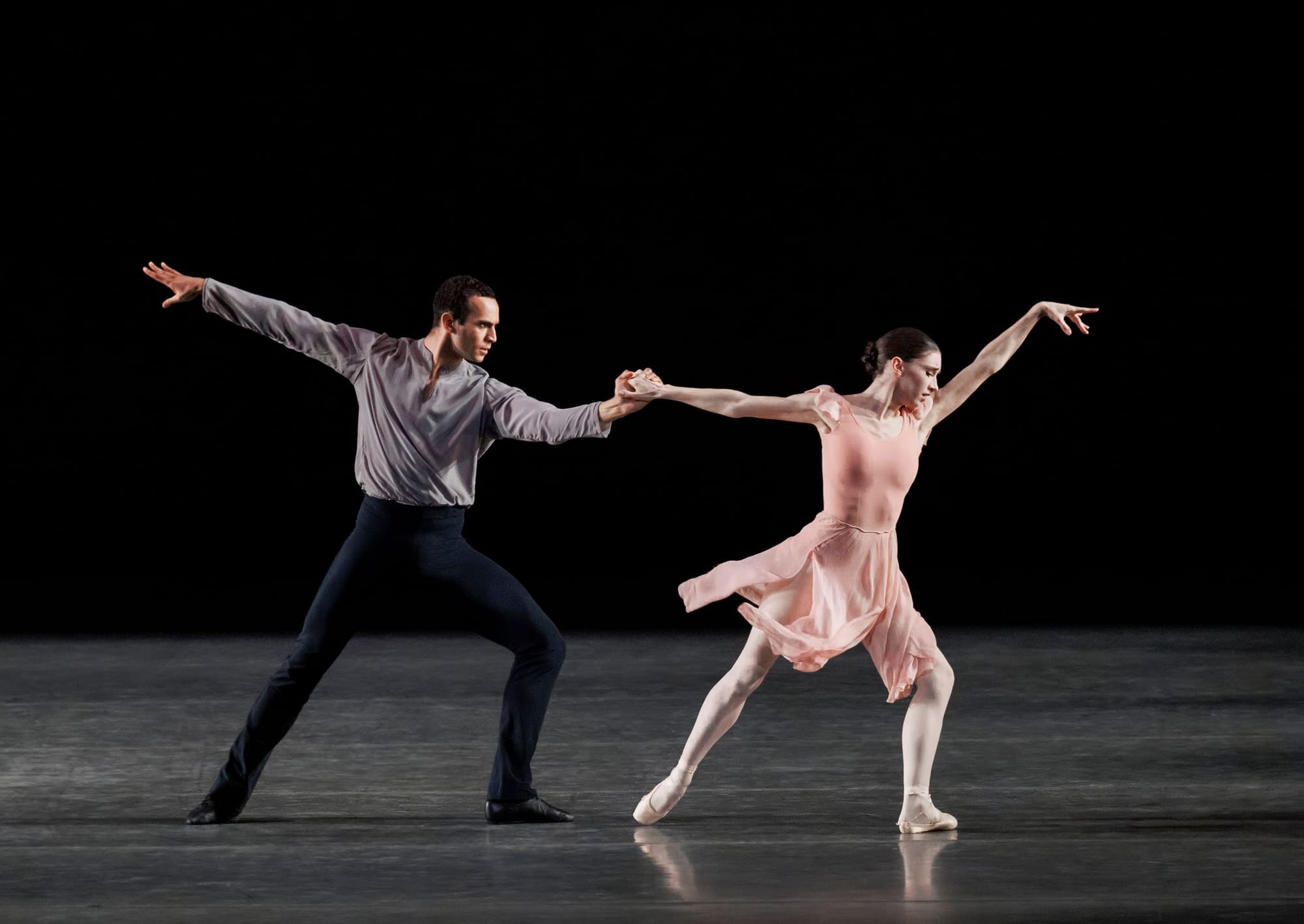
Maxwell made a compelling victim, airy and fragile. The opening pas de deux with Bolden was full of gently, skimming lifts and brief hints of unease, as they danced back to back. Bolden, returning from a year-long injury, was a discrete, protective presence; he can certainly be exuberantly flamboyant when that is appropriate—his first movement in “Western Symphony” was a raucous delight—but can melt into the music and the background when that is called for, and he was a generous partner.
Tomash, as the symbol of death, was not discrete, he was powerful and commanding, grabbing Maxwell, swinging her around, controlling her movements, forcing her into a series of incredibly fast turns. Tomash gave his movements a desperate, greedy anger, as if he were Pluto going after Persephone and Maxwell’s final surrender felt both elegiac and tragic, as if Spring really had vanished.
The third section had the cast, now in white move with stately calm across the stage, led by three men who do rich, controlled, deep pliés, a simple but majestic move. Maxwell, now in white with unbound hair, joined the throng, and the ballet ended with her being lifted by both Bolden and Tomash; yes, it was sentimental but the dancers’ passionate sincerity made it profoundly moving.
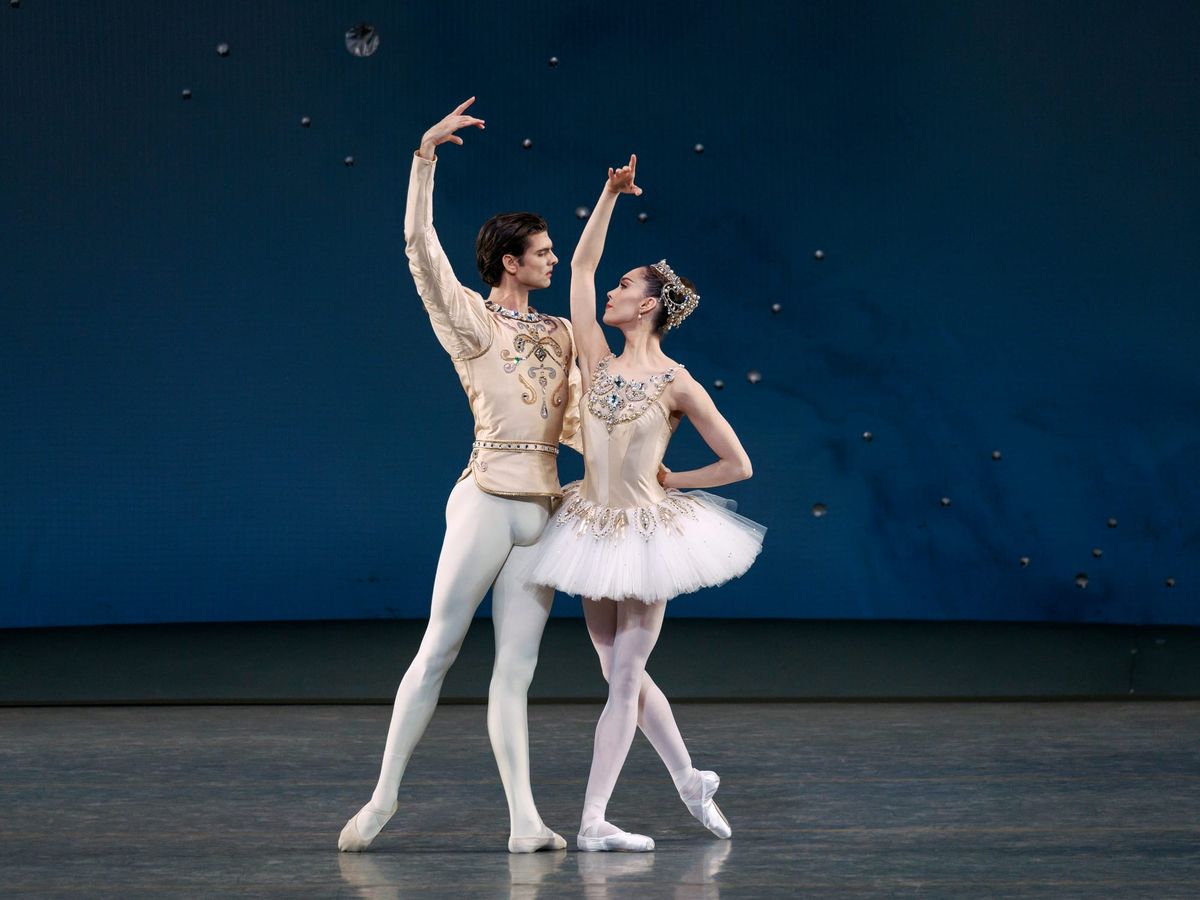
The audience burst into rapturous applause when the curtain opened on “Diamonds”, stunned by the new tutus’ almost electrified sparkles; though the costumes do resemble Las Vegas on the Hudson, they did grad the audience’s attention. The lengthly introduction, with the corps tiptoeing through Tchaikovsky’s melodies, moved at a fine clip and then, with no buildup or fanfare, Mira Nadon and Peter Walker appeared opposite each other on the empty stage, walking slowly towards the center with little hesitant pauses, and the stage and all its glitter seemed to vanish, leaving only these two people and Tchaikovsky’s plangent music.
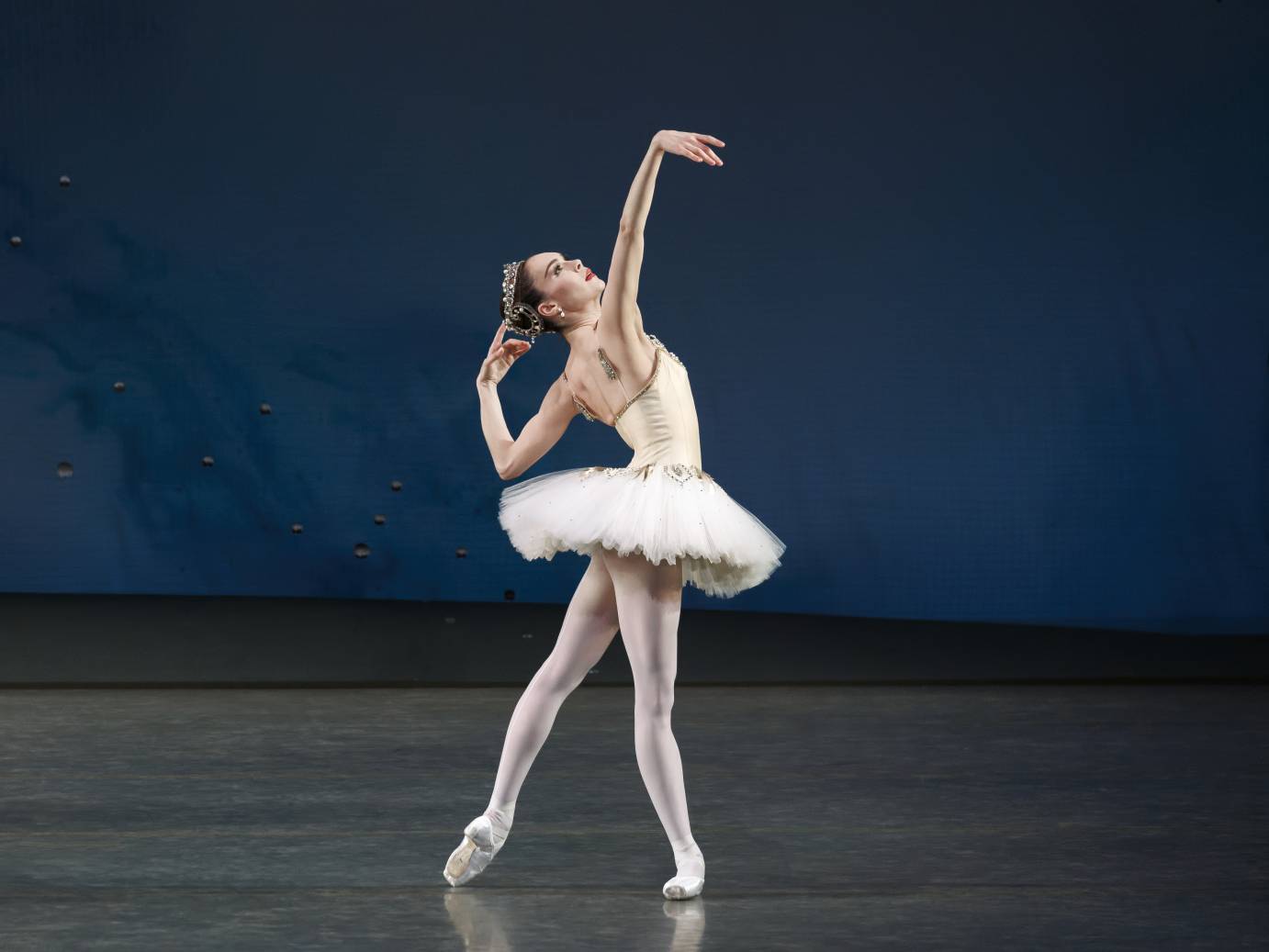
Nadon’s magic is hard to describe—other dancers are just as beautiful, have equally long legs, move with just as much plush confidence, but her air of dancing in the moment, of breathing the music, of radiant spontaneity, of dancing only for her partner, make her performances unique and breathtaking. She was a cooler Diamond than some, more of a slightly tentative Aurora than a tragic Odette, and she seemed to calibrate her mood to the music rather than concocting a dramatic through line, which made every moment, every move seem seismic.
Walker was a courtly partner, catching her every mood. His solo had a gracious flow, his turns a la seconde were solid, and his jumps were elegantly soft—he was going for style rather than flash. Nadon, following the music, was bright and happy in the finale, showing off her luxurious line. The final polonaise, so evocative of “The Sleeping Beauty”, with its mass of triumphant corps, was a vision of a perfect world.
© 2026 Mary Cargill



