View from the Desert
View from the Desert

"Rhythm of Rajasthan"
Peter Norton Symphony Space
New York, NY
January 14, 2011


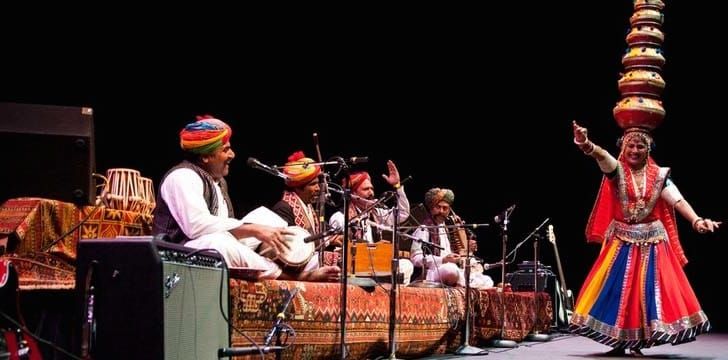
The World Music Institute, an organization devoted to presenting traditional music and dance from around the world, sponsored a visit by folk singers (and one dancer) from the area of Rajasthan.  The very interesting program notes explained that western Rajasthan is probably where the gypsies originated, and it was very interesting to note the connections.  There was a gracious, informal feel to the evening, as the four musicians sat on a dias, and seemed to sing and play spontaneously.  The songs had a plaintive, keening edge, even when the infectious music was at its most rhythmic--many in the audience didn't resist the urge to clap along, reinforcing the campfire feel.

There were two dances, both performed by Suva Devi, an absolutely enchanting performer.  The first, the Bhavai dance, has the dancer doing various tricks (balancing on the blunt end of a sword, hopping on a pair of upturned glasses, and skipping around in a pie plate--not all at once) while carrying a pile of pots on her head (I counted seven); all these competitive tricks were danced through without looking gymnastic.  Petipa must have been familiar with this dance when he choreographed "La Bayadere", for there are clear echoes of this in the charming Danse Manu, where a dancer, accompanied by two young girls, balances a pot on her head--obviously Petipa made some concessions to Western abilities!

The second dance was the Kalbeliya Dance, a spinning dance which, according to the notes, was used to charm snakes.  It certainly charmed me, with the colorful costume, and the swaying, sensuous movements, combined with some unique feats--at one point the dancer did a back bend and picked up two rings with her eyes, something I don't expect to see soon.   Unless New York is lucky enough to host this gorgeous dancer again.

copyright © 2011 by Mary Cargill

Read more

All That Worth Protecting

All That Worth Protecting


“When the Water Breaks,” “Monarcas,” “Floes,” “Symbiotic Twins,” “Network,” “After the Rain,” “Asylum,” “Moss Anthology: Variation #5b (2025)”
vildwerk.
New York Live Arts
New York, NY
December 17, 2025


Dance lovers are drawn to dance because of its inherent beauty: visual, musical, and in story ballets, narrative. And it’s no coincidence. Humans are creatures captivated by beauty, whether born of nature or shaped by human effort. And so, when vildwerk., a three-year-old nonprofit with an urgent mission, married an

By Marianne Adams
Complexions: Gorgeous, Stalled

Complexions: Gorgeous, Stalled


“Beethoven Concerto,” “Deeply,” “I Got U,” “Love Rocks”
Complexions Contemporary Ballet
The Joyce Theater
New York, NY
November 25, 2025


Founded in 1994, Complexions Contemporary Ballet’s endurance is to be applauded, and its two-week run at The Joyce Theater is testament to the weight of commitment.  The company bills itself as an innovator, yet Program B, which I saw on this night, revealed that steadfast dedication to creation was more of its forte than innovation itself.  Two

By Marianne Adams
Toxic Masculinity

Toxic Masculinity


"The Winter's Tale"
The National Ballet of Canada
Four Seasons Centre for the Performing Arts
Toronto, Canada
November 14, 2025


The National Ballet of Canada’s 2025-2026 season skews heavily towards newer works with a contemporary style, featuring ballets by Crystal Pite, Will Tuckett, Jera Wolfe, Helen Pickett, Wayne McGregor, Bobbi Jene Smith and Or Schraiber. The revival of Christopher Wheeldon’s “The Winter’s Tale” is the most traditional story ballet of the whole season, which is saying something.

By Denise Sum
Tapping Into It, the Soul of Things

Tapping Into It, the Soul of Things


American Street Dancer
Rennie Harris Puremovement
The Joyce Theater
New York, NY
November 12, 2025


There's something powerful about watching a body create rhythm and sound. Rennie Harris's company’s new program titled “American Street Dancer” offered an entire evening of such flavors in the form of a documentary-style performance that honored the African-American roots of American street dance and celebrated three distinctive regional traditions: Detroit jitting, Chicago footwork, and a now seldom performed on the streets, and dear to

By Marianne Adams


