Vienna nights
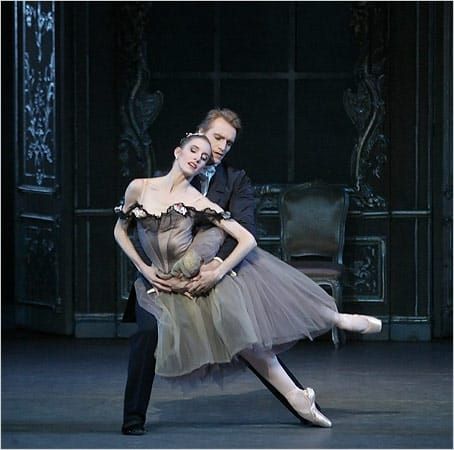
“Liebeslieder Walzer”, “Brahms-Schoenberg Quartet”
New York City Ballet
New York State Theater
New York, NY
May 16, 2006
This all-Balanchine, all Brahms (via Schoenberg’s orchestration of Brahms’ “Piano Quartet in G Minor”) evening had more variety, morerichness, and more beauty than any comparable two hours I can think of. “Liebeslieder Walzer”, that grandmother of all piano ballets, remains one of the most subtly dramatic works of art ever made. Four very well-off couples from 19th century Vienna waltz with each other for an hour, and by the end the audience feels as if it knows every emotional detail of their lives — at least it does in a well-danced version, which this, by and large, was.
It was a veteran cast, with the exception of Tyler Angle, who looked like he was born to wear white gloves. He danced with Miranda Weese, who had the Jillana role. In earlier performances she had tended to perform pretty steps in a pretty way, but now she has developed a mysterious and restless sadness that gave depth and resonance to the slightest movements she made.
“Liebeslieder” is all about gestures, especially in the more decorous first half, and Nikolaj Hübbe made simply offering Wendy Whelan his hand a more eloquently romantic statement than many complete evenings of Siegfrieds or Albrechts. It was as if the air in the theater were a harp string for him to pluck, a sound which continues to resonate. With Whelan, he danced a perfect portrait of mature and contented devotion, two people so perfectly in tune with each other than they moved as one.
Kyra Nichols returned to the Verdy role, and her experience and musical intelligence still gleam, her dancing seems ageless. She doesn’t, of course, have quite the flexibility of earlier years, but her développé has a magisterial sweep. Nilas Martins was her understanding partner. Darci Kistler, another veteran, danced the Diana Adams role, with Charles Askegard. Unfortunately, she seemed to be overacting, as if compensating for her technical difficulties, and spent much of the ballet focused on the audience as if saying “Look as how giddy and gay I can act” rather than dancing for and with the other dancers. It was the only slightly false note in that extraordinary ballet.
“Brahms-Schoenberg” is a more typical Balanchine, four different vignettes providing unrelated but beautiful reflections of the musical movements. Jennie Somogyi’s noble and nuanced upper body and her seemingly innate sense of drama (without any playing to the audience) gave the section a wonderfully elegant flavor, spiced by Ellen Bar’s equally dramatic reading of the Myrthaesque character. Jenifer Ringer brought a smoky, fluid quality to the Intermezzo, and Albert Evans, though seemingly too short to partner her as effortlessly as the choreography calls for, had a dramatic urgency.
This urgency was missing from Yvonne Borree’s Andante. Though she can be an appealing dancer, her general aura of pinched terror made her uncomfortable to watch, and probably difficult to partner. Andrew Veyette coped well, and his solo, though it could have used more weight, had a fine militaristic snap.
The gypsy finale is all snap, and Damian Woetzel made a rare and welcome appearance in the type of bravura role he is so good in, verging on but never descending into parody. Wendy Whelan replaced Sofiane Sylve, and looked like she was having a wonderful time dancing to that infectious music. Her unique brand of lyricism and straightforward integrity doesn’t really lend itself to that sensuous and luscious cream puff of a role, but the vision of her “Liebeslieder” part is so compelling, it hard to see her as anything other than the finest example of warm and dignified feminity around.
copyright ©2006, Mary Cargill



