Variety Show
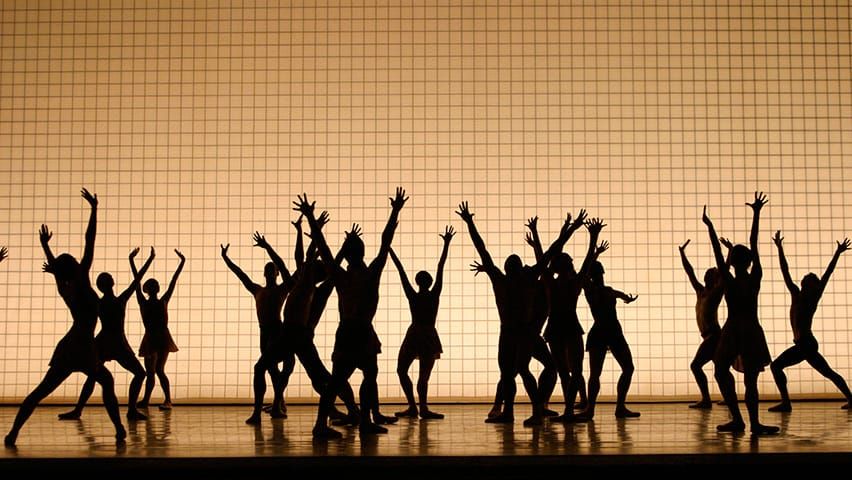
"Scotch Symphony" "Belles-Lettres", "Glass Pieces"
New York City Ballet
David H. Koch Theater
Lincoln Center
New York, New York
April 26, 2025, Evening
This program featured three ballets by three choreographers created in three decades each separated by about thirty years; this variety made for a very lively and interesting evening. Balanchine’s “Scotch Symphony” (1952) is an oblique take on Bournonville’s nineteenth-century Romantic work set to Mendelssohn, Justin Peck’s “Belles-Lettres” (2014) is a neo-romantic swoon set to César Frank, and Jerome Robbins’ 1983 “Glass Pieces” is a hypnotic visualization of Philip Glass’s music.
In Bournonville’s “La Sylphide” the hero James leaves his fiancé Effie to run of into the forest after the magical and enticing sylph, only to accidentally kill her and to watch Effie marry Gurn, a local farmer. In Balanchine’s “Scotch Symphony”, an energetic little Scottish girl (Claire von Enck in her lilting debut) prances through the opening scene, the hero (Jules Mabie) finally enters, bows to her, and runs off to the forest where he meets a sylph (Emma von Enck, another debut) who is guarded by some severe Scotsmen. The dancer formerly known as James and the sylph do get together and dance a lyrical pas de deux, eventually floating off into the wings. The third scene evokes a happy village wedding with lots of hearty dancing by all; thanks in part to the family resemblance of the von Enck sisters, it did seem that perhaps James and the sylph were still off in the forest and Effie and Gurn were going to settle down happily—this does make more sense than the sylph inexplicably turning into a cheerful Scottish lassie. But a logical plot is not really necessary to enjoy the ballet.
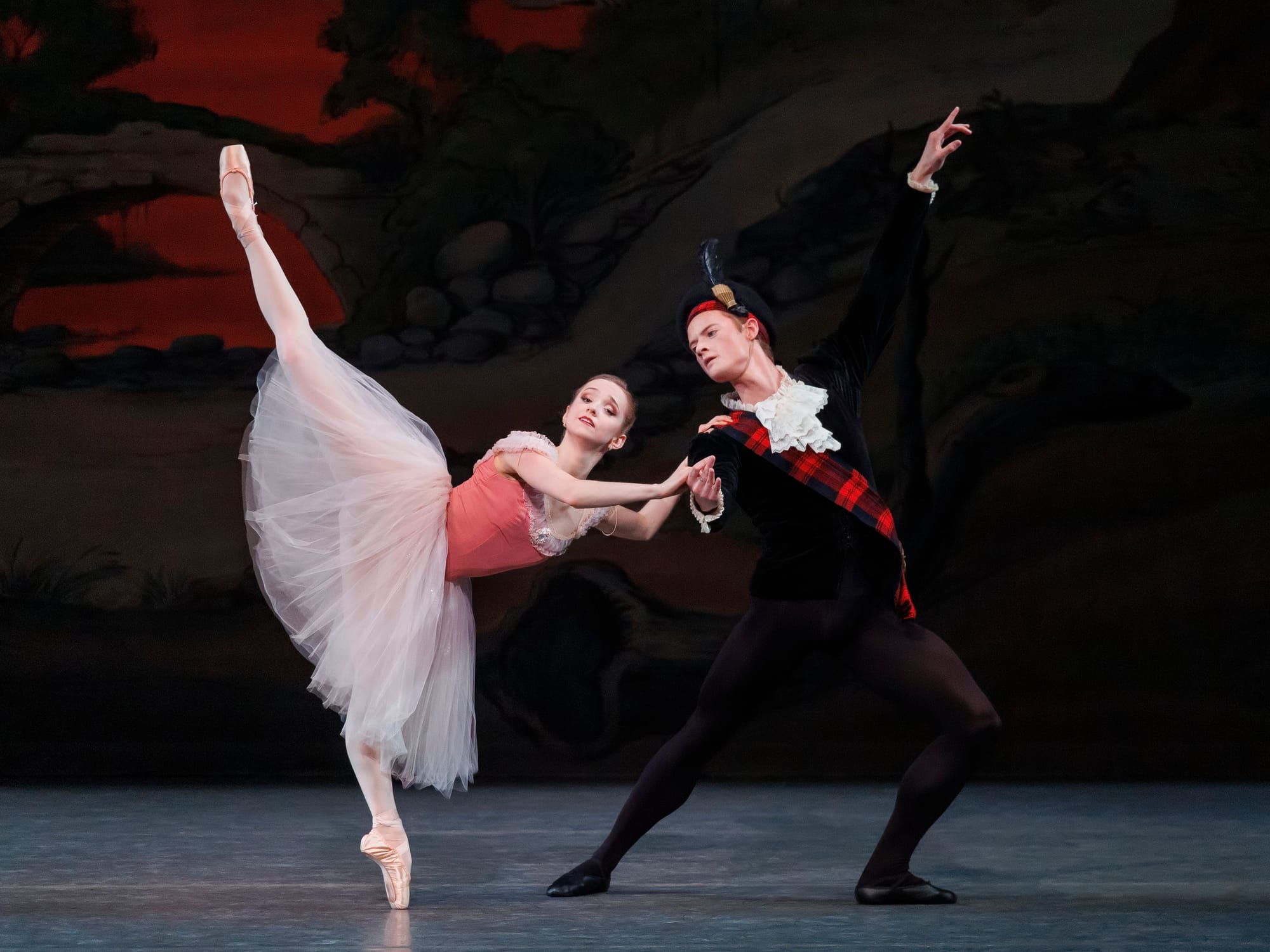
Emma von Enck usually dances with a quick and happy energy (she sparked in “Rubies" and "Danses Concertantes"), so her luminously lyrical, Romantic but unmannered dancing was a revelation. The heart of “Scotch Symphony” is the extended pas de deux in the forest, where she captivates the dancer who is really James. Von Enck shaped her arms and back with hints of the Romantic style, looking for him, beckoning him, even whispering to him in the iconic “Les Sylphides” pose, without any “I am a lithograph” drooping. Her jumps were light and airy, her dancing effortless, and she gave the occasional hints of mime (“stay here”, “go that way”, “go the other way”) a delicate sincerity, as if the pas de deux were a beautiful remnant of a longer conversation.
Mabie, too, gave the pas de deux a romantic richness, with eyes only for his sylph, reacting to her various whims, lost in wonder at this magical creature dancing with him. His solo in the final scene, though, was on the weak side and he didn’t manage the multi-directional turns. But the glorious mist of their pas de deux was a true emotional highlight.
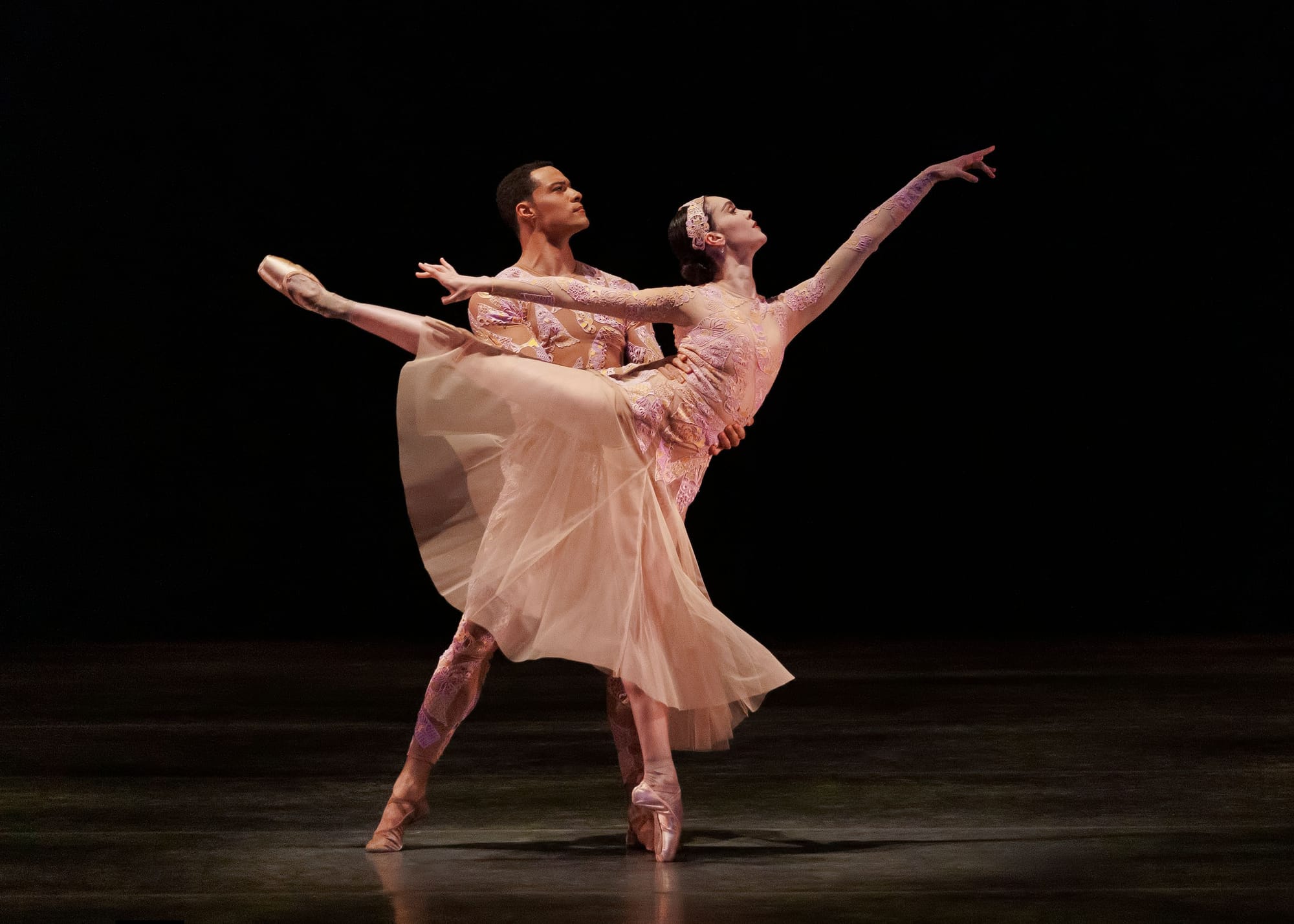
There is much emotion in “Belles-Lettres”, as the four couples dance and swoon to Franck’s tempestuous “Solo de piano avec accompagnement de quintette à cordes” (Stephen Gosling was the pianist). The youthful work was written in 1844 but not published until 1991, and is full of shifting moods which Peck translated into many pas de deux for four couples, watched by one outsider. The work premiered at the annual fashion gala, where big-name designers try their hand at ballet costumes, not always successfully. Mary Katrantzou’s results were mixed—the women’s costumes were beautiful flowing lace dresses but the men looked like they were wearing mottled beige Dr. Denton’s.
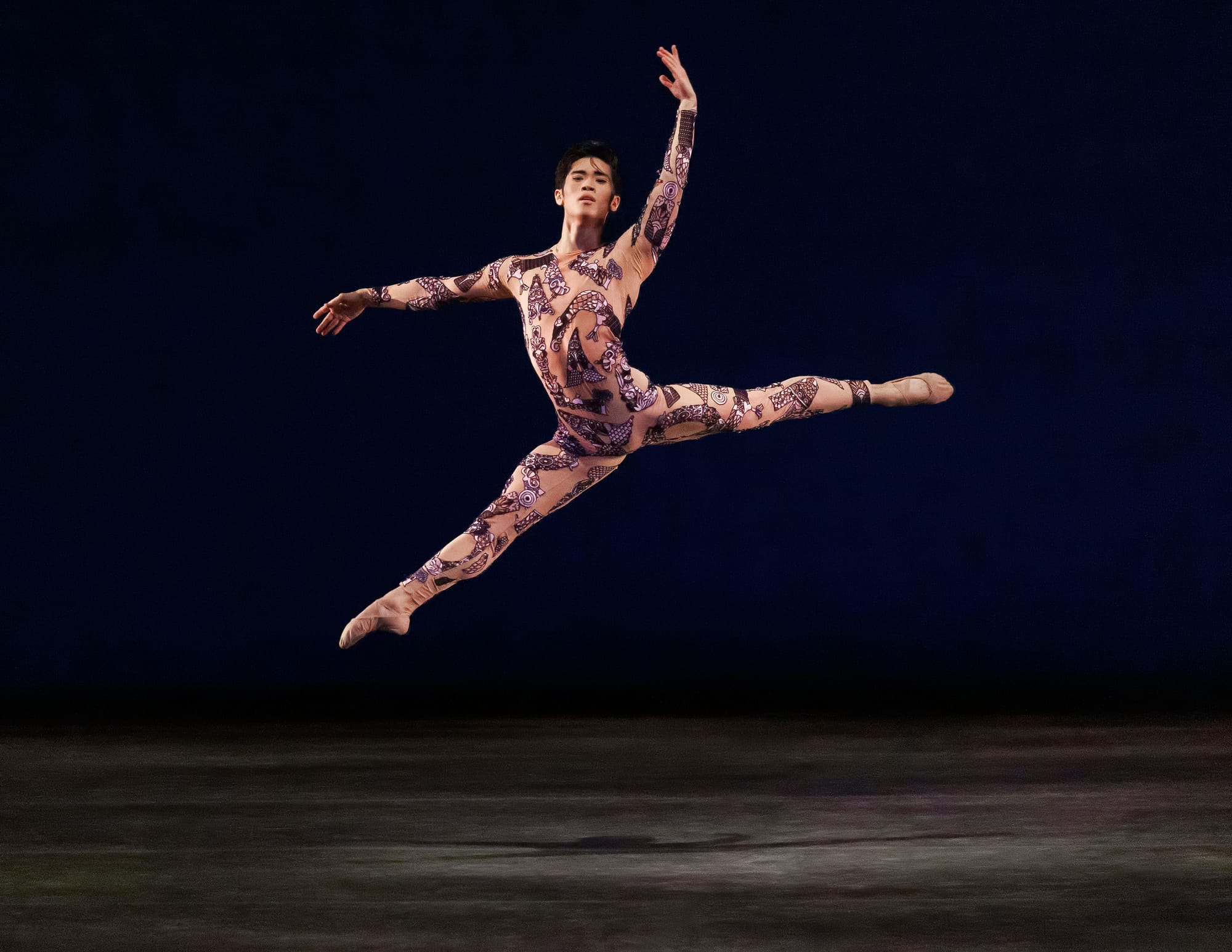
The work owes much to Jerome Robbins, especially the Robbins of “In the Night” with its swooning couples and extravagant lifts. The cast (Ashley Hod with Victor Abreu, Mira Nadon with Preston Chamblee, Mia Williams with Alec Knight, Indiana Woodward with Jovani Furlan, and KJ Takahashi as the man alone) were committed, enthusiastic, and mostly new; Hod, Nadon, Chamblee, Williams, Knight, Furlan, and Takahashi were all making their debuts. Takahashi got the flashiest choreography, full of jumps and turns, which he tossed off with elegant aplomb. He wasn’t just a bouncing ball, he gave the energetic role, which seemed to be a mixture of lonely outsider, Puck arranging human love affairs, and irritating younger brother, a true warmth, though Peck’s hyperactive choreography (he seemed to pack in twice as many steps as there were notes) had an air of nervous energy rather than deep feeling.
This was also true for the many pas de deux, fine though the dancing was. The most impressive moments were the few quiet ones, especially the sculptural opening, where the dancers seemed to emerge from a circle into a starburst. There was little variety in the pas de deux (or in the lighting, which was uniformly dm) and the couples weren’t really characterized; everyone swooned when the music was soft and looked agonized when the music was loud. In a rare quiet moment, the audience got to savor Nadon’s luxurious arabesque and Furlan’s powerful grace but, impressive though the dancing was, Peck gave the dancers a lot to do and little to be.
The dancers in Robbins’ “Glass Pieces”, too, are abstracted, but tied so closely to the intense repetitive rhythms of the music that the audience seemed hypnotized by the moving parts. It looked very well rehearsed and the opening dancers rushed purposefully across the graph paper background like so many anonymous office workers rushing to their desks; their simple, determined striding seemed almost like a city’s heartbeat.
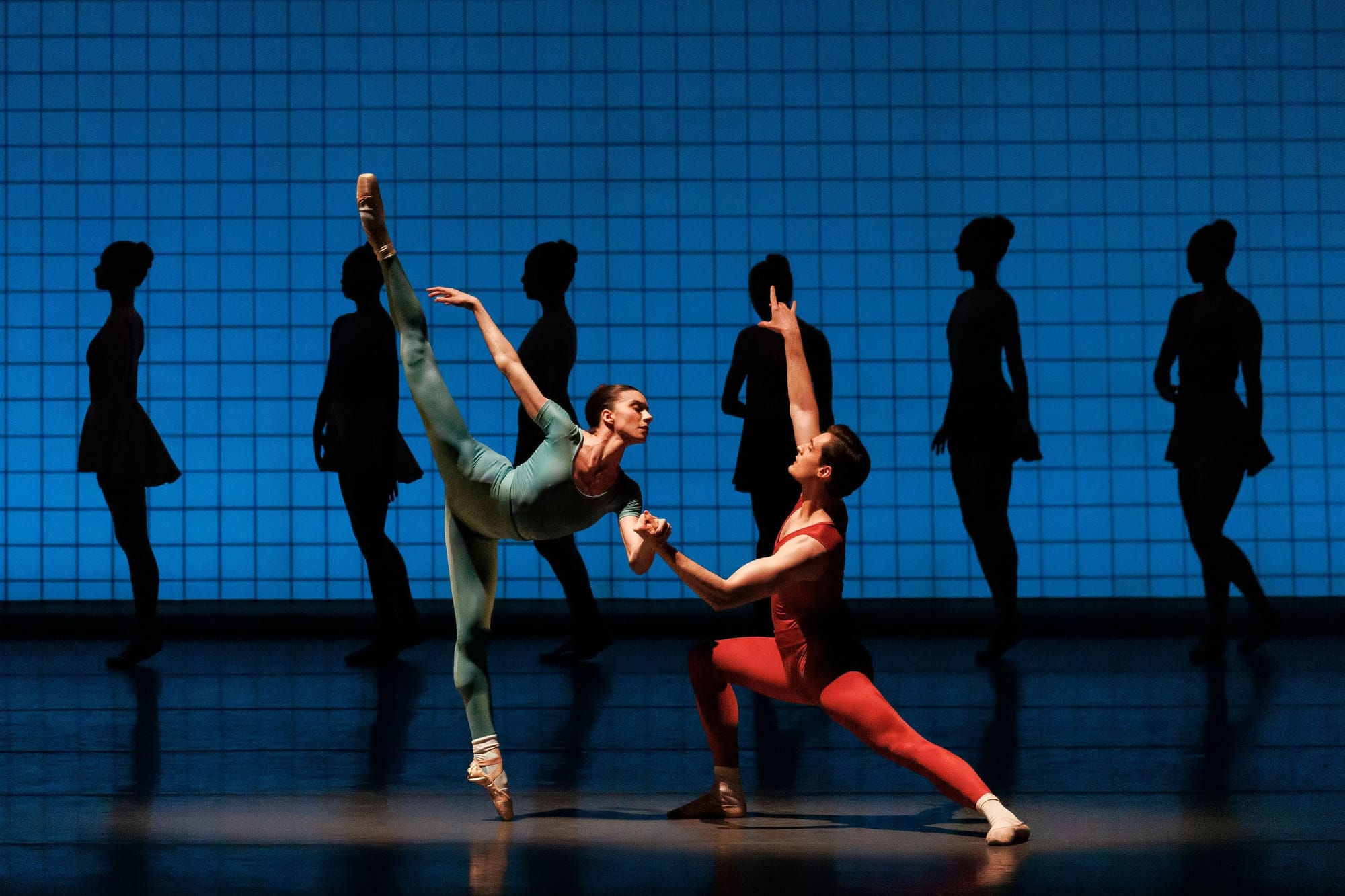
Ashley Hod and Aarón Sanz were the mysterious couple in the middle section, moving with quiet determination in front of the rippling corps. Hod’s almost feral intensity and Sanz’s solid nobility gave the slow, sculptural poses with their odd, goal-post arms and flat profiles a sense of ancient statues coming to life. They danced with a powerful and haunting simplicity. The third movement also has a lot of power, as the male phalanxes pour on. Their odd gait, with the halting strides, was perfectly timed, and the repetition built to an exhilarating climax.
© 2025 Mary Cargill



