Vangeline's Story
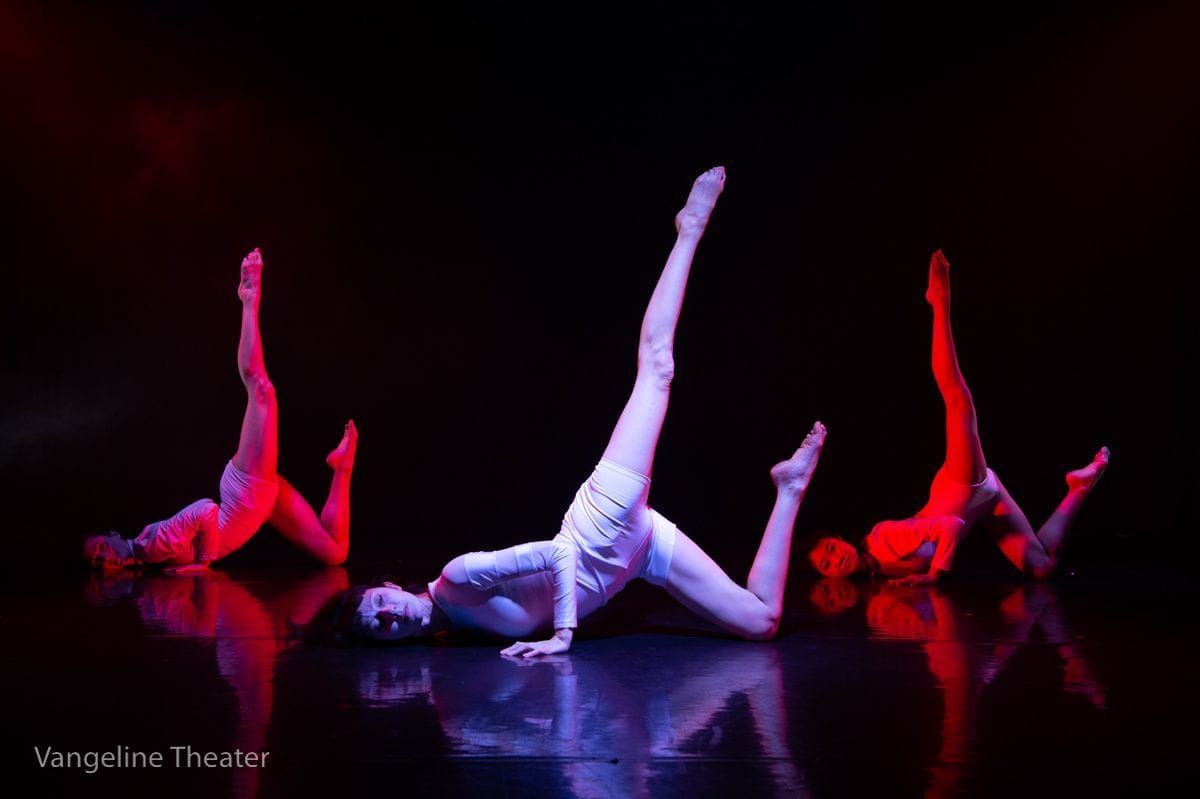
Butoh began in the ruins of post-war Japan as the "dance of utter darkness." Today it is performed and taught all over the world, and increasingly influential in other techniques and styles. No one is more responsible for this than Vangeline, founder and director of the New York Butoh Institute, which marks its 20th anniversary in 2023. After many years on the margins of the dance world, this year she is flooded in fellowships – including a grant from the National Endowment for the Arts to study the brain waves of Butoh dancers.
Vangeline was born in 1970 in France, and came to New York in 1992. She told us her life story recently while sitting and stretching on the floor of her dance studio, near the banks of the Gowanus Canal in Brooklyn.
TP: What was your reason for coming to New York at age 22?
Vangeline: I came to do an internship at the UN — a diplomatic visa, all the doors were open, red carpet. Then two months into it I decided to quit and just become a dancer, to my parents’ great chagrin! I lost my visa, I lost my status, and I became an underground performer. So that was my switch, my commitment, my landing into New York and saying No – this is the life I’m going to lead. And I followed my path kind of stubbornly ever since.
I was born in the country, in Burgundy, in a very small town with nature all around. My childhood was just being in nature, reading books, being very studious, going to school and dance class. My dad is a paleontologist, so we would go for excursions and look for dinosaur tracks. And my mom is a painter and a writer. I feel like nature is in my body – I was raised by the forests of Burgundy.
My dad treated me and my brothers like adults. I was raised with that logical scientific kind of mindset, to analyze and understand things. For a long time I thought I was more of an artist, but now I say No ---it’s so much a part of me, this drive, this curiosity to explain and make sense of things, to rationalize and put into context.
TP: Tell us about your artistic development in New York, after you decided to dance.
V: I was mostly a jazz dancer at that point – a “jazzerina” --- so I auditioned for roles underground, off-off Broadway – burlesque shows, club gigs, commercials, modeling. I was in the underground scene for many years and that was where I wanted to operate. I’m friends with some of those people to this day. The strippers, burlesque dancers, circus actors, gogo dancers, we were a subculture, like a family. Now that we’re older we’re becoming established. People want to learn from us, and it’s bleeding into other areas of popular culture.
TP: What was your first exposure to Butoh?
V: I was doing a show called “The Seven Deadly Sins” with this downtown choreographer Ami Goodheart in 1999. And she took us to BAM to see Sankai Juku, the most prominent Butoh group. That performance was a revelation, almost an out-of-body experience. I knew it was life-changing.
I was reaching the end of my showgirl days anyway, feeling limited and sexualized. I knew there was another part of me that was darker, and not just feminine, maybe masculine, androgynous, or more spiritual, that I was craving to explore. The transition took a while, but eventually I found a teacher and started training. And my life has never been the same.
TP: Fast forward to your latest work, “The Slowest Wave.” I had kind of a wild political interpretation – like a fascist takeover. One of your dancers (Miki) was covering up, trying to protect herself from this tidal wave, and then suddenly she got caught up in it. That was a very dramatic moment. What were you thinking when you choreographed it?
V: First of all, our teachers tell us that when Butoh is successful, it is like a mirror – people see themselves, and what’s in their minds. So I’m very happy that you had this experience.
For me, I don’t really think of it in thematic terms. I made this piece as part of an experiment with brain waves. I had one month to make it, and I made it around Ray Sweeten’s music. I rarely work that way, but I gave him carte blanche — four different sections with very basic instructions. It was almost perfect. But as you say it was dramatic – and that is challenging for Butoh, because it implies that somehow you have to match the music,or go against it.
TP: I felt the first part of the piece was pure Butoh – slow movement, atmospheric sound. The second half was more like modern dance. Is your brand of Butoh becoming a hybrid?
V: I know it may seem that way. But the Butoh techniques are so embedded in that piece that I don’t see it as more or less Butoh – rather different styles of Butoh. From the beginning Butoh was a hybrid. I’m not doing pure Butoh, because it doesn’t exist!
TP: Could you describe the Butoh techniques?
In the first section, I use movement so slow that you can’t detect with the naked eye. That’s my trademark. There’s also technique based on organizing impulses. Stop and go. Releasing your impulses and then catching them. Control and lack of control. Even though it may look like Western dance, if the internal thread is unbroken, then to me it’s Butoh.
We strive to be on the border of consciousness and the unconscious – teetering – and that’s very difficult, because you lose your balance, you run the risk of getting lost. If you don’t take the risk, you are too much in control. But if you are too much out of control, you don’t organize enough for the audience. It’s a very delicate liminal border, taking a risk to go a little bit deeper into the unconscious.
The piece was created in preparation for a study that will begin in February, in Houston. It was designed with all these different sections, thinking about how that consciousness changes. We plan to record brain waves to see what’s happening. And we hope to do larger-scale studies – for example, is the brain of a Japanese dancer different from a Western dancer? This is where my scientific curiosity comes in. We don’t know anything, so why don’t we try to find out?
TP: Did you originate this study?
V: It’s my idea. I’ve been trying to get it off the ground for ten years. And then in 2022 I got NEA funding, and magically attracted three neuroscientists, and everything fell into place. You work for ten years and nothing happens and then one day, snap! The universe says Yes.
copyright 2023 by Tom Phillips and Vangeline



