Upended Expectations
“Raymonda Variations,” “Variations Pour Une Porte et Un Soupir,” "DGV: Danse à Grande Vitesse"
New York City Ballet
David H. Koch Theater
New York, New York
September 18, 2019
On paper, the first mixed bill of the New York City Ballet's fall 2019 read like a study in diminishing returns, increasingly anemic as the program progressed. But assumptions are made to be upended and so they were here. For the most compelling work fo the evening was the strangest, "Variations Pour Une Porte et Un Soupir".
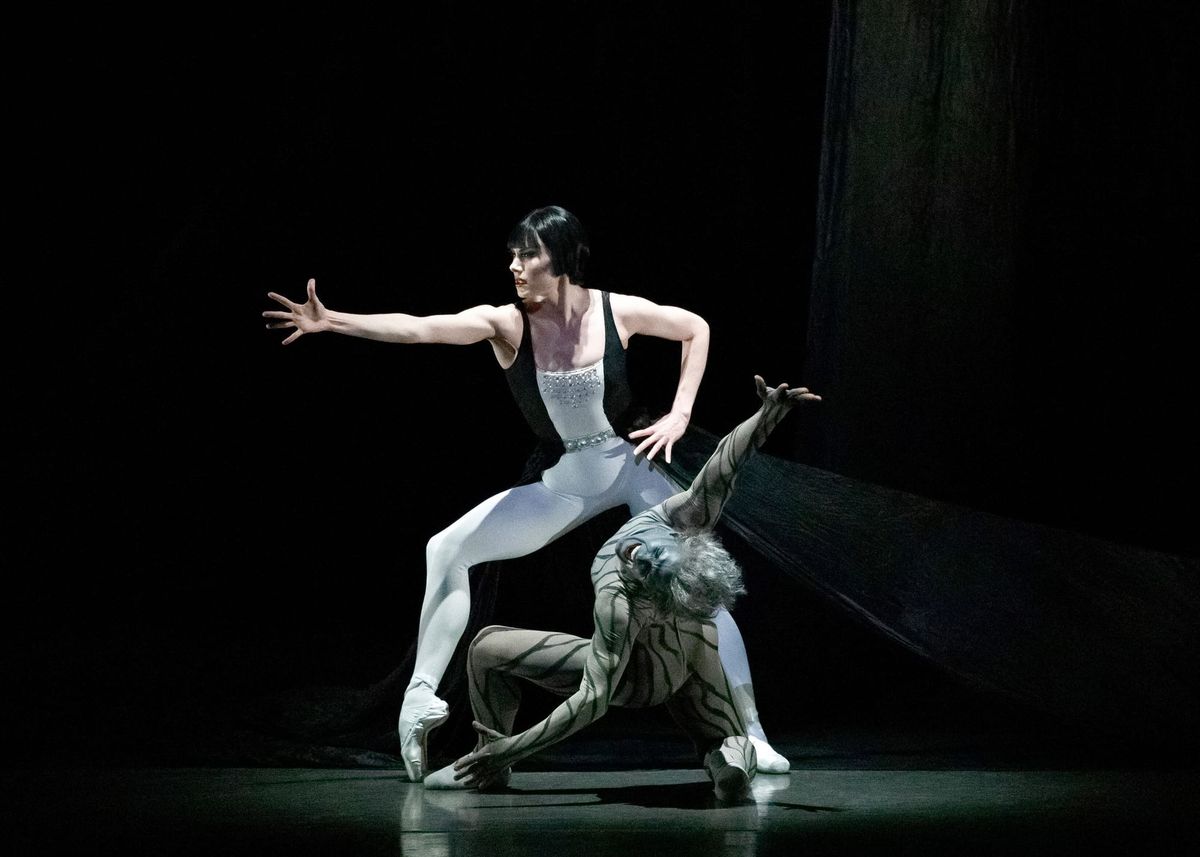
The ballet, made in 1974, is set to musique concrète by Pierre Henry, a tape of sighs and squeaks from a door in need of 3 in 1 oil, one of the least expected of Balanchine's floors to dance on. It's a duet for a tall dominant woman – if not a dominatrix – with a Louise Brooks bob, and clothed in a crystal studded white unitard to which are attached yard goods borrowed from Loïe Fuller and Count Dracula's cape which inundate the stage. She's the Door.
Her partner -- if one may call him that since the two almost never touch -- wears a darker unitard, face paint and a wig combining Harpo Marx and bed head. Looking green under the stage lights, he resembles nothing as much as an tiger striped amphibian. He is rarely out of sight of the woman to whom he is in thrall, a small segment of the stage and is never seen standing. He's the Sigh.
To assign these roles with their disguises and limited spatial range to Sara Means and Daniel Ulbricht, two of the most extroverted and space-hungry dancers in the New York City Ballet, is almost perverse. But both seemed to relish the challenge. Their concentration was absolute. Both brought variety to their characters. Mearns was not just a one-note "She Who Must Be Obeyed", but luring and alluring, her hands stiff and splayed, her shoulders fluid. Ulbricht was by turns awed, sad, desperate and determined. Whether rolling on his back and rebounding or skittering across the stage on knees and elbows, he never stiffened up or lost the connection between one movement, however unexpected or bizarre, and the next. At one point, the dancers engage in a conversation, here so clearly in sync with the music, and each other that the moment was touchingly intimate and almost tender. At the end of the ballet, the Sigh is swallowed by the fabric between the Door's legs. Here again is was hard to tell whether she had devoured him, or whether he was, both literally and figuratively, returning to the (maternal) fold.
Done well, "Raymonda Variations" builds thrillingly, inevitably from it's lilting waltz tempo overture through an adagio and nine solos to it's final moment when the ballerina dives full throttle toward the orchestra pit to be caught by her cavalier just before disaster strikes. It is Balanchine's most durable ballet to Glazunov's score for "Raymonda", a look back at ballet history (and the choreographer's own) but updated for a new century.
But problems cropped up immediately. The overture was lugubrious, too slow and almost without a pulse. Megan Fairchild did all the steps, but lacked the grandeur for this homage to Russian ballet, a soubrette who was also too tall for her partner Anthony Huxley. Huxley's beats in his first solo and ballon in his second were breathtaking, but something, perhaps that technical prowess, seemed to isolate him from his partner. He and Fairchild danced their adagio simultaneously but not to or for each other.
In her solo, Sara Adams executed the show-stopping hops on pointe with which it ends with aplomb, but rather separated from the rest of the piece. Kristen Segin, in the solo full of bouncing jumps, had a secure sense of the whole. Among the debutantes, Emily Kikta aced the fouetté competition, strong secure, her upraised arms signaling both joy and victory. Both Mary Elizabeth Sell and Ashley Hod looked rushed. All of them shown as part of the corps, newly rehearsed, clean, clear, with the style just right. Details were newly visible. Balanchine's musical and kinetic wit sparkled.
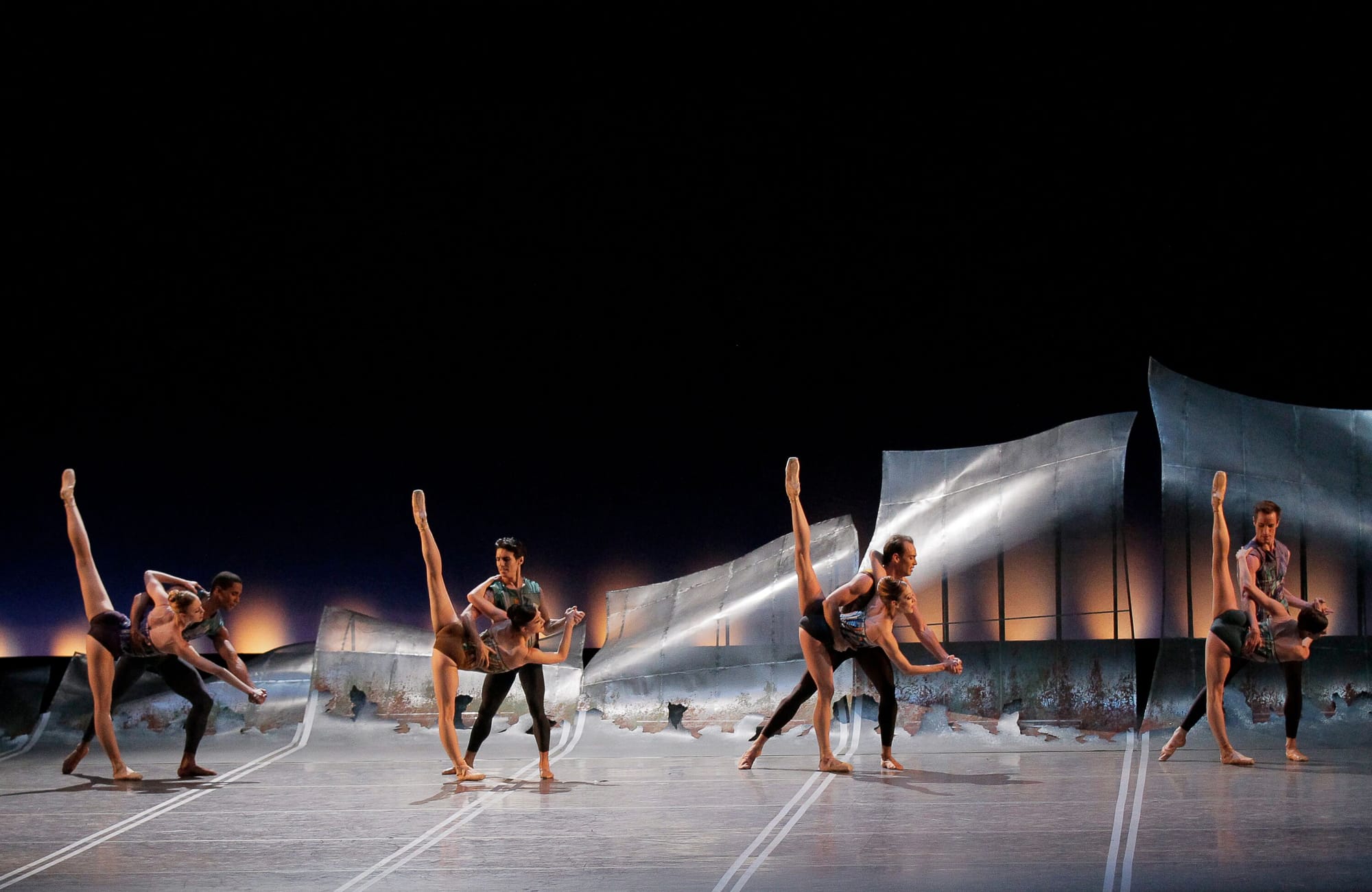
Made for the Royal Ballet in 2006, there was a certain amount of buzz when Christopher Wheeldon's "DGV: Danse à Grande Vitesse" entered the NYCB rep six years later. What had Wheeldon made for the company that raised him and how would it look transferred to the company where he became a sought after choreographer? Michael Nyman's score had catchy propulsive drive. Jean-Marc Puissant's set of waves of steel, which the dancers moved in and out of seemed new and chic. Wheeldon's mastery of moving groups of people was evident and still is. The corps has the best choreography, and, as in "Raymonda Variations," danced it with great care, clarity and understanding.
But now, the music seems repetitive and the set small, not at all imposing, the ballet hollow and dependent on the skill and charisma of its four leading couples. This was Sara Mearns' night for partnering without touching and for danced conversations. She and Taylor Stanley (in his debut) moved side by side, all shared flow, like a happy couple who finish each other's sentences. Together and separately they have charisma to burn. Jovani Furlan, newly arrived from the Miami City Ballet, looked at ease on stage and with his partner Ashley Bouder. Only Unity Phelan, the final debutante of the night, was swallowed up by all the bustle. But the star of the ballet was elsewhere. Maria Kowroski entered, carried at arms length over the head of her partner, Tyler Angle. She looked almost sedate up there as Angle walked backwards out of the wings. Charisma takes many forms, sometimes as great partnering.
copyright © 2019 by Carol Pardo



