Fated Choices
"Kismet", "Emma Bovary"
The National Ballet of Canada
Four Seasons Centre for the Performing Arts
Toronto, Canada
May 29, 2026
The National Ballet of Canada’s summer season opened with the world premiere of Jera Wolfe’s “Kismet”, his first mainstage work for the company, and the return Helen Pickett’s 2023 psychological drama “Emma Bovary”. Both works examine the concepts of choice, destiny and free will in fresh and nuanced ways.
Wolfe, a Toronto native of Métis heritage, is a homegrown talent and an alumni of the Royal Winnipeg Ballet School who has also worked extensively in the contemporary dance space. “Kismet” is an epic work for 36 dancers anchored by a leading couple that opens and closes the piece. The music is Ezio Bosso’s Symphony No. 2 “Under the Trees’ Voices”. “Kismet” deals with archetypes and universal themes, rather than a formal or specific narrative. It takes place in both the natural world and a fantasy world. The dancers are dressed in earth tone costumes designed by Robyn Clarke. The unitards have strips of textured fabric that resemble foliage or tree bark and the dancers wear thin socks, creating a barefoot look and grounded movement quality.
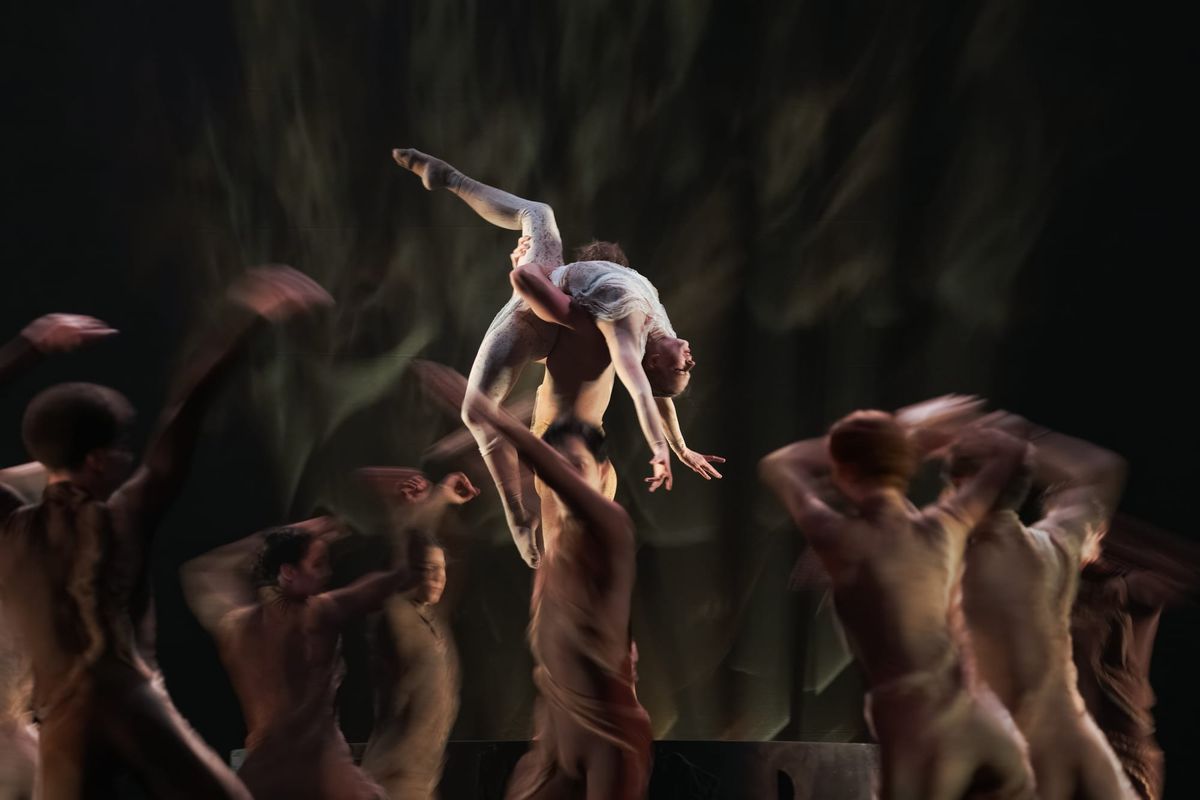
The opening pas de deux is stunning in its choreography and compellingly performed by Genevieve Penn Nabity and Ben Rudisin. It begins as an adage, full of expressive developés, slow and controlled penchées and deep, athletic lunges. Suddenly, imperceptibly, another couple appears and then another, doing the same steps in tandem. The effect is hypnotic and hallucinatory, due to smoke-like special effects and thanks to Simon Rossiter’s evocative lighting design. What follows is a variation on the hero’s quest. Penn Nabity is a powerful figure enacting a fate that involves both creation and destruction. Rudisin is her companion, ever steady and supportive (figuratively, and also quite literally with strong lifts).
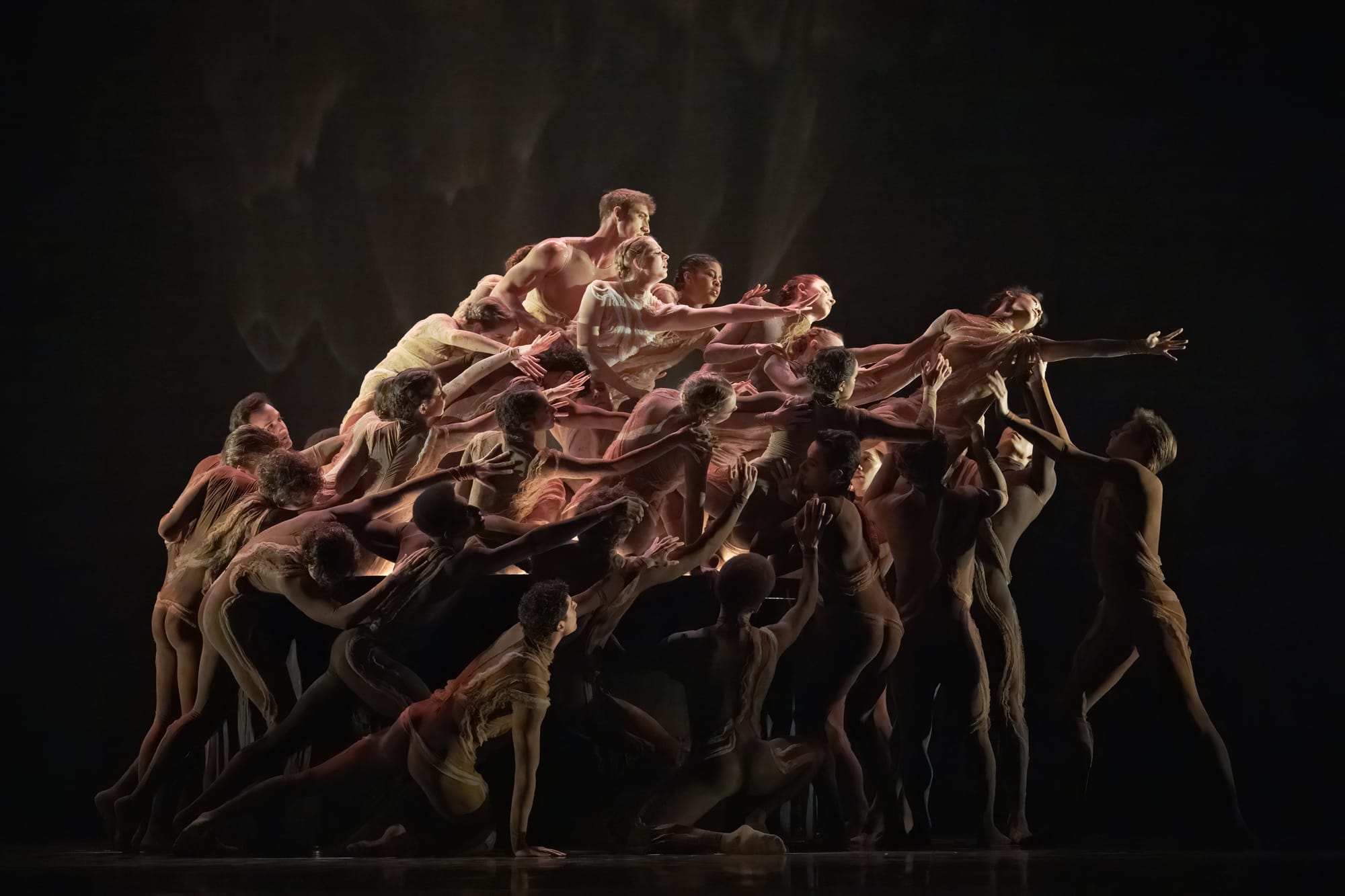
As the piece builds, a large group assembles into a mass formation. It builds slowly and then suddenly until there is a cohesive body moving as one organism. As the clump takes form, it takes on a tree shape with dancers’ outstretched limbs as its branches, while other dancers form a sturdy trunk-like base. Just as it reaches a pinnacle with Penn Nabity and Rudisin held aloft, the shape disperses, almost inevitably. The structure becomes more chaotic, with various dancers taking turns riding above the arms of their peers, as if crowd surfing in a mosh pit. The scene makes the natural cycles of coming together and falling apart joyous and hopeful rather than tragic. Wolfe’s contemporary background is evident in his use of floorwork, partnering and breath. His choreography looks great on the NBoC dancers, while also stretching their range.
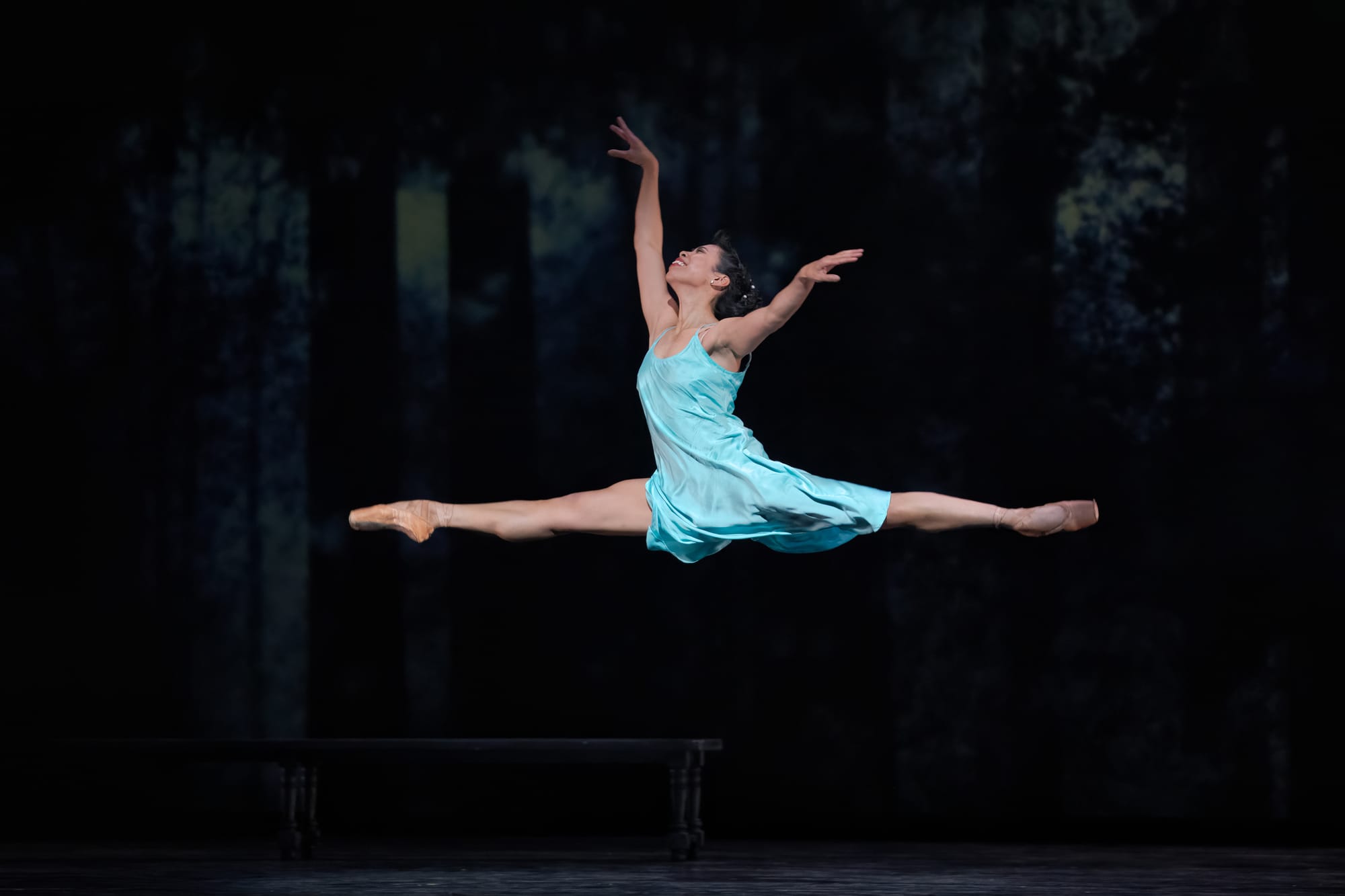
Following “Kismet” was a remounting of “Emma Bovary” which premiered in 2023. This run coincided with the retirement of first soloist Jenna Savella, after 22 years with the company. This ballet was a great channel for Savella’s skills as a dance actress. She earned an emotional and enthusiastic standing ovation at the end. She is stepping down from the company at the height of her abilities and can be proud of giving a profoundly moving performance.
Pickett centres the production on Emma’s restless and conflicted inner world. Events from Gustave Flaubert’s novel are not presented in a sequential or literal manner. Rather, the audience experiences mid-19th century rural Normandy through the eyes of Emma. The banal setting is mundane, stifling and utterly at odds with the glamour and romance that she envisions for herself.
Her husband Charles (Donald Thom) is the picture of bourgeois mediocrity – respectable and a total bore. Her mother in law (Alexandra MacDonald) is worse – stern, domineering and highly critical from the start. Pickett uses stiff, repetitive port de bras that Emma, Charles and her mother in law perform while sitting at the dining room table to portray the claustrophobic home environment that she yearns to escape from. When Emma climbs up on the table and screams, it marks a turning point. In that moment, she exercises her right to choose. She will not be a passive victim of domestic ennui. She will create her own destiny, no matter how ill-fated it is. We see the charming and handsome Rodolphe (Shaakir Muhammad) take full advantage of Emma’s vulnerability and impulsivity.
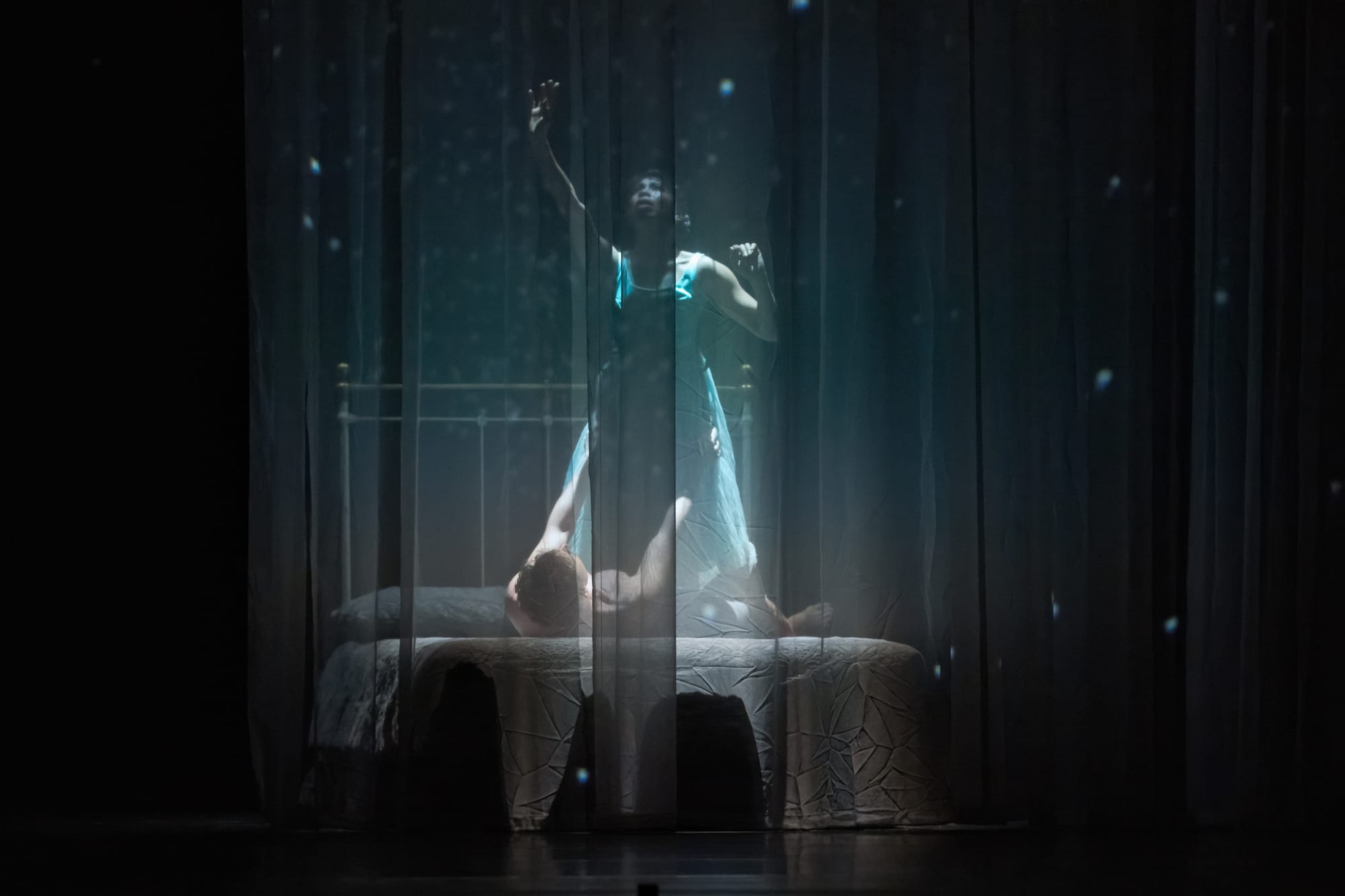
Since the premiere, Pickett has added the character of Homais, the apothecary (made wickedly slimy by Isaac Wright), a corrupt figure who knows how to play the game. His role is important in the book, but in this one hour condensed version of the novel, there is not much time to flesh out his character. An additional scene was added, where Homais encourages Charles to try an innovative surgery for a servant’s clubfoot, which goes awry, requiring Charles to amputate the leg. The scene is particularly grizzly and shows Emma losing respect for her husband. However, her repeated disappointment in him is already vividly depicted in other scenes, so this addition felt somewhat unnecessary. Probably one of the most powerful scenes is earlier on, when Emma and Charles are being intimate and she is totally unsatisfied. She dissociates and escapes into her own fantasy. Savella is suspended high above the bed to amazing effect using a harness, floating into a starry sky.
Savella gave her all in a dramatic performance that was deeply expressive, without overacting or falling into melodrama. She laid bare Emma’s flaws and brought a real pathos to her character. Thom was appropriately square as her hapless husband. He demonstrated lovely phrasing and technique. In contrast, Muhammad was a magnetic presence as the rakish Rodolphe. He is a strong partner and his pas de deux with Emma in the garden scene was filled with slides and counter balances, which he skillfully manoeuvred. As the merchant Lheureux, Spencer Hack was nimble in body and mind – fast and light on his feet, while also clever and quick-thinking in convincing Emma to spend beyond her means. As L’abbé, David Preciado was flashy and proud, tossing off dizzying tricks one after another. This showed how the spiritual leader was in fact just the same as everyone else – seeking fame, status and attention.
Pickett’s choreography is not the most interesting, but the cast really sold it. “Emma Bovary” also benefits from collaboration with director James Bonas, who brings a wealth of experience working in theatre to the production. Bonas ensures the storytelling is clear and efficient. The music by Peter Salem maintains a dark and dramatic tone, with a ticking clock motif signifying the unrelenting and oppressive passage of time. Finally, the set and costume designs by Michael Gianfrancesco are sumptuous and beautiful. Velvet and brocade dresses in the ball scenes are luxurious, while the fine fabrics and furniture sold to Emma by Lheureux are wonderfully extravagant. It is easy to see how Emma is seduced by such fancy things. One of the most affecting visuals in the ballet is when the chairs she has bought from Lheureux are stacked upon one another, creating a mountain of excess and a visual symbol of the web of lies she has spun and become trapped by. She climbs to the top and then realizes she has nowhere to go but down.
Copyright © 2026 by Denise Sum



