Unto the Breach
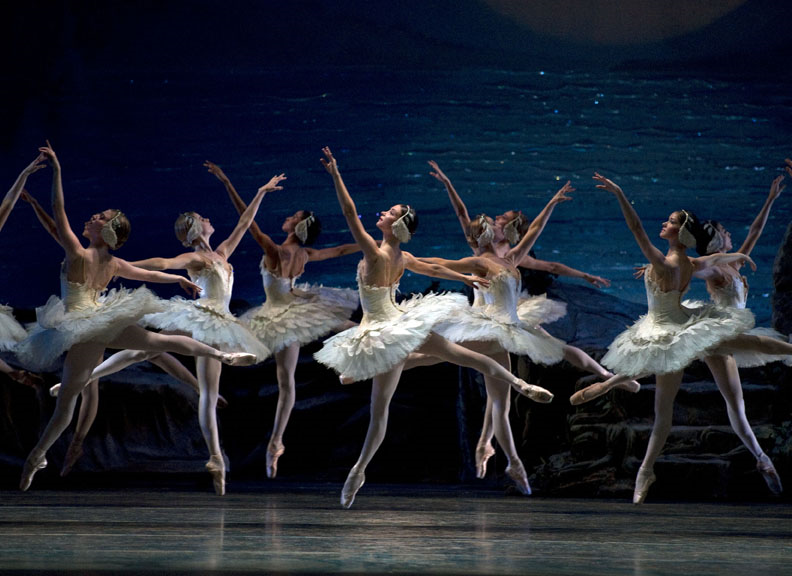
"Swan Lake"
American Ballet Theatre
Metropolitan Opera House
New York, New York
June 27, 2014
The injury bug has hit ABT with a vengeance, and Friday's announced "Swan Lake" cast, Alina Cojocaru and Herman Cornejo, were replaced by Hee Seo and Roberto Bolle; Seo had already stepped in on Monday for the black act to replace Gillian Murphy, injured during the performance. This gallantry meant the audience was already rooting for her, but her Odette/Odile is still very much a sketch, illuminated now and then with bursts of beauty.
The production, too, is a sketch with occasional bursts, though unfortunately, it isn't a sketch of "Swan Lake". Bolle, however, tried his best to dance Siegfried, and his plush nobility, big easy jumps and generous partnering mitigated some of the un-theatrical touches of the production--how on earth can anyone not give Siegfried his first act curtain, as he sees the swans flying overhead and rushes off to his destiny? But here he just slinks away unseen, not even taking his new bow. He did give the feeling of isolation and longing in Act I, basically because he was the only noble on the stage. The other dancers, peasants and courtiers alike, cavorted like they were on Spring Break from Heidelberg U, the men chasing after the women, and the women lusting after the hunkiest guy in the bunch.
The white act, though, is firmly based on the iconic Ivanov version, even though Odette's mime tells a completely different story from the one the audience sees during the prologue. But the white magic of Tchaikovsky's powerful music and the mass of corps dancers prancing in unison casts a spell that even the oversized Hallmark moon can't break. Seo's opening moments were beautiful, as she jumped on with a delicate power, seeming to luxuriate in her freedom. Her mime, too, as she told her sad story and pleaded for love was potent. But so far, she isn't able to show Odette's various emotions (fear, hope, love, and resignation) through her dancing, clear and lovely though much of it was, and the act was performed in the same emotional register.
Her black swan was dutiful rather than rapacious, as she seemed to be just following von Rothbart's instructions. The dancing could have been sharper, and the fouettés, though they started well, came unglued at the end. She was at her best in the final scene, and she made the mish-mash of the choreography genuinely moving (oh, for Ivanov's lyrical groupings!). I especially remember the heartfelt gesture she gave Siegfried just before she jumped, a combination of a plea and a promise that yes, they will be reunited in that rising sun.
Sascha Radetsky, who is retiring after this season, was scheduled to dance the Act III von Rothbart, but he too was replaced. Alexandre Hammoudi, who spent so much time last year on the injured list, replaced him. He danced the overheated role straight, without the campy exaggerations that Marcelo Gomes so memorably adds, and which the dramatically nonsensical choreography needs. Unfortunately, he was troubled by the difficult adagio, and seemed to be concentrating on his balances; he does look terrific in the costume, though, and that is certainly half the battle.
The pas de trois was danced by Devon Teuscher, Christine Shevchenko, and Jared Matthews. Matthews stood out for his combination of power and flow, though at times he seemed to be pushing a bit. Shevchenko moved with a lovely freedom in her upper body, opening her arms so beautifully. Teuscher was sprightly, though a bit staccato. The four little swans, Cassandra Trenary, Luciana Paris, Sarah Lane, and Yuriko Kajiya, got their usual round of applause, but this quartet deserved even more, as they moved in absolute unison, pawing the ground delicately and moving their heads as one. Joseph Gorack and Zhiyao Zhang as the Neapolitan twins were also a highlight. A tarantella should star a boy, a girl, and a tambourine, but their bounce and joy certainly made the case for the barber pole costumes. And it was a treat to see Keith Roberts back on stage, as Wolfgang the tutor and the dignified master of ceremonies.
copyright © 2014 by Mary Cargill



