Tchaikovsky Variations
"Divertimento from 'Le Baiser de la Fée'", "Tschaikovsky Pas de Deux", "Bal de Couture", "Diamonds"
New York City Ballet
David H. Koch Theater
New York, New York
January 27, 2013
All Tchaikovsky all the time (with Stravinsky channeling Tchaikovsky) is a gimmick, yes, but the Tschaikovsky (as NYCB spells it) Celebration does include some wonderful music and powerful dancing, so as gimmicks go, there are certainly worse ideas to warm up a bitter winter. The "Divertimento from 'Le Baiser de la Fée'" is not a warm ballet, and it is a slightly downbeat opener. But Tiler Peck, with Robert Fairchild (who made his debut earlier in the week) found the soul of this oddly disturbing work, using her incisive musicality to dance inside the music, almost to disappear at times, so that Fairchild gave the impression of dancing with a cloud or a memory, as he reached for her in vain. Their pas de deux had a hushed privacy that was hauntingly beautiful, and Peck's timing, as she reached for him and fell back was simply shattering. Fairchild, one of NYCB's most imaginative dancers, gave his twisting, turning solo a fierce urgency, and the final group of turns and bends, as he scooped his hand from the ground to the sky managed, in a few seconds, to convey so many unrealized dreams.
There is nothing unrealized or dreamy about the "Tschaikovsky Pas de Deux", with Ashley Bouder and Chase Finlay (in his debut). Bouder has been dancing this for quite a while, and radiates with confidence. But she also gives her solos a delicate flirtatiousnessand buoyant musicality, and has a particularly juicy upper body. She doesn't fling her leg into position, her arabesques are all perfectly placed, and any freeze frame would show perfect placement. She combines scrupulous accuracy with a flamboyant energy that is irresistible in this work.
Finlay was a generous partner, still, so some extent, feeling his way through the technical challenges, as he seemed to run out of steam a bit at the end. He used his elegant and slightly reticent persona to fine effect, avoiding showboating the turns a la seconde (exciting though those boats can be), and his big sideways jumps flowed effortlessly.
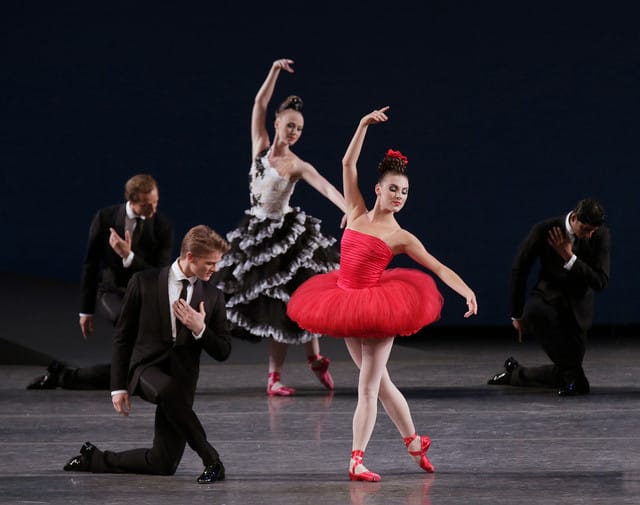
Both Finlay and Bouder, as well as almost every other principal, showed up in Peter Martins' new "Bal de Couture", with its Valentino costumes. The Marie Antoinette hairstyles have disappeared, but the tutus still look like lampshades at a swanky bordello (reinforced by the frequent flashes of rhinestone underpants). The men wear tuxedo pants (beautifully cut) with suit jackets, which I find pretentious, but, I am assured, is the latest trend. However, the natural look makes them appear out of place in the artificial (or rather hyper-real) world of ballet steps. Not that there are many steps to do, as the work is just generic posing, and the talented, wonderfully individual dancers all disappear into the swirling background.
All except Janie Taylor and Sébastien Marcovici, who popped in the middle of the bright "Eugene Onegin" excerpts dancing to the languorous "Elegie in G". She got to wear lilac chiffon with huge sleeves, which Marcovici tried in vain not to be upstaged by as he poked his head around them. This could have been played for comedy, but, judging by Taylor's air of incandescent mystery, it was supposed to be Significant. For some reason, Robert Fairchild appeared from the other ballet for a bout of hugging until Taylor finally boureed off. Fairchild then straightened his tie, mentally shrugging his shoulders, went back to the other ballet and seemed perfectly happy with Sterling Hyltin. Again, this could have been played for ironic surrealism, but the dancers just waltzed aimlessly through the music as they tried so hard to sell it with bright smiles from the women and a false bonhomie from the men.
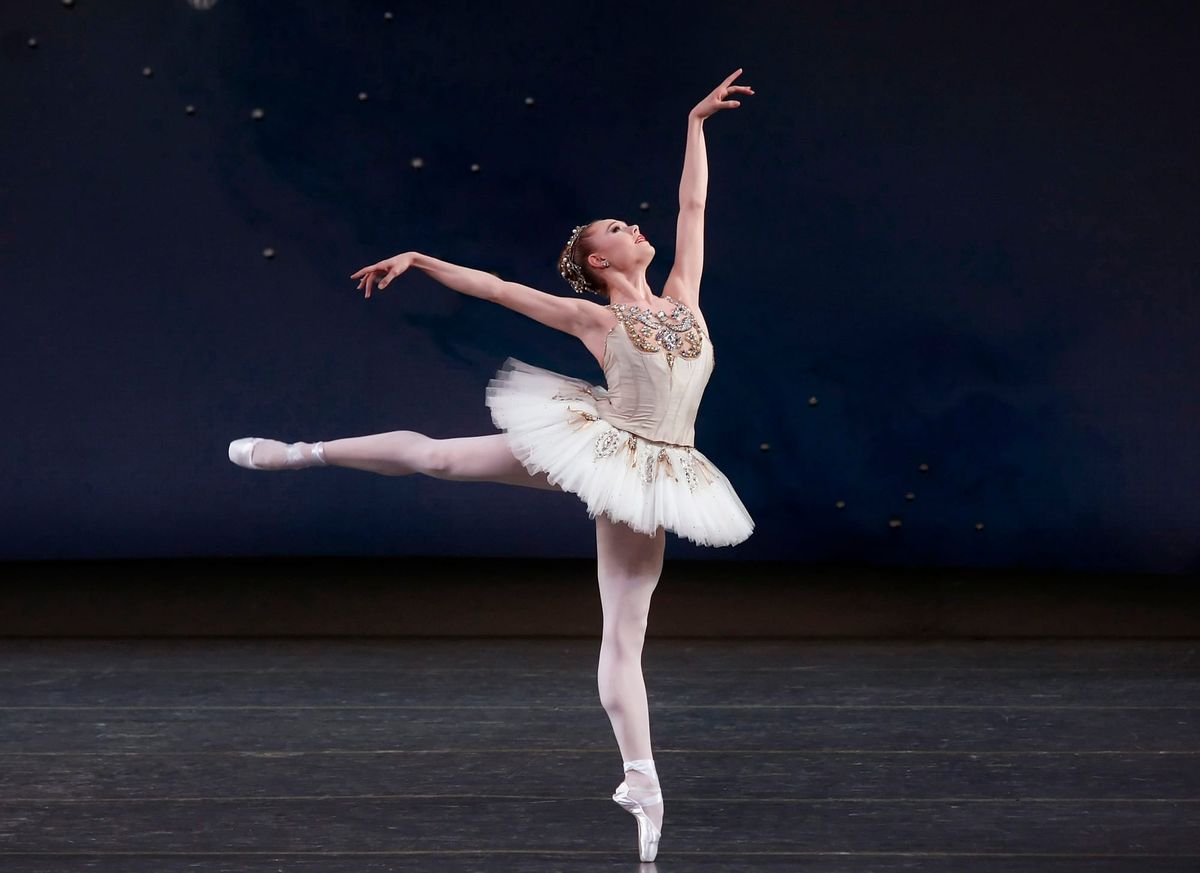
There is mystery and ambiguity in Balanchine's "Diamonds", but it is never pointless. For me, it isn't one of his masterpieces, (except for the pas de deux), as the corps dances on and on. But it has sublime craft, and the patterns, with their delicate references to "Swan Lake", suit the mood. Even the light blue background with the cheesy baubles can't destroy the moonlit atmosphere. Sara Mearns and Ask la Cour were the modern day Odette and Siegfried, and the pas de deux was hauntingly beautiful. La Cour was steady and deferential and Mearns, though she seemed to be dancing rather carefully, moved with her usual luscious sweep.
Mearns made the rather abrupt switch from moonlight to sun, as if the ballet changed from "Swan Lake" to "The Sleeping Beauty", a bit less distinctive than she has in the past, as she retained her slightly melancholy mood. The scherzo, with the two solos, was dropped, so it may be that she hasn't quite recovered from her long injury. But even Mearns as half-mast is wonderful to see, as she pulls the audience into her own world, a world, I expect, that Tchaikovsky would understand.
copyright © 2013 by Mary Cargill



