Unknown Dancer at Japan Society
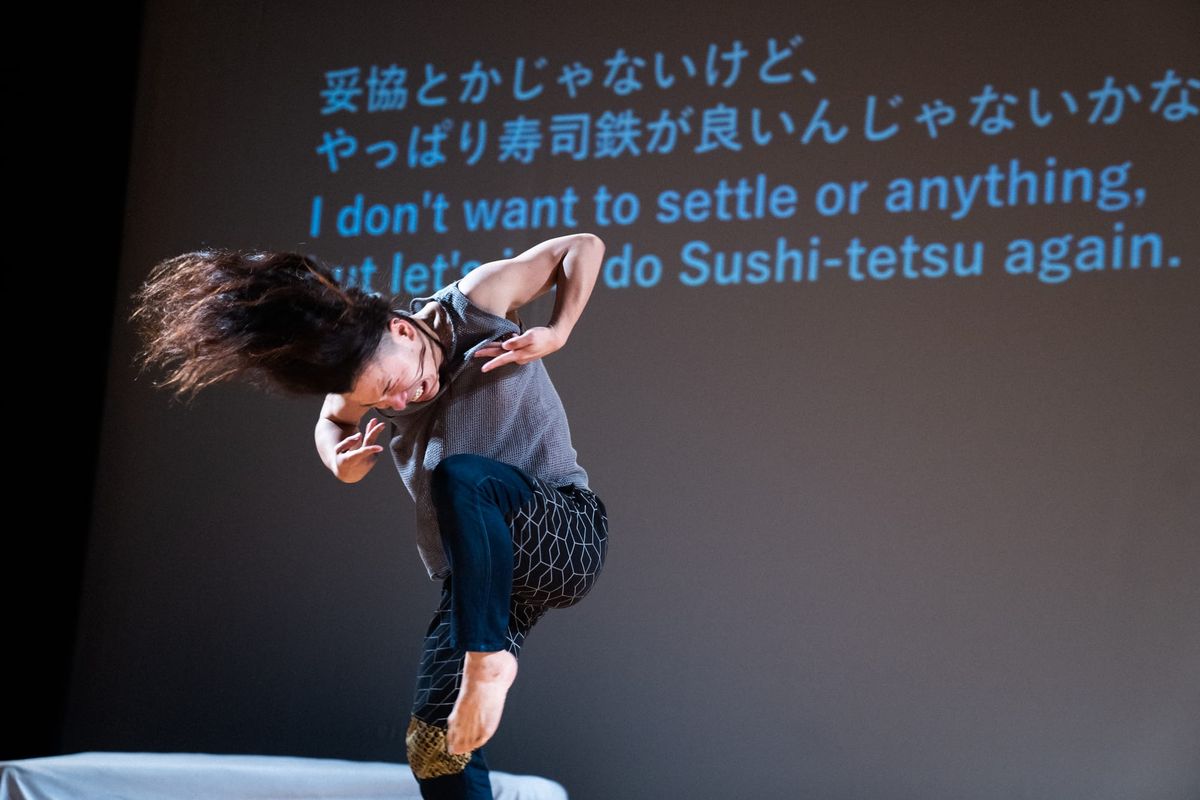
"The Unknown Dancer in the Neighborhood"
Written and Directed by Suguru Yamamoto
Wataru Kitao, Performer
Japan Society, New York
January 10, 2020
Mayday! Mayday! Is a cry that comes up repeatedly in Suguru Yamamoto’s dance/drama “The Unknown Dancer in the Neighborhood.” It means “help me” in French, but it seems to fall on deaf ears in Tokyo, the setting for this theater piece by and for a new generation of Japanese artists.
Despairing dramas about alienated people were a staple of the last century. What makes this fresh is that it suggests alienation is only the other side of human community. We feel disconnected because we are connected.
“The Unknown Dancer in the Neighborhood” is a whole cast of characters, played by one brilliant young dancer-actor, Wataru Kitao, equally at home with hip-hop and ballet, in male and female roles, as a child or an old person, as a human being or an animal. The ability to cross so many lines is a feat of acting empathy – the very opposite of disconnecting.
He begins as a chest-thumping gorilla in the Tokyo Zoo – then jumps outside the cage to play a bunch of camera-toting zoo patrons, getting in each others’ shots, getting on each others’ nerves. One of them knocks down an old man, who is so cranky that he refuses a hand up from a young person.
The show is a rapid-fire series of urban vignettes. There’s a fatal accident on the packed Tokyo subway, where people fall into a gap between the door and the platform, and other commuters just walk on the victims' heads as they hurry off. But one young man tries to help, tries to lift them from their death trap. The “unknown dancer” is the thread that runs through the show – dance embodying the emotions that run under the city's hard surface.
An inquiry is held into the subway tragedy, with questions for the unknown rescuer flashed like text messages or tweets on the wall. Are the questioners even human? No way to tell.
The dancer’s most poignant character is one who was never born or conceived: the non-existent child of a non-relationship between a prostitute and a customer. She tells him she’s lonely, and asks him to stay. He considers, refuses, and walks away. The unrealized one then dances an elegy for himself – saying he’s glad he was never born, he’s better off as wind, empty air. We are left to wonder – is non-being really better than being?
TV News saturates the air, covering the subway tragedy, then a siege at a bank with hostages taken, some murdered. No one can understand the hostage-taker’s demands: he wants to have time stop, and someone look his way. Mayday, mayday.
The masked, unknown hostage-taker then seizes the stage – whipping out a samurai sword and threatening to eviscerate the audience for its indifference. For a minute I thought he might do it. But no.
The piece ends with a gut-wrenching dance of grief by the mother of one of the subway victims –- a shy teenage girl -- as text messages from their last evening together flash ghostly on the wall.
The last exchange goes -- Mother, am I ugly? No, you’re not ugly.
Kitao pulls out all the stops in this climax, making a mother’s grief so real that it falls into the gap between life and death – between two people whose relationship was strained, incomplete. The texts on the wall are a brutal reminder that we have memories, and regret for what is lost.
In a program note, director Yamamoto says the piece “is about the indifference of people toward other people; however, it is not about despair … by taking note of this indifference, we should be able to know what kind of love or caring is needed.”
So, what looks like despair to a 20th century critic like me looks like “not despair” to Japanese millennials. Also to my 20-year-old granddaughter, who helped me spot myself in the show – a comical old man who gets knocked over by the dog he’s walking, who groans that he can’t even understand dogs today.
She also helped me see this show is about an epochal shift in consciousness. As the aged sink into dotage, a new generation is dancing -- young people in a world under siege, who still know what it means to be human: to resist.
copyright 2020 by Tom Phillips



