Universal Language
"Frame by Frame"
The National Ballet of Canada
Four Seasons Centre for the Performing Arts
Toronto, Canada
June 2, 2023*
It is rare that a new work shows us something we truly have never seen before. When "Frame by Frame" premiered in 2018, it did just that. An ambitious, multidisciplinary collaboration between choreographer Guillaume Côté and famed Quebecois multi-hyphenate Robert Lepage, "Frame by Frame" is a homage to the life and work of Scottish Canadian animator Norman McLaren (1914-1987). In addition to artists of the National Ballet of Canada, LePage’s multidisciplinary production company, Ex Machina, also formed a large part of the creative team. The Quebec City based company brought expertise from working in film, theater, opera and even circus arts. Most importantly, the National Film Board (where McLaren founded an animation studio) was on board with the project, allowing several of McLaren’s works to be presented on screen as part of the ballet. “Frame by Frame” was a strong, original work when it was presented in 2018. Five years later, it has undergone some significant edits that have made it even more cohesive and worth viewing.
While the integration of film projections is hardly new in the ballet world, the approach here is fresh. Instead of feeling gimmicky, LePage and Côté use their respective art forms to complement and enrich one another. Rather than simply juxtaposing film and dance, in “Frame by Frame” different media interact and inform one another. Screens with text or video projections have become very popular in newer ballets, but can at times feel like a lazy way to fill plot holes or provide concrete markers of setting. Here though, film is used to reveal deeper aspects of the choreography and vice versa. The result is a unique and immersive experience. It rises to the challenge all performing arts organizations face now - luring people away from their homes and streaming services and into the theater. It is also a production that could bring new audience members to the ballet.
Compared to the 2018 version, the revised “Frame by Frame” has a steadier pace and smoother flow between vignettes. The original version clocked in at over two hours with no intermission. For the new iteration, the team has made some judicious cuts and added an intermission, which gives the audience some breathing room and time to digest the work. Awkward scenes, such as a segment referencing McLaren’s time in China that included dancing red guards, are thankfully omitted. Although entire scenes were cut, the overall rhythm of the ballet was not badly affected since the structure of “Frame by Frame” is impressionistic. While it loosely follows a chronological order, acknowledging different milestones in McLaren’s life, it does not purport to be a comprehensive biography.
Another major difference between the 2018 and recent run of this ballet is that this time most roles had two or three different casts, whereas in 2018 there was just one cast that danced every performance. While many of the dancers who created leading roles in the first run are no longer with the NBoC, thankfully Jack Bertinshaw was able to reprise the role of McLaren. Bertinshaw’s warm portrayal of McLaren as a curious and trailblazing artist carried the work. It is no secret that McLaren was a dance enthusiast who loved ballet. Nowhere is this better shown than in the scene where he attends a performance of “Swan Lake” and meets Guy Glover (Alexander Skinner), who becomes his life partner. Bertinshaw conveys McLaren’s pure childlike awe as he watches the dancers, transfixed. His encounter with Glover is a perfect meet-cute as their eyes meet from across the room, a modern spin on Romeo and Juliet locking gazes at the ball. His giddy, wiggly movements perfectly capture the excitement of young love.
Of McLaren’s works that are shown or referenced in “Frame by Frame”, “Pas De Deux” is the most directly connected to dance. It is a pure dance film featuring choreography by Ludmilla Chiriaeff (founder of Les Grands Ballets Canadiens). It is a startlingly beautiful film on its own, but layered with a pas de deux with live dancers, it takes on new depth. Here, by mixing stage and screen, dancers of the past and present can mingle in ways never possible before. Harrison James and Genevieve Penn Nabity dance alongside the dancers in the film, Vincent Warren and Margaret Mercier. In an additional layer of innovation, McLaren himself is written into the scene as he films the dancers on stage in real time, his view finder also projected and visible to the audience. We see James and Penn Nabity in multiple forms so it appears that they are not only dancing with Warren and Mercier, but also dancing with copies of themselves. On a technical level, the dancers are very exposed as their steps are on view from every angle. Luckily, both are gifted with excellent placement and clean lines.
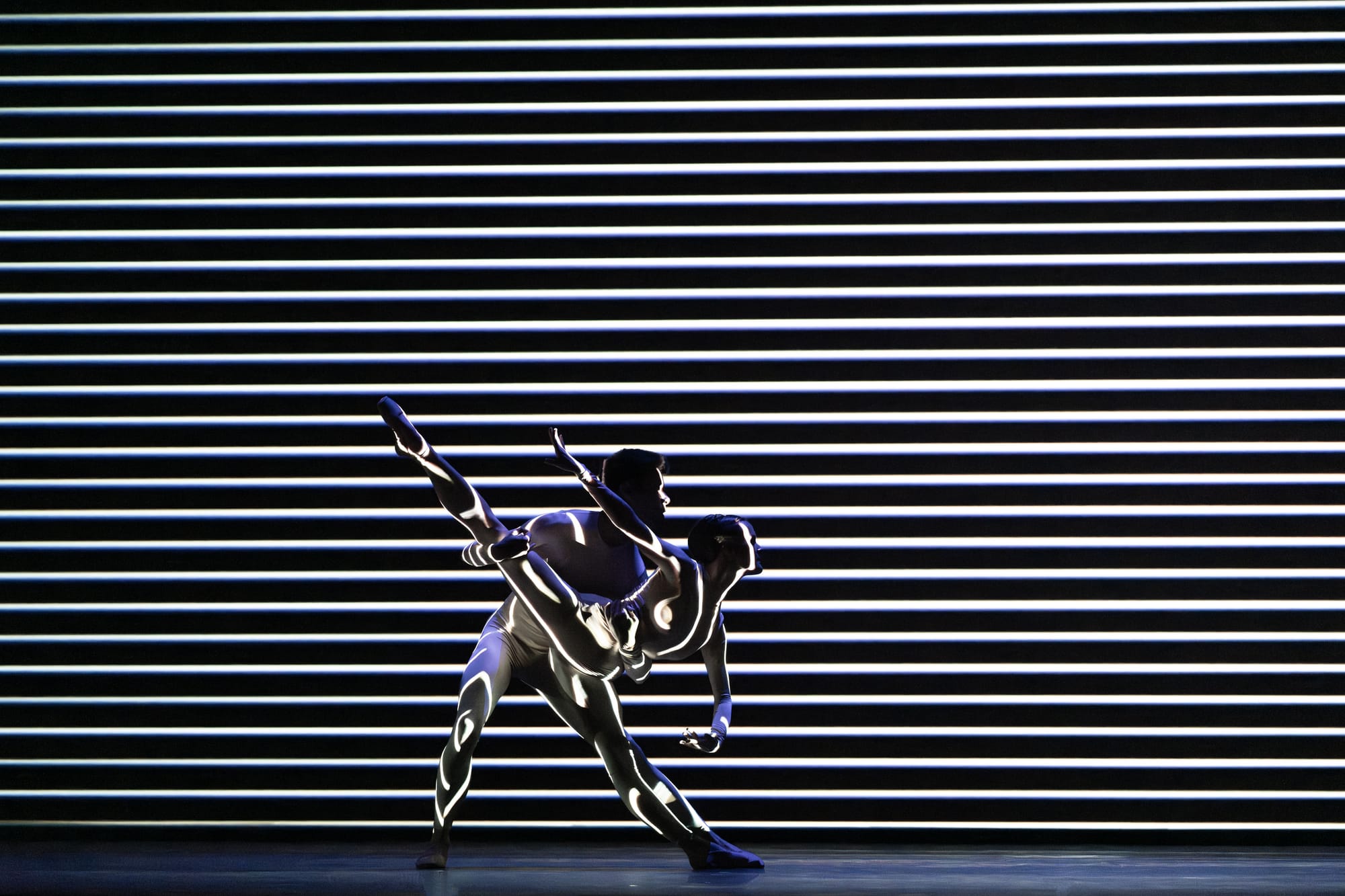
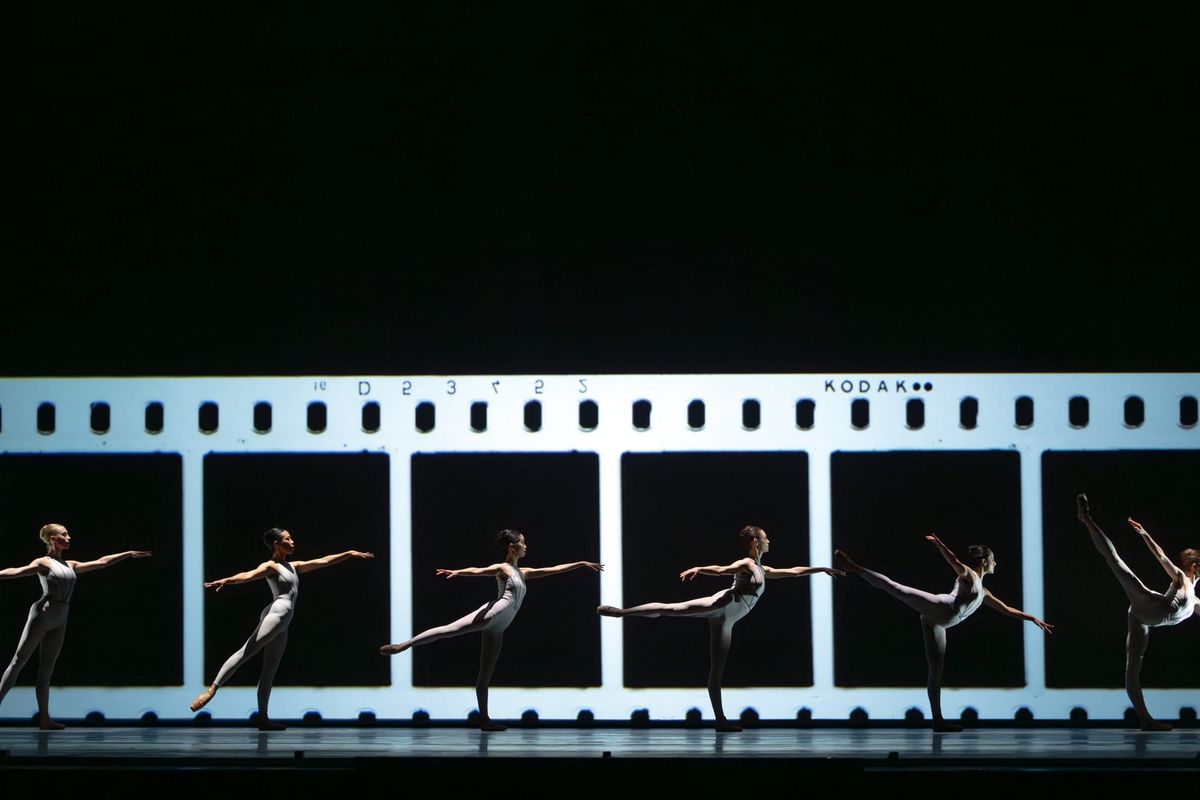
Other memorable moments include a segment for 6 women appearing as silhouettes in front of a giant film reel creating exaggerated shapes and pictures with their lines. In another section, dancers leap across the stage while a film projection of dancers plays in the background. Flashing strobe lights are used, so the continuous movement is broken up and the audience sees snapshots, as if watching a flipbook. These more abstract pieces are interspersed with references to McLaren’s most famous films such as “Neighbours”, a commentary on conflict, war and greed that won him an Oscar.
In terms of things that could be adjusted in the future, there are a couple aspects of the lighting design that could be improved. In the first act, there is a portion where the lighting is quite dim and Bertinshaw is wearing dark almost black pants. It becomes quite hard to see his legs, which is a shame especially with the choreography that has lots of intricate details. Towards the end of the ballet, there is a long sequence of blindingly bright flickering lights directed towards the audience. It is annoying and distracting, like someone flashing their high beams at you.
The success of “Frame by Frame” is largely related to the synergy of the collaboration between Côté and Lepage. Côté’s previous attempt at a full length work, “Le Petit Prince” , was an expensive disaster. He seems to benefit greatly from the unique perspective Lepage brings to the stage – the result is much stronger than his solo works. They must enjoy working together as they subsequently collaborated on a production of “Hamlet”. “Frame by Frame” succeeds more as theater than ballet, while still having enough pure dance to satisfy ballet audiences. It is inventive, distinctly Canadian and has a broad appeal, which is a real asset to the company. They were supposed to bring it on tour to the Sadler’s Wells Theatre in 2020, however their performances ended up being canceled due to the pandemic. Hopefully they will have a chance to tour with this production in the future.
copyright © 2023 by Denise Sum



