Two Completely Different World Premieres and a Beloved Repeat
Kaleidoscope
Kammerballetten
The Concert Hall at the Royal Danish Academy of Music
Copenhagen, Denmark
August 13, 2026
The dance company Kammerballetten was founded by the chamber music trio Trio Vitruvi in 2018. Since then, Kammerballetten has proven itself to be one of the most exciting elements of the overall dance repertoire in Copenhagen. The first couple of years it was in many ways a well-kept secret playing before the official opening of the season at Takkelloftet, the intimate and small black box stage at the Opera House. As a testament to the quality of the company's offerings, the Danish princess, H.R.H. Benedikte has been a regular guest of honor for years.
The concept of Kammerballetten is as simple as it is brilliant, merging chamber music with new ballet by choreographers of today over the years working with a slew of dancing favourites from The Royal Danish Ballet: principals Alban Lendorf, Astrid Elbo, Ida Praetorius, Stephanie Chen Gundorph and several soloists, most notably Tobias Praetorius, Liam Redhead and Sebastian Pico Haynes. The latter being a favourite of choreographer Paul Lightfoot who has been a mainstay at Kammerballetten presenting some of the most breathtaking, moving and intricate choreographies in the history of Kammerballetten ('Suffer Little Children' to name just one). Even the current artistic director of the Royal Danish Ballet, Amy Watson, danced in Kammerballetten as one of her final performances before her retirement.
This year however was a year of change for Kammerballetten. A similar concept, Equinox Chamber Music and Dance Festival, had booked Takkelloftet on the dates where Kammerballetten usually performs, necessitating a move and a subsequent artistic shakeup.
Rather than sticking to the tried and tested formula of Trio Vitruvi and Takkelloftet, Kammerballetten moved to The Concert Hall at The Royal Danish Academy of Music, collaborating with Concerto Copenhagen that specializes in baroque music.
The change of scenery did not prove an undisputed success.
Foregoing Takkelloftet meant foregoing the intimate setting of just three brilliant musicians and dancers in a blacked out room where the entire audience could enjoy the dancers up close.
The Concert Hall is located in the building known as the radio house because it was the home of Danish state financed radio (today Danish Broacasting Corporation) for decades. But while it has always been an active concert hall, it has previously also been used for fashion shows during Copenhagen Fasion Week. It is still primarily a concert hall, and though the acoustics are great, lighting wise it was not suited for Kammerballetten.
Renowned Concerto Copenhagen played beautifully throughout the three part programme of the evening, however 16 musicians do provide a different and more imposing backdrop to the dancing than a trio when they take up the entire background in a hall that was not completely blacked out at any point.
Part I was placed in the choreographic hands of Tobias Praetorius. He is a soloist with The Royal Ballet at the Royal Theatre in Copenhagen where he masters both the classical and modern repertoire. He danced the part of Basilio in 'Don Quixote' last season leaving me and many more wondering why he has not since been given challenges on that level as well as a promotion to principal. At the same time he is one of the most interesting new choreographers with an innate ability to make classical ballet seem new and fresh while maintaining a distinct point of view.
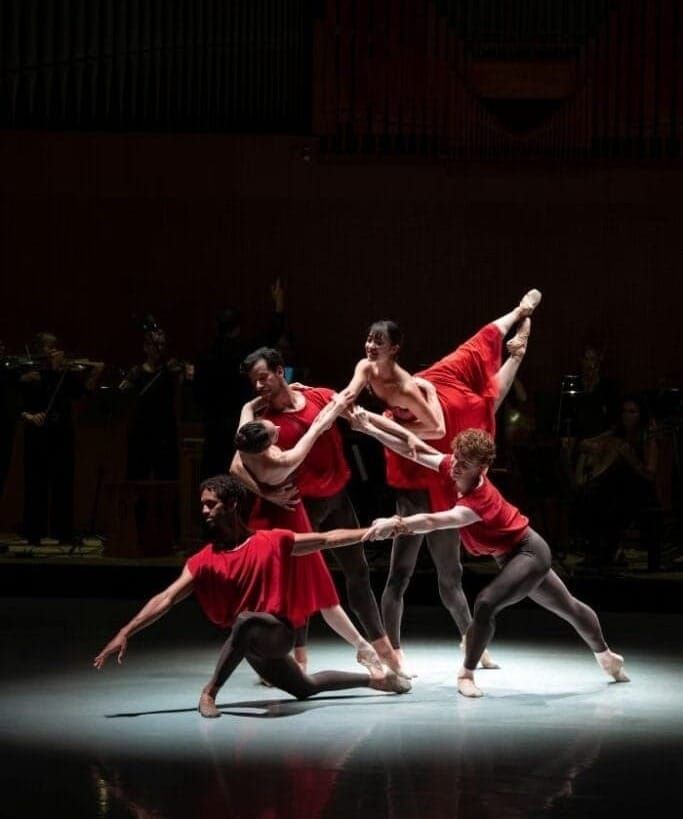
Part I, 'Armonico Tributo,' was vibrantly poetic and delightful. Tobias Praetorius had enlisted his Royal Danish Ballet colleagues Grace Curry, Tomoka Kawazoe, Liam Readhead, Nico Janssen, Vitor de Menezes and Meirambek Nazargozhayev. All dressed in red with Liam Redhead as the luminous central figure.
Drawing on returning and transforming formations, emulating court dances and curtsies, he made their movements become an extension of the music - sonatas from Georg Muffat and Heinrich I. F. Biber.
'Armonico Tributo' gave nods to both Balanchine and his 'Apollo' as well as Bournonville, the heritage in which Praetorius has been brought up as a dancer. The joy of dancing that is quintessentially Bournonville was certainly present in the dancers that seemed to thoroughly enjoy being back on stage after the summer break. A throw away movement of an arm signaling that the olden days are over, this is now, we are here, before the dancers launched into an homage to the third act of 'Napoli', and the audience was right there with them.
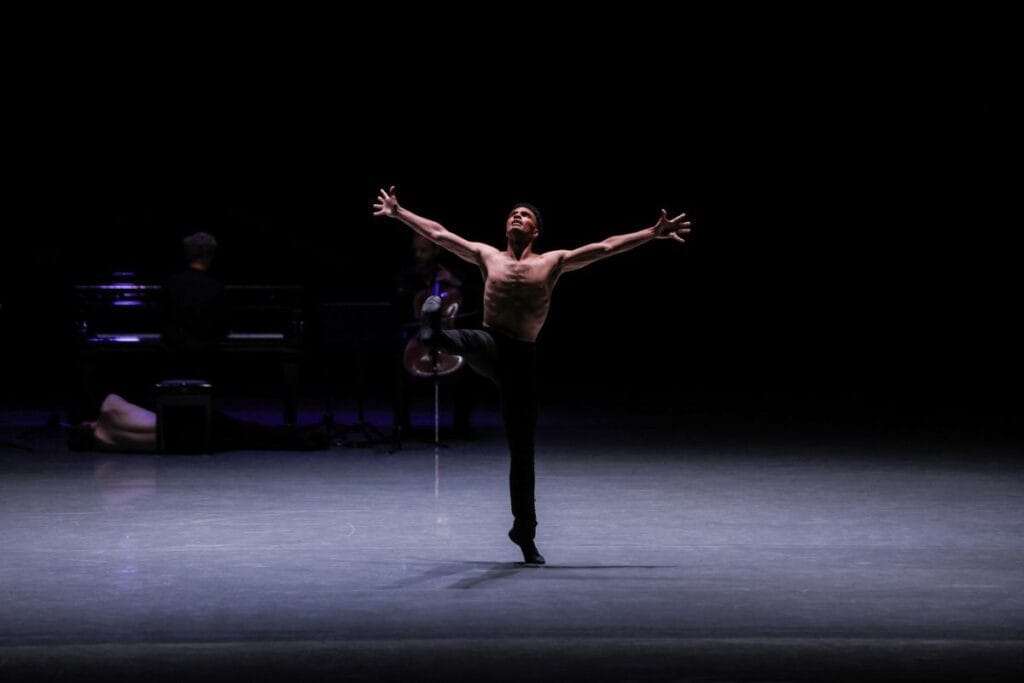
Paul Lightfoot's 'Selvportræt' ('Selfportrait') was Part II. It has been danced before as Lightfoot created it for Kammerballetten in 2021 as well as on Old Stage at The Royal Theatre. Sebastian Pico Haynes, Roger Van Der Poel and Maria Kochetkova as the three characters representing life, love and death, all existing individually yet inescapeably linked. The original music by artistic director of Kammerballetten, Alexander McKenzie.
At Takkeloftet Maria Kochetkova would enter from the side in coloumn like beams of light. At the concert hall she entered via a door in the back of the stage braving a few stairs without the same impact of light breaking the darkness of the stage. The contrast between light and darkness that is so essential to 'Selvportræt' almost removed. The end image of Sebastian Pico Haynes curled up in a square light that becomes smaller and smaller until lights out, was not reproduced to the same harrowing effect in the Concert Hall.
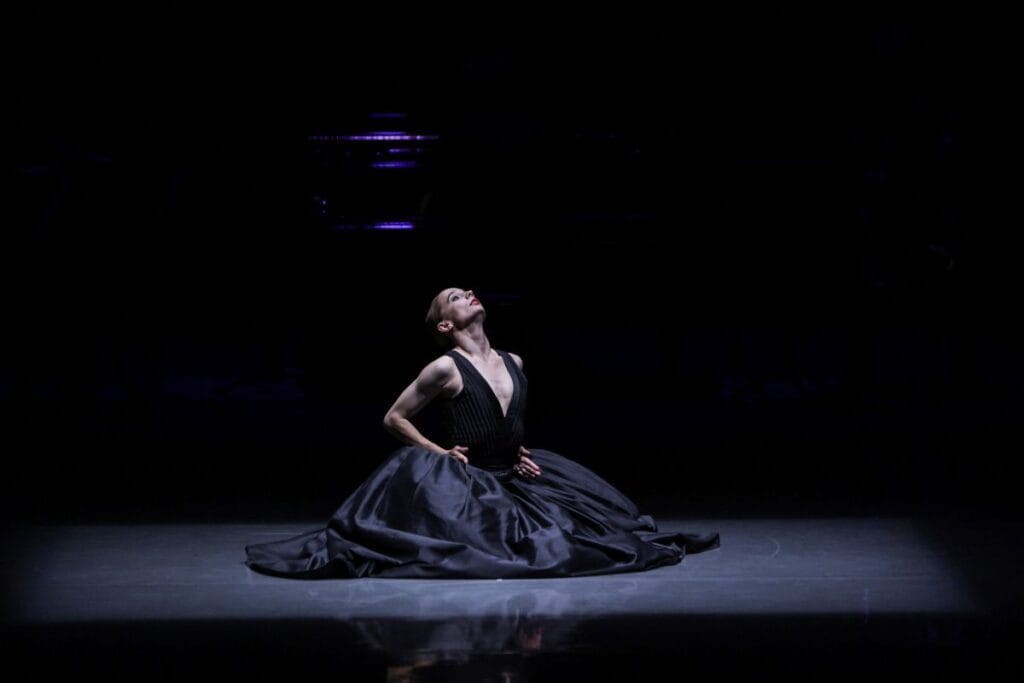
'Selfportrait' became a segue from the very classical standpoint of Part I as a more stringent take on modern dance with characters deeply engaged in their interactions and beautiful movement where each step must naturally be followed by the next. On the other end of the spectrum Part III rounded out the evening.
Sebastian Kloborg, once a soloist with The Royal Ballet, is much more of a wild card. He is known to experiment often leaving the audience with an impression of a choreographer completely uninterested in the harmony and beautiful lines traditionally associated with ballet.
'Live on Tape' is no exception. Kloborg, the son of former RDB-dancers Eva Kloborg and former artistic director of the RDB, Frank Andersen, wittingly draws on the history of the surroundings letting performer Simon Kongsted enter the stage in a beige jacket looking like one the radio journalists that used to inhabit the building. As he sits down at a table with a old tape recorder, he taps the mic and starts speaking: 'Boo! You can't see me, but you know I am here. My voice has returned. For a while...' He then waxed on in increasingly odd sentences.
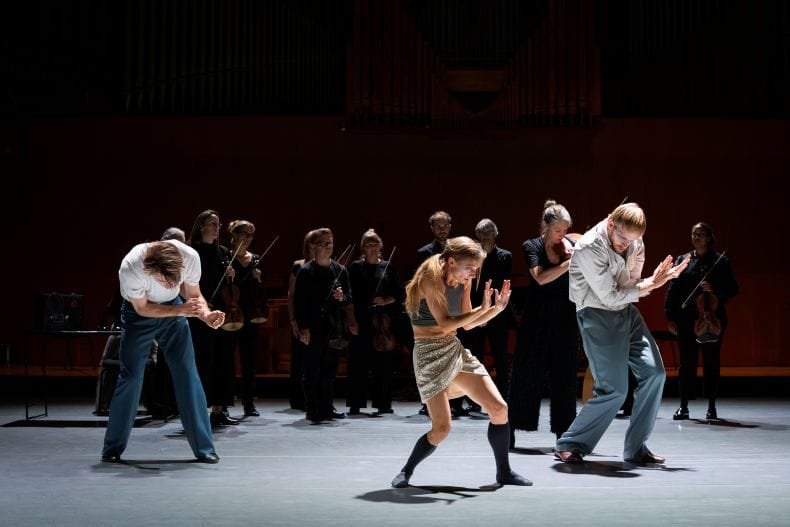
The piece is created in close creative dialogue with the performers, and many ideas were at play. Alban Lendorf entered in white makeup, possibly a younger or dead version of Simon Kongsted's journalist, the musicians come on stage, a long wire was laid out to form a stage within the stage, a short, but lovely pas de deux between Alban Lendorf and Maria Kochetkova the saving grace.
Kochetkova first entered trotting stifly around in black patent leather stilettos that she was worn in previous work by Kloborg. Her giant fur slowly transformed her in to a wolf, only for her to exit the stage on all fours and return in a full wolf costume at the end - an absurd nod to the ongoing discussions on the return of the wolf in Denmark. Singer Nicolas Tamagna then took the stage to sing 'With the Hey Ho, the Wind and the Rain' from 'Twelfth Night' with the final lines: 'But that's all one, our play is done. And we'll strive to please you every day'. And thus an evening of two distinctly different world premieres and one beloved repeat came to an and.
copyright © 2026 by Signe Ravn