In Conversation With Dance

“Prelude: Discipline Is Freedom,” “Never Top 40 (Jukebox),” “Priestess Hill,” “Messages to the Storm”
Garth Fagan Dance
The Joyce Theater
New York, NY
November 5, 2026
For its 55th anniversary, Garth Fagan Dance staged a conversation across generations. Two older works by its founder, “Prelude: Discipline Is Freedom” and “Never Top 40 (Jukebox),” were paired with 2026 creations: “Priestess Hill” and “Messages to the Storm,” by Norwood ‘PJ’ Pennewell, the company’s Artistic Director, and Natalie Rogers-Cropper, its President, respectively. The old dances proved resonant beyond their years, while the new took up some of the language of Fagan Technique, the company’s fusion of modern, Afro-Caribbean, and classical dance, and pushed it toward new themes.
“Prelude,” from 1981, read at first like a dance class, with its regimented isolations, holds, and repeated steps. It lived up to its name by turning that framework into a kind of freedom as it built to a breathless crescendo. The full company traded stillness and athletic balance for spinal release, as in a series of deep second position pliés performed with the stomach fully isolated. The routine never loosened its grip on repetition, yet the repetition began to read as an alphabet: the abrupt pauses and elongated holds that would return, to meaningful effect, in the works that followed. Class concerts are common enough, especially in the classical tradition (one need only look at the dazzling Asaf Messerer's “Class Concert”), but this is the first I’ve seen that asks a question and answers it: what lies behind the daily honing of a dancer’s tool? Fagan’s answer is that training is more than conditioning a set of muscles. It is a dialogue with the body, and the movement looked inquisitive rather than prescribed, as if the dancers were asking their bodies what else they could say.
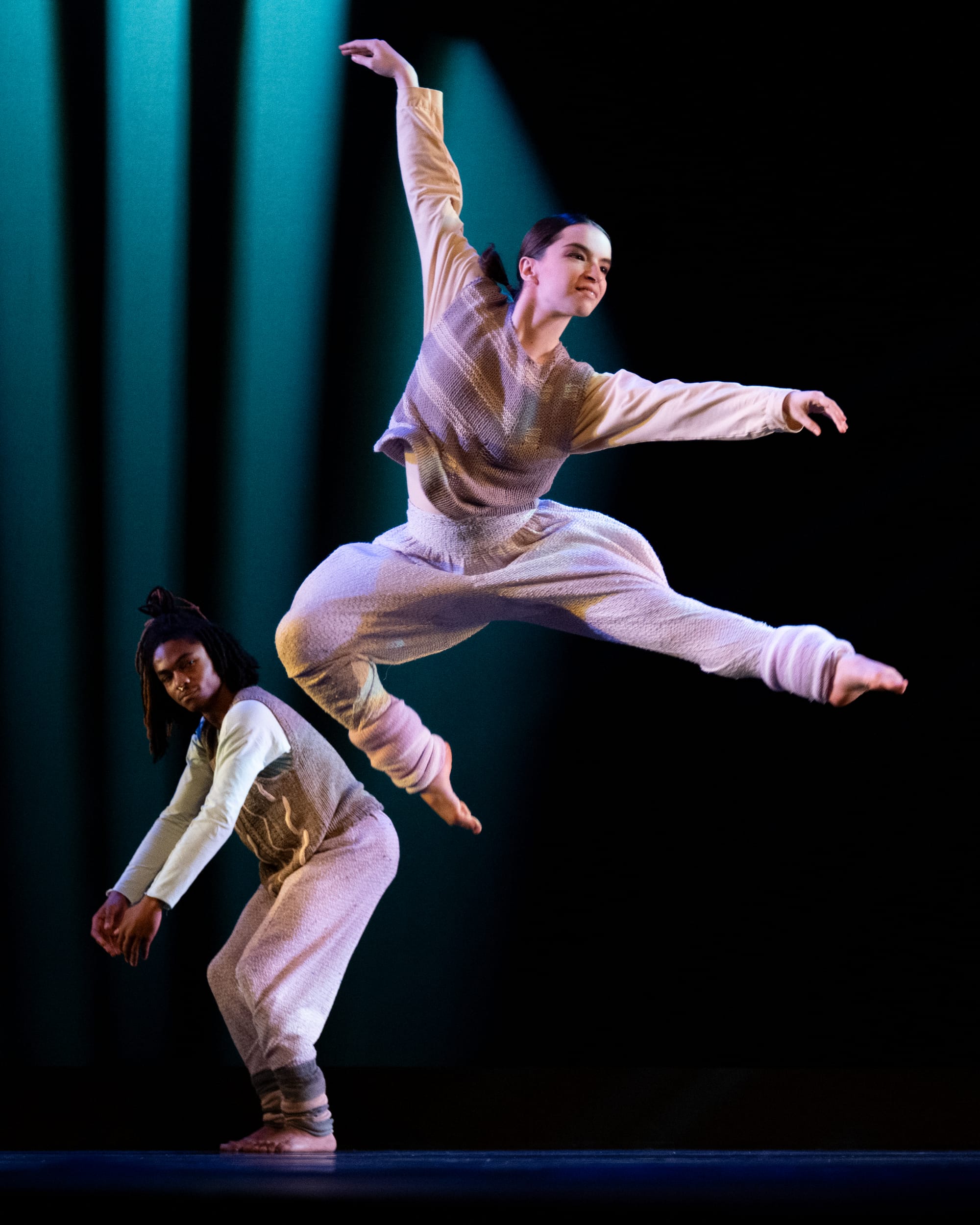
With that foundation, “Never Top 40” made more sense. Its five songs, from Puccini’s “Nessun Dorma” to Jamaican “Rivers of Babylon,” showed what that vocabulary can say once it is fluent. To “Nessun Dorma,” in the section titled “Court Dance Contemporary,” two couples danced with courtly decorum that made the dance both a spectacle and a formality at once. Jahkim Hodge-Prince, Sabrina Shiman, Raea Moorehead, and Kemal Marshall fed off one another’s expression, each couple picking up an abstract gesture from the other and sharpening it in the repetition. The later dances ranged across the stage and even brought in humor in “Dance Psalmody 137,” where Marshall hip-thrusted and tilted his shoulders to “Rivers of Babylon” with an unapologetic sense of self, delivering the punch line. Then, the finale brought the idea to its fullest form. The same four dancers who opened the piece began slowly, then, to Roscoe Mitchell’s “Walking in the Moonlight,” launched into jazz-infused duets full of playful haunches and freeing jumps. The conversation had loosened into banter.
“Priestess Hill,” set to Philip Glass’s “Days and Nights in Rocinha,” came after an intermission that felt less like a pause than a border crossing, a measure of how far this was from the original work. It carried Fagan’s vocabulary forward, but with a different grammar. The biggest anchor was the heavy use of balances, which populated the work and threatened to overtax the wonderfully expressive Kiara Jolie Haywood at its center. Balance and twist, balance and twist: her pauses said more than her movements, including many challenging écartés in a turned-in position. She began and ended with arresting motions of a finger held up in a “halt.” Those moments were some of the work’s most potent, and most differentiating: the stillnesses Fagan used as punctuation and inflections, Pennewell asked to carry whole sentences. The middle, a varied sequencing for the entire company, ran on at times and cut off far too briefly at others. Its most evocative section was for five women, hands held above their heads in a shape suggesting a water jug, or perhaps crowns.
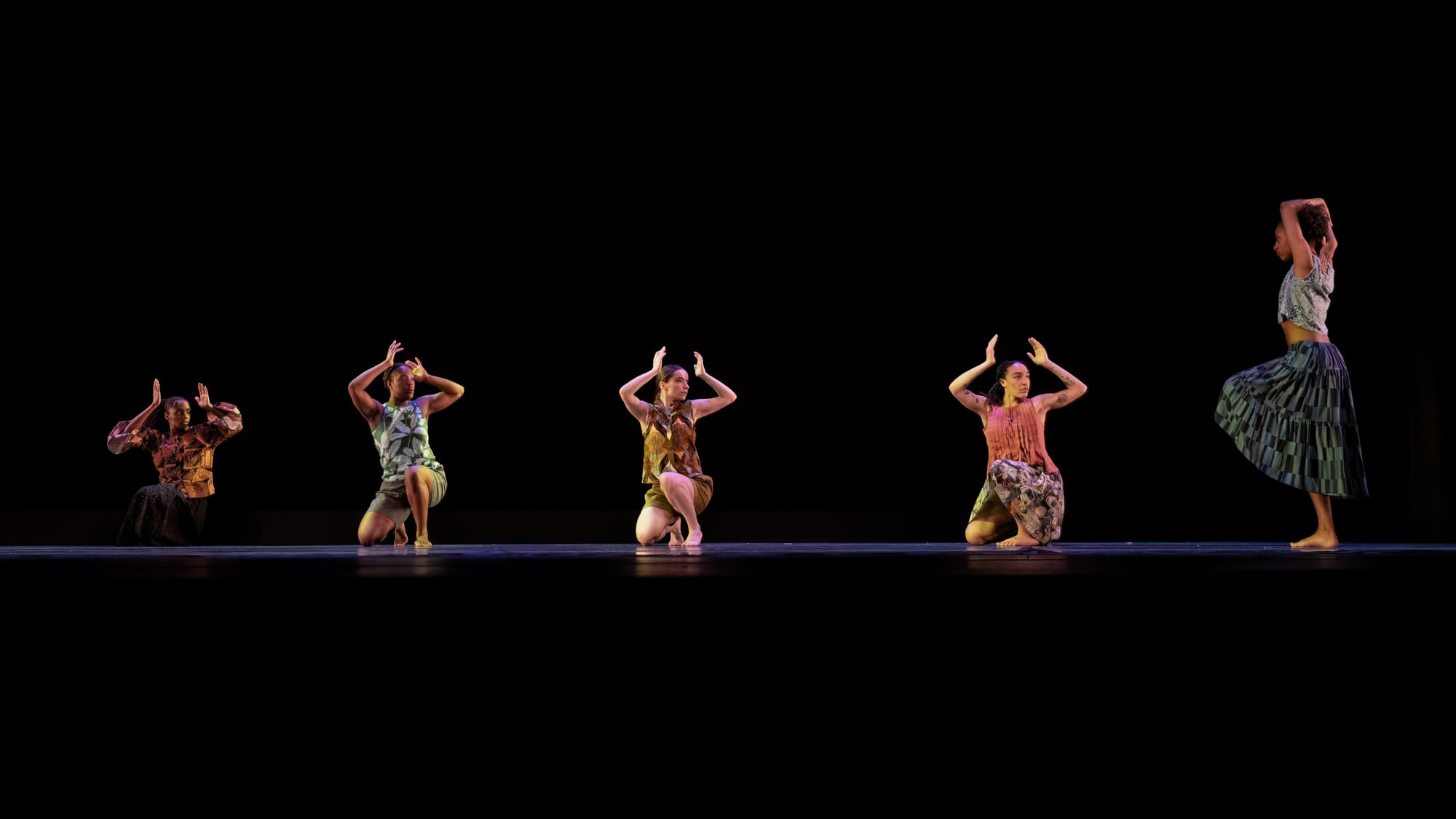
“Messages to the Storm,” named for Maya Angelou’s idea that every storm eventually runs out of rain, replied in a more unified voice. The company began as a spider’s web, moving with forward and back bends to enlarge the shape, and the collective seemed both supportive and restrictive. As the piece progressed, dancers held one another from behind and ran on and off the stage in that shape, as if protecting and propelling their partner while also restraining them. A duet for Daria Clarke and Moorehead ushered in stillness with extended balances, and seemed like the only element where Fagan’s dialect was still audible. Inadvertently, it raised a question: how closely should new works stick to the style of the company’s namesake founder?
The rest of the dance seemed to answer on its own terms. A pattern for the whole company explored the dancers’ placement in space, the women forming a straight line, those on the outside raising an outer arm to make a lingering Y across the group. The shapes then contracted into a cluster once again, its spiderweb now feeling more emboldening than restricting. It was a strong, assertive work, and showed that while Garth Fagan Dance is still in conversation with its founder, at 55 it is unafraid to talk back.
copyright © 2026 by Marianne Adams