Twenty Years and Counting
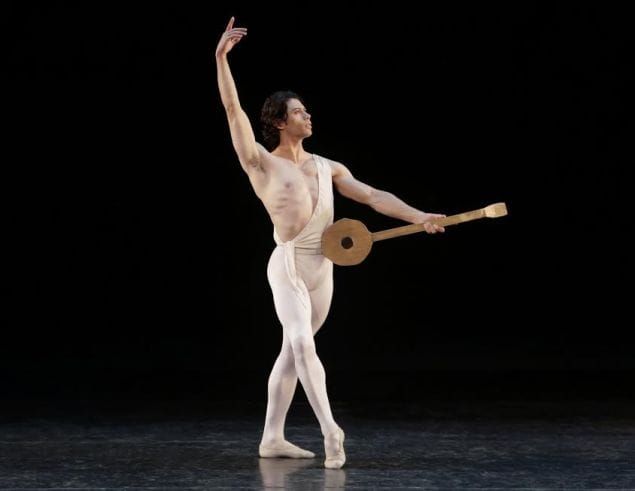
Herman Cornejo: Celebrating 20 Years
Act II pas de deux from "Giselle", Second solo from "Apollo", "Sinatra Suite"
Studio 5
New York City Center
New York, New York
December 2, 2019
Alastair Macaulay's too brief stint as Studio 55 programmer ended with a salute to ABT dancer Herman Cornejo's twenty year career with the company. Cornejo himself selected the repertoire and the dancers (Skylar Brandt in "Giselle" and Luciana Paris in "Sinatra Suite"), which with characteristic modesty highlighted partnering and subtlety rather than bravura. The evening opened with the pas de deux from Act II of "Giselle", which with its complicated balances is a tour de force for the ballerina, while the man concentrates on making her float effortlessly. Cornejo is an experienced Albrecht and Brandt will be making her debut in February; the excerpt was magical. He closed with Twyla Tharp's "Sinatra Suite", a partnering extravaganza with ends with a contemplative solo to "One for My Baby". These sandwiched the second solo from "Apollo", with its awkward energy and gripping images. In between the dances Macaulay talked with some of his colleagues: Kevin McKenzie, ABT's Artistic Director; Damian Woetzel, former director of the Vail Dance Festival where Cornejo frequently performed; and Twyla Tharp, who has choreographed several works on Cornejo. Cornejo also wanted, Macaulay said, David LaMarche, a conductor with ABT who accompanied the dances, to take part, since they were both celebrating twenty years with ABT.
After the "Giselle" pas de deux, Cornejo (breathing heavily) talked briefly with Macaulay, who asked him why he chose that particular work. Cornejo explained that he loves the acting challenge that "Giselle" gives the man; Albrecht has little dancing in Act I, but has to make an impact. For Cornejo, creating a character is more important than doing steps. Macaulay asked Cornejo how he got started. Julio Bocca, a fellow Argentinian and ABT star, was his first inspiration and he and his sister Erica (formerly with ABT and later a principal with Boston Ballet) joined Bocca's small touring company when Cornejo was fourteen. He praised the example Bocca set, his dedication and his discipline.
Then in 1996 ABT performed in Buenos Aires and for Cornejo became his dream company. The dancers were such striking individuals, and he felt he could learn so much from them and their different styles. Kevin McKenzie then picked up the story, explaining that John Meehan, then director of the ABT Studio Company, told him about the Cornejo siblings appearing in New York with Bocca's company, saying that McKenzie had to see them. Coincidentally, they took class with ABT soon after, and McKenzie said that Cornejo's absolute focus and concentration stood out from the beginning. Cornejo joined ABT in 1999 and the next year Twyla Tharp gave him a leading role in her "Brahms-Haydn Variations". Usually, McKenzie said, dancers do traditional roles before new roles are set on them. There is a vulnerability, McKenzie said, in working with a choreographer on a new role and Cornejo's progression -- original works first and then the classics -- helped develop his phenomenal versatility.
Cornejo's unique musicality was noted by all the speakers, as well as his generosity -- including LaMarche in his 20th anniversary evening was just one example. Cornejo talked about working with LaMarche in the studio (LaMarche is a rehearsal pianist as well as a conductor with the company), the joys of collaboration and the beauty (and difficulties) of Stravinsky's music for "Apollo".
Cornejo first danced "Apollo" in 2015 at the Vail International Dance Festival, and Damian Woetzel talked about working with Cornejo over the years. (He mentioned a "Fancy Free" they had danced together years ago, which must have been something to see.) Woetzel admires what he called Cornejo's "sophisticated reticence", saying he doesn't need to kill it, even when he can, and spoke in detail about Cornejo's dancing in Jerome Robbins' "A Suite of Dances", describing it as being "about the perfume of dancing", never about imitating his predecessors but always about inhabiting the role.
Cornejo wanted to dance Tharp's "Sinatra Suite", he explained, as a tribute to her support. His career at ABT started with those kinds of roles, he said, when, at nineteen, Tharp chose him for a leading role. This, he feels, opened the path for him at ABT. He thanked the audience, saying that for him, if there was no one to perform for, he might as well go home, and hoping to be back in another twenty years; he certainly would be welcome.
copyright © 2019 by Mary Cargill



