Twelve Makes A Dozen
Program A: "The Collective Agreement," "Bound To" "Hurry Up, We're Dreaming"
Program B: "Otherness," "Snowblind," "Anima Animus"
San Francisco Ballet
War Memorial Opera House, San Francisco
April 20 and 21, 2018
This past weekend San Francisco Ballet opened its much anticipated, or at least much advertised, unbound-a festival of new works with two programs of three world premieres in each. An additional two evenings will bring the grand total to twelve new choreographies. That’s a remarkable achievement for any company. One might quarrel with some of the choices but the fact that half of these choreographers have never worked with SFB – Alonzo King, Cathy Marston, David Dawson, Trey McIntyre and Annabelle Lopez Ochoa – speaks to Helgi Tomasson’s approach to programming: challenge your dancers and your audiences – but not too much. The first two openings were sold out; the quality of the dance-making high; the audience’s enthusiasm infectious. It looks like SFB may have a hit. For people worrying about where ballet is going in the 21st century, they got a glimpse.
Program A. The Festival opened with the neighbor down the street, Alonzo King, whose own Lines Ballet celebrates its 35th anniversary this year. “The Collective Agreement”, to an exquisite commissioned score by Jazz Great Jason Moran for piano and orchestra, paid tribute to the traditional ballet structure of soloists and corps de ballet. Jim Campbell's light sculptures suggested the rising and waning of light.
Of course, King imprinted his own stamp on this collective agreement. For the most part, he succeeded admirably though choreographing for the corps remains a challenge. The opening duet for Tiit Helimets and Sofiane Sylve, the woman who grabs for the stars with those precision shooting limbs, showed the male dancer in a traditional support role, yet making an impressive statement of his own. By pushing, lifting, sliding, embracing and establishing parameters, often at great speed, Helimets became Sylve’s equal. The second duet for Jahna Frantziskonis and Joseph Walsh was a gentler more emotionally vibrant work.
For the corps choreography, which ultimately incorporated the soloists, King divided the octet along gender lines with one of the opposite sex. I wondered whether these odd unisons, plus the teeny tutus , were not slightly ironic. They recalled the rockettes. Newcomer Solomon Golding introduced himself with a fine solo to music that included the raucous clapper and snare drum.
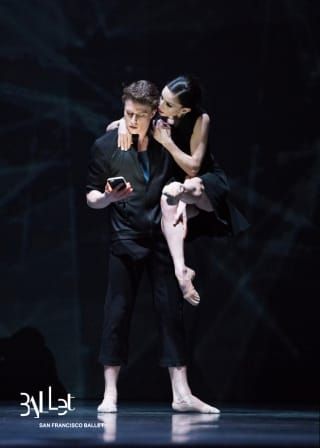
Performed in ballet slippers, Christopher Wheeldon’s “Bound To” is something of a lament for the lack of intimacy in the age of the iPhone. The work pushes our buttons gently and, therefore, communicates easily. Its touch of romanticism and nostalgia feels like a soft wind. Wheeldon has the skill and imagination to work robustly as well as delicately. Each of “Bound’s eight sections, that circle back to the beginnings, rides a trace of narrative: being different, loneliness, innocence, and desperation among others. An intruder ruins Dores André and Benjamin Freemantle's pitiful relationship while Yuan Yuan and Carlo Di languidly heats up. If the quartet of girls interacts like Isadorables; the guys value their mates. Lonnie Weeks’ brilliantly dramatic solo-- gorgeous elevation and tours-en-l’air -- about loneliness and desperation was a promotion-deserving achievement. “Bound” pulls up a finale that called up a slogan from French politics: La rose fanée (the wilted rose).
James F. Ingalls lighting design suggested that Justin Peck set “Hurry Up We’re Dreaming” in a New York subway station. Its citizens seem to be in an awful rush; they just about run even when they walk. Every pair of legs knows exactly where it is going. No wonder everyone wears sneakers.
Set to piped-in music by W83 -- too loud for my taste -- three couples and a corps of eight, this “Hurry Up’s” most unusual part is Peck’s ea employing such a pedestrian vocabulary. Whether stepping in line to slide the metro card (?), bunching up to avoid an obstacle (?), running to the arriving train (?) or crisscrossing the space to find the proper platform (?), these people are both anonymous and us. How far this vocabulary can be pushed remains to be seen. Robbins’ “Glass Pieces” was an above ground attempt.
Yet romance can sprout even on cement. Peck opens the ballet with a crowd dance in which a giggling André ends up being thrown into the air. He follows this with three finely crafted, intriguingly different duets. André and Wei Wang get to know each other by at first almost shyly by revolving around and away from each other but then graduating into ever higher and more intricate lifts. A seemingly lost Sarah Van Patten wanders around aimlessly until in Luke Ingham she meets a soul mate. Their initially shy encounter engages them in slow walks, modest turns and low lifts. If this were a musical composition it might be fair to expect an allegro after andante and adagio sections. Peck obliges. High flying, high kicking and speed rolling, young Gabriela Gonzalez and Ulrik Birkkjaer could enter a talent show.
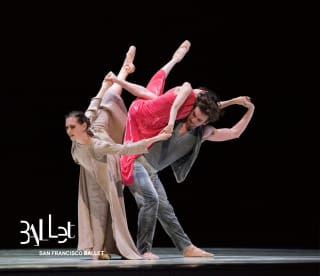
Program B. If you held your breath with Van Patten taking us into a quasi private space in the Peck piece, she did even more so in Cathy Marsden’s “Snowblind,” an extraordinarily effective interpretation of Edith Wharton’s “Ethan Frome”. Tightly constructed around this “no exit” fate of its three characters, the farmer Ethan (Birkkjaer), Zeena his wife (Van Patten) and the home help Mattie Silver (Mathilde de Froustey), they are watched over and haunted by a thirteen member chorus who in the end turned into New England’s heterosexual erinyes.
Birkkajer’s passion -- love, hate, desperation -- at times almost pulled it him out of his skin; while Van Patten frozen in her anguished needed the hands on her guts to keep herself together while De Froustey’s Mattie, with the lovely last name, had her own simple nobility. Tragedies often are defined by everyone’s being dead. Here the tragedy is that these people are not. The next SFB season will include five works from unbound. “Snowblind” should be an easy choice.
So will the other Brit’s premiere, David Dawson’s “Anima Animus” which stars two similar yet ever so different artists. Maria Kotchekova, who will leave the company at the end of this season, may be the shortest and Sofiane Sylve, perhaps the tallest of SFB women. Both of them are superb dancers, crystal clear in every move, able to hang on to a phrase for just a split second so we can take it in.
Dawson's choreography set one off against the other, not competitively but by showing individual qualities. They sail through grand jetés separately and crossing mid-stage, one like spitfire, the other ever so regally. The choreography also emphasizes separate ways of interacting with the quartet of male partners (Carlo Di Lanno, Ingham, Henry Sidford and Wei). It was delicious to watch, impossible to catch all of it.
“Anima” devolves non-stop even though Ezio Bosso’s Violin Concerto minimalist-flavored score echoes sometimes suggested alternatives. At first all ten dancers whirling, leaping and running looked chaotic -- molecules under a microscope -- until you realized some plan, such as unisons distant from each other.
James Ingall’s brilliant lighting of John Otto’s white backdrop set off Yumiko Takeshima’s black and white costumes. The trio greatly contributed to this ballet’s shimmering luminosity.
The evening opened with "Otherness" by SFB’s Myles Thatcher, who also performed in several of the new ballets. It’s a work in which he attempted to examine superficial differences between people. Not exactly new topics to examine. Max Cauthorn and Sean Orza do look very different. But what else? Here Thatcher badly overreached. He certainly learned one lesson: costumes do not make a ballet.
copyright © Rita Felciano 2018



