Tricks and Treats
"Rodeo", "Le Grande Pas de Deux", "Rhapsody Pas de Deux", "Theme and Variations"
American Ballet Theatre
David H. Koch Theater
New York, NY
October 31, 2025
ABT celebrated Halloween in grand style, handing out candy to the departing audience, holding a costume contest (I set next to the winning couple, a Venus fly-trap and a trumpet pitcher plant), and a program of tricks and treats (the trick was Christian Spuck’s comedy “Le Grand Pas de Deux” and the treats were ballets by Agnes de Mille, Sir Frederick Ashton, and George Balanchine).
Zimmi Coker and Joseph Markey made their debuts as the Cowgirl and the Champion Roper in de Mille’s 1942 salute to the imaginary Americana West and the power of dressing nicely. Coker was a touching Cowgirl, underplaying the comedy of the opening “I’m galloping as hard as I can” moves to suggest a real person trying to fit in; every high-school loner who was not invited to the prom could understand her despair. She didn’t turn it into a Cinderella story, transforming herself into a sagebrush princess girly-girl after she showed up in her new dress, but retained some of her slightly awkward charm, dancing tentatively with her newly smitten beaux, tugging her dress, and instinctively grabbing at her non-existent belt to hitch up her abandoned trousers. The little Cowgirl would never loose her spunk, and the audience, warmed by the rousing finale, cheered her on.
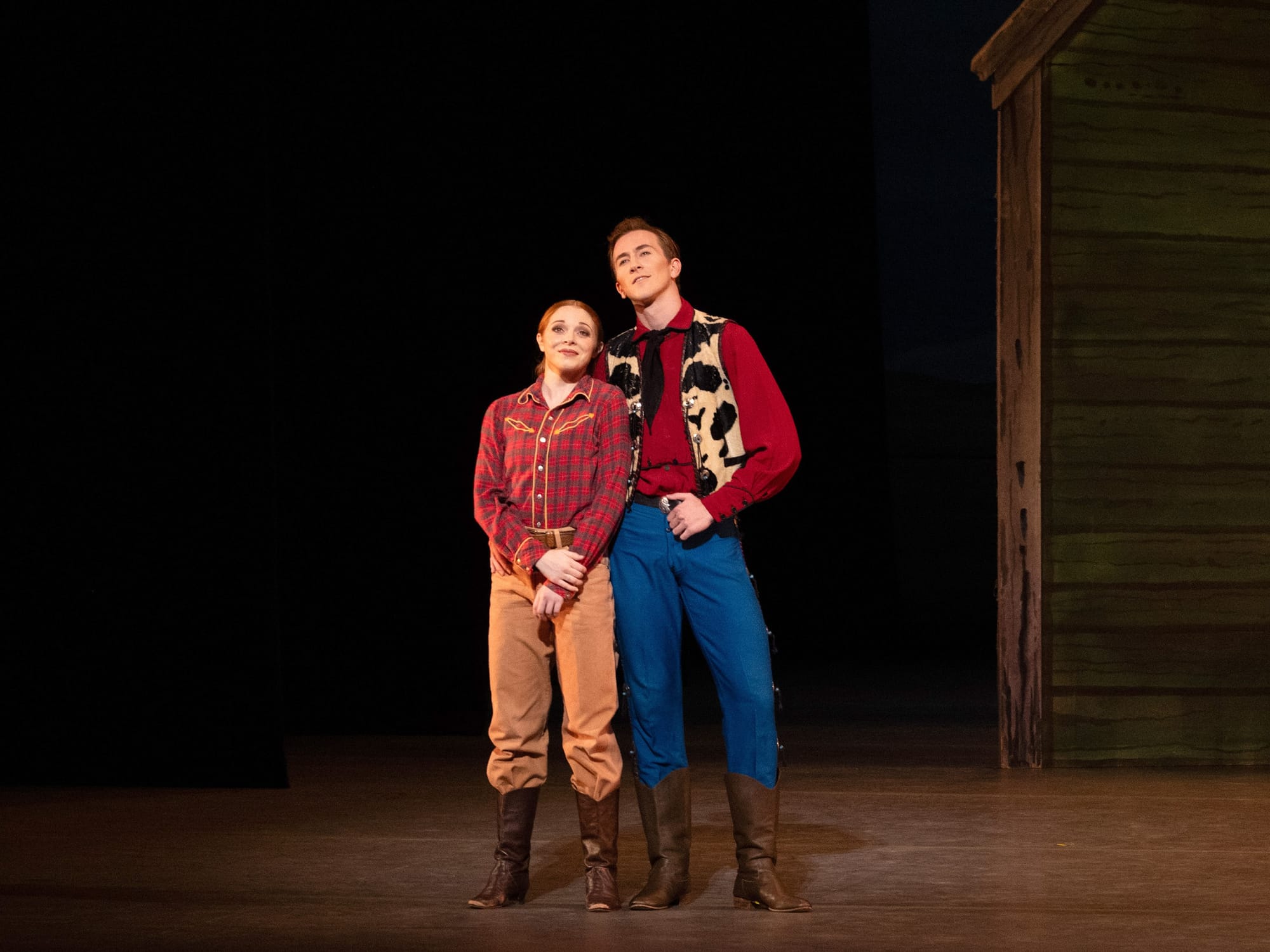
Markey, still in the corps, was a lanky, slightly awkward champion Roper with an appealing stage presence—his gawkiness made his kindness to the little Cowgirl seem especially gracious. He flew through his tap dancing with a limber ease and irresistible cockiness—he does have tap training, and he looked like he was having a wonderful time. So did the other cowboys, who moved with a thrilling vigor, even though the “I’m sitting on my horse in full command” poses occasionally looked like the horses were winning the contest.
Tristan Brosnan, also a young corps dancer, was arrogant but not overbearing as the Head Wrangler, confident in his power, but not deliberately obnoxious. His lady love, Betsy McBride, was a rather sweet Ranch Owner’s Daughter—this seems to be the current take, but I missed the snooty prissiness of the earlier prairie Odiles.
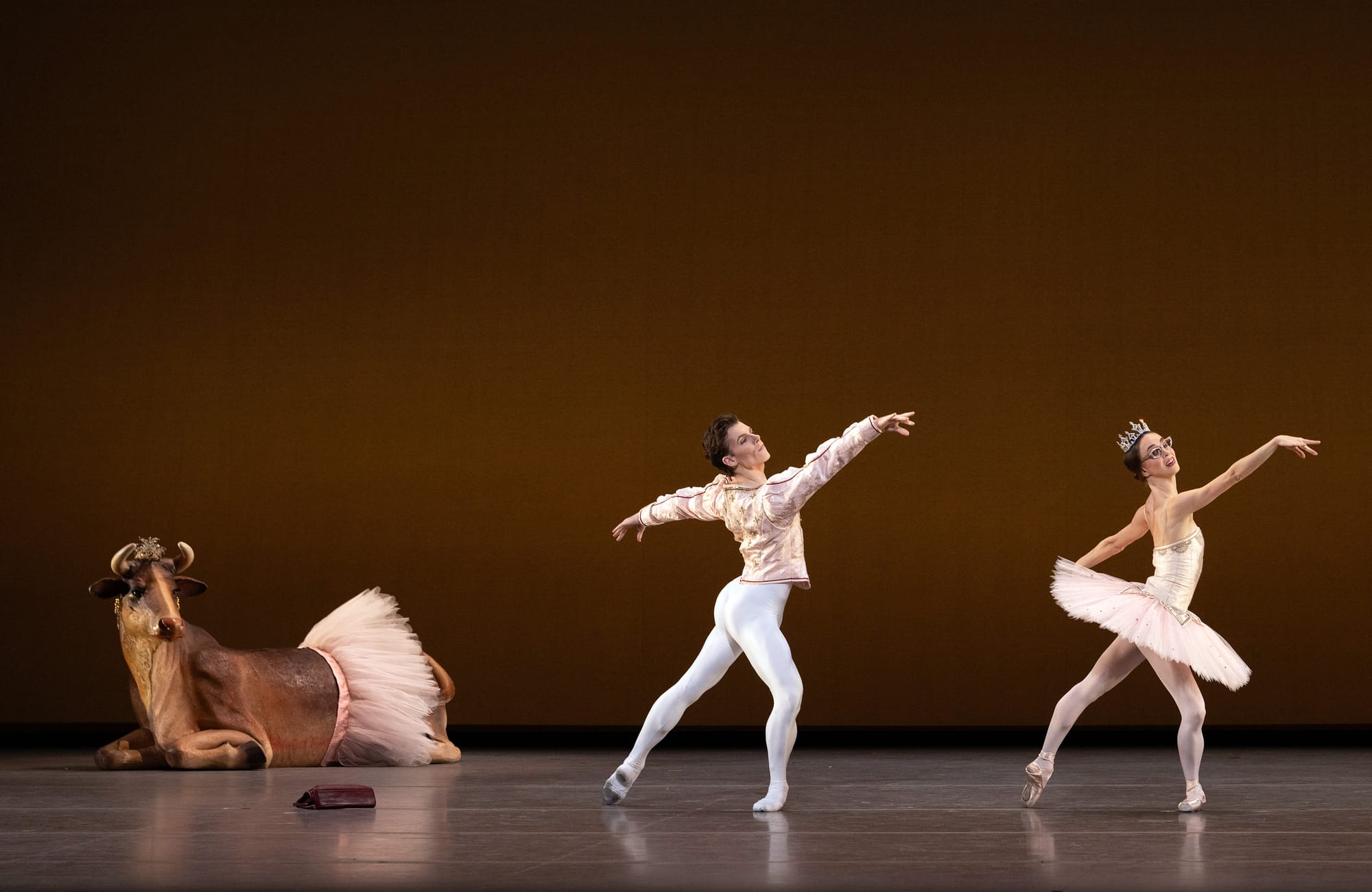
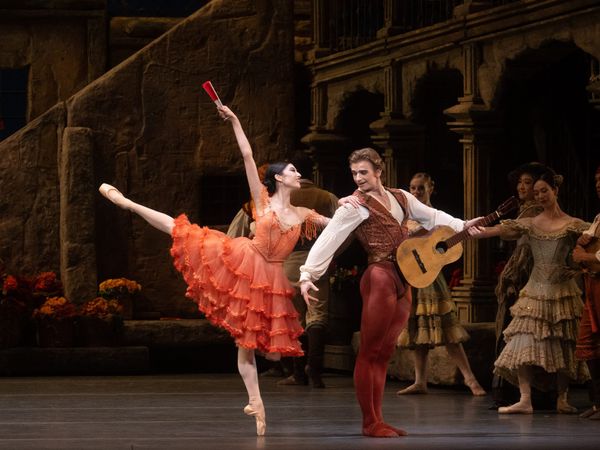
There was plenty of snooty prissiness in Skyler Brandt and Jake Roxander’s “Le Grand Pas de Deux”, Christian Spuck’s 2000 romp through every gala pas de deux under the sun. (He choreographed it for the Stuttgart Ballet, so apparently German humor does exist.) Brandt and Roxander managed somehow to underplay it, dancing with a pristine yet flashy technique while seeming to be oblivious to the jokes, both broad and subtle. There broad ones were very broad, from the intrusive red handbag and cat woman glasses to the betutued cow in the background, who passively ignored Roxander, when, like Siegfried, he asked for help finding the ballerina. (Ballet aficionados may see this as an oblique comment on Siegfried’s overall intelligence.)
There were many other ballet clichés; I loved the smug expressions after the “Grand Pas Classique” trope where Roxander propped Brandt up in a balance, only to ignore her while he was showing off his double tour, the exasperated “Oh just come over here, will you” mime, the daredevil death spiral, the by gosh and by gum torch lift, and the literally dizzying fouettés. The humor wasn’t in the dancing being done badly, it came from it being done extremely well, with all the effort showing. Their power, precision, and coordination as the choreography flowed between haute classicism to hip shaking shivers was both very funny and very impressive. The jokes continued through the curtain calls, with Brandt’s humble brag “You like me, you really really like me” bows and Roxander’s nonplused efforts to get his share of the applause. They both deserved every cheer.
Ashton’s “Rhapsody Pas de Deux” was a much quieter affair as Léa Fleytoux and Herman Cornejo floated through the three minute excerpt. It unspooled in one long breath, as Cornejo let Fleytoux float through low, skimming lifts, building to one final triumphant lifted arabesque. Fleytoux’s arms rippled through the music with delicate wrist movements, and the work had a rapturous, if too brief, delicacy.
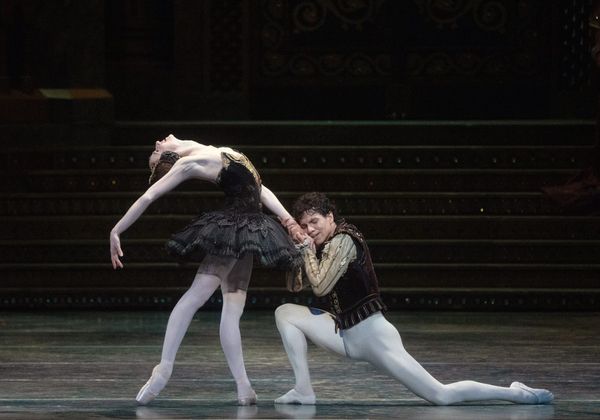
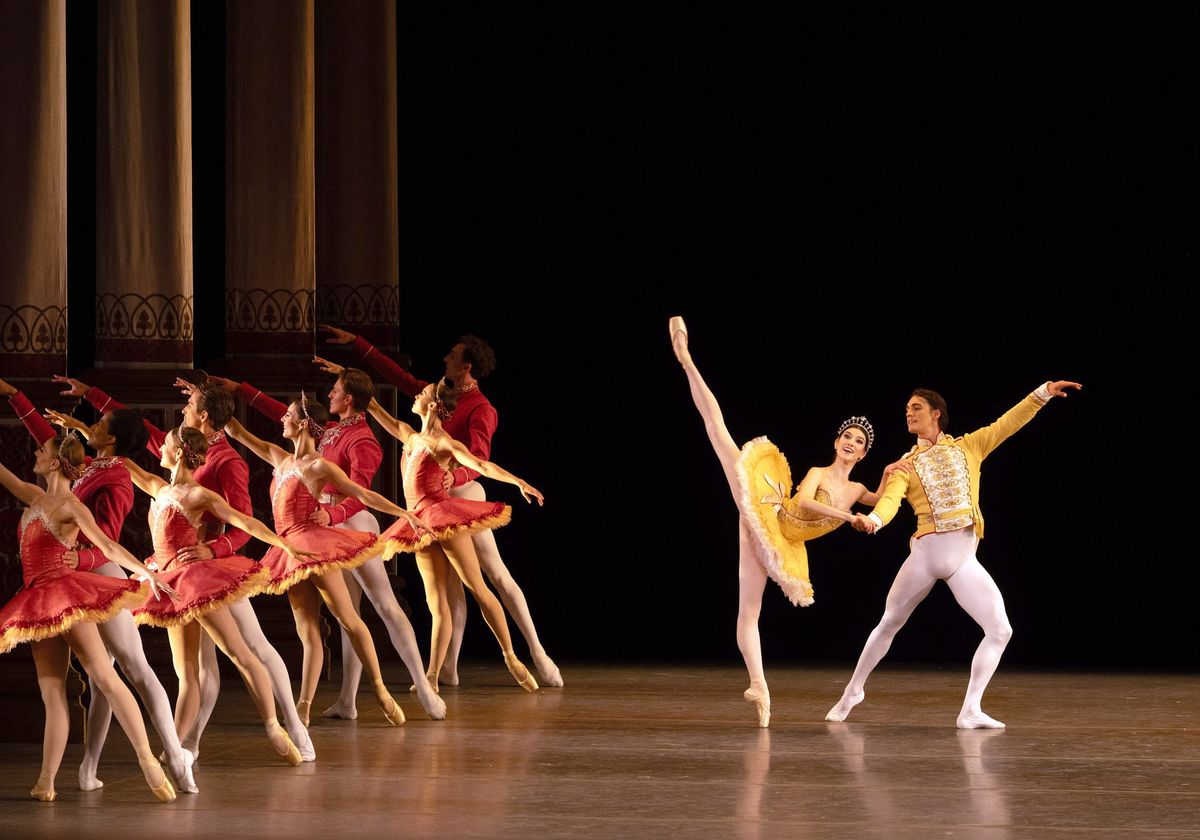
Balanchine choreographed “Theme and Variations” for ABT in 1947 at the request of Lucia Chase, who wanted a formal one-act ballet. The title came from the music, Tchaikovsky’s “Theme and Variations” from his Suite No. 3 for Orchestra, but the ballet could have justly been called “Theme and Variations from ‘The Sleeping Beauty’”, as its majesty and warmth, not to mention its final Polonaise, echo that most grand of ballets. Chloe Misseldine, in her New York debut, danced with Daniel Camargo in his debut. They both danced with an understated radiance—pearls rather than diamonds, which suited the Act III “Sleeping Beauty” feel, as order, harmony, and love have been restored to the world.
Misseldine danced with a calm and generous assurance, including everyone on stage with her regal warmth. She seemed to melt into the music, not mastering it by playing with the tempos or holding her poses but by letting it flow through her. Like her Odette, she made the pas de deux seem to be the instrument Tchaikovsky wrote for. Though his double tours did veer a bit from center, Camargo was a generous partner, joining her in the otherworldly atmosphere; a real treat without any tricks.
copyright © 2025 by Mary Cargill