Tragic Valentines
Matters of the Heart
"Raymonda Variations", "The Steadfast Tin Soldier", "The Nightingale and the Rose", "Robert Schumann's 'Davidsbundlertanze' "
New York City Ballet
New York State Theater
New York, NY
February 14, 2008
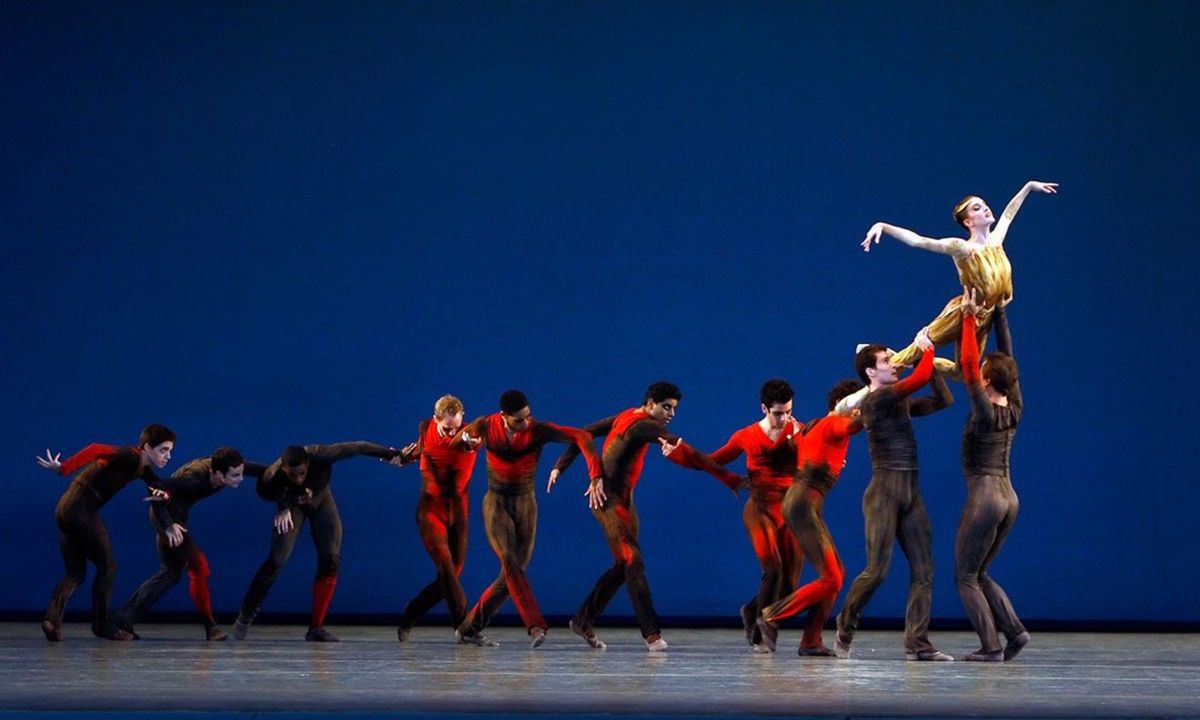
Pity the poor marketing person who thought this program was a celebration of love--the audience saw tragedy, insanity, indifference, abandonment, and death. The opening ballet, "Raymonda Variations", however, was more like it, a Valentine by Balanchine to the luscious Gazounov music. Ashley Bouder danced with Andrew Veyette, substituting for Benjamin Millepied. Bouder's performance was, on a technical level, simply astounding, without being purely technical. She can play with rhythm and phrasing, and hold her poses seemingly at will, without distorting the music; she makes the steps sing. But for me, as yet, she doesn't have the ability to make the steps speak. She seemed to be more aware of the audience than of her partner, and the pas de deux, which can seem to be a hushed and transcendent conversation, was a series of brilliant, beautiful monologues.
Veyette, too, seemed to concentrate on his dancing, which was certainly worth concentrating on. His beats, in the fiendishly difficult solos that Balanchine choreographed, were sharp and clear, and he danced with a stylish flow. But again, I missed the slightly haughty, effortless elegance that can turn an anonymous dancer into Jean de Brienne.
The five soloists, too, in an ideal production, are not just five soloists, they are Raymonda's elegant companions. Balanchine's choreography for the soloists is a reworking of Petipa's basic outline (as ABT's full-length "Raymonda" showed), which ratcheted up the difficulty, in some cases too high, since the dancers can must concentrate on the steps to the exclusion of style. Teresa Reichlen and Sara Mearns, however, as the two fouette fiends in the finale, were glorious. The current programming style, where dances are bunched together, does seem to be paying off in the performances, since the ensemble work was confident and exhilerating.
Balanchine's "The Steadfast Tin Soldier", based on the Hans Christian Andersen tale, also received a confident performance from Megan Fairchild and Daniel Ulbricht, both making debuts. Fairchild is a fine and seemingly natural actress, who gave the poor doll a genuine and unaffected sweetness, without a trace of self-conscious coyness. Ulbricht's bravura style worked very well for the toy soldier, but he was also able to give the role a gentleness and an understated pathos. This work is certainly not one of Balanchine's masterpieces, but its Biedermeier charms are not easy to convey, and the dancers met the challenge.
Christopher Wheeldon's "The Nightingale and the Rose" is also based on a literary fairy tale, this one by Oscar Wilde. Wilde's story is an ironic and slightly self-pitying fable of the artist in a shallow, bourgeois society surrounded by ignorant and pedantic critics. Wheeldon ignores Wilde's metaphors and irony, and tells, somewhat murkily, the actual story. This is choreography as Xerox machine. By the end of the ballet, we know that birds have beaks and flutter a lot, and that men in brown are best avoided, but nothing about the themes or spirit of the story.
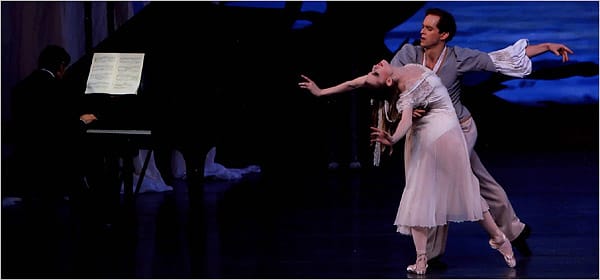
"Davidsbundlertanze", too, features ignorant and pedantic critics, but Balanchine, in one of his most imaginative coups de theatre manages in a simple and powerful stroke, to seem to summon their power up from the music, as the large black cut outs appear as the music is surging. That moment is still, after so many viewings, extremely powerful. As is Charles Askegard's tragic Schumann, all understated and inevitable tragedy.
There were several debuts, most notably Sara Means in the role so closely associated with Kyra Nichols. Abi Stafford and Janie Taylor, so long absent, also made their debuts. It may be that the current scheduling practices give works more rehearsal time, or it may be that this ballet gets special coaching, but whatever the reason, this delicate and unusual ballet got a sensitive and moving performance. Stafford, who can sometimes seem to bring the classroom to the stage, had an urgency about her dancing, focusing only on her partner, Nilas Martins, whose Danish training certainly makes portraying character on stage seem natural. Taylor was pure lace and lightening.
The only weak link in the cast was Darci Kistler, in Farrell role. Few people can capture the combination of spirituality and rapturous abandon that Farrell had, and that Balanchine stamped all over the choreography. Kistler danced carefully, which made the steps just seem quirky and her essentially sunny approach did not convey the sense of fate needed in the stunning exit where she points inevitably to the tragic end.
Mearns, who was so impressive in "Diamonds", had what can only be described as a triumph. As in "Diamonds", she managed to find her own approach, and danced it as if she had never heard of Kyra Nichols. There was an arc to her approach and she began as a younger and more impulsive Clara than we are used to seeing, rebelling against fate, supporting Schumann, and being in turn supported by him, and then at last a sorrowful acceptance. Once it was over, the "compare and contrast" stage could begin, but fortunately no one has to vote on the "best" approach, and I feel so fortunate to have seen two such very different and extraordinary versions.
copyright © 2008 by Mary Cargill



