Toxic Masculinity

"The Winter's Tale"
The National Ballet of Canada
Four Seasons Centre for the Performing Arts
Toronto, Canada
November 14, 2025
The National Ballet of Canada’s 2025-2026 season skews heavily towards newer works with a contemporary style, featuring ballets by Crystal Pite, Will Tuckett, Jera Wolfe, Helen Pickett, Wayne McGregor, Bobbi Jene Smith and Or Schraiber. The revival of Christopher Wheeldon’s “The Winter’s Tale” is the most traditional story ballet of the whole season, which is saying something. Serge Lifar’s plotless “Suite en Blanc” is filled with classical technique and Tuckett’s “Pinocchio” may have name recognition, but if you are looking for coherent storytelling through classically-informed dance, “The Winter’s Tale” is the only one that fits the bill.
It was a great move for the NBoC to go in with The Royal Ballet on this production, which premiered in London in 2014 and Toronto in 2015. Wheeldon’s talents for creating distinctive and evocative choreography and conveying complex emotions through movement are perfectly suited for this genre-blending Shakespearean tragicomedy. He worked with many of the same team members that brought him success with “Alice’s Adventures in Wonderland” – composer Joby Talbot and designer Bob Crowley.
Of the original 2015 cast, only Naoya Ebe (who plays Prince Florizel) remained on this opening night. The dancers that the other leading roles were created on have since retired or left the company (the original Polixenes, Harrison James, is still listed on the company roster but did not appear in this run and is a principal dancer at San Francisco Ballet now). As a result, this run featured a lot of interesting and exciting debuts.
Wheeldon adds a zippy prologue to quickly establish the characters and their relationships. The childhood best friends, Leontes and Polixenes, are seen playing and growing up together before both becoming rulers, of Sicilia and Bohemia respectively. Their almost brother-like closeness is shown, which adds to the sadness of their eventual falling out in Act I. A movement motif with the body leaning forward and back with one leg extended signifies their friendship like a secret handshake (and reappears in their reconciliation in Act III). Leontes is seen wedding Hermione and then giving her a large emerald necklace when she gives birth to their son, Mamillus.
Act I is the heart of the ballet, setting up the central conflict that brings tragedy to Sicilia. The sets and lighting are moody and austere, setting an ominous tone immediately with imposing pillars and oppressive, Brutalist architecture. The music here, while somewhat generic and forgettable, is inoffensive and mostly remains in the background.
Front and centre is Leontes, a king who falls victim to his own insecurities, jealousy and impulsivity. Ben Rudisin made a lasting impression in his debut in this role. It is difficult to show certain elements of the text which contextualize his suspicions of his wife, Hermione, being unfaithful. In the play, we know she becomes pregnant exactly 9 months after Polixenes visits. When Polixenes is supposed to leave Sicilia to return to Bohemia, Leontes is unable to convince him to extend his stay, yet Hermione is able to sway him. Without these details, Leontes’ jealousy can seemingly come out of nowhere. Thankfully, Rudisin sketches a detailed character study of Leontes, making him more than an abusive tyrant (though he is definitely also an abusive tyrant). His Leontes battles self doubt and seems unable to trust or comprehend Hermione’s pure and steady love.
The turning point occurs when the Hermione invites both Leontes and Polixenes to place a hand on her pregnant belly. In that moment, the seed of jealousy is planted. He grabs his son’s face, scrutinizing it to reassure himself that this is indeed his offspring. From there his psyche continues to unravel, as he hides behind sculptures, spying on his wife and best friend, completely paranoid. His angular, twisted gestures mirror his internal discomfort building to a furious explosion. His violence towards the pregnant Hermione is cruel and truly awful to see, as he manhandles her across the stage. In other moments, his violence turns inward. He hits himself and wrings his extremities, as if trying to rid himself of the irrational intrusive thoughts that he cannot shake.
As Hermione, second soloist Isabella Kinch gave a remarkable performance, proving herself an up and coming talent to watch. Despite a very youthful appearance, she brought maturity and gravitas to her role. She clearly expressed Hermione’s indignation and sorrow without overacting. Her technique is strong and clean. She has gorgeous lines and nailed Hermione’s signature arabesque turns. Donald Thom was well cast as Polixenes. His folksy solo had a whimsical, lyrical quality that brought some color and vivaciousness to an otherwise somber Act I. Heather Ogden was effective as Paulina, the moral compass of the play. She tries everything to avert tragedy. She shows Leontes the newborn baby in hopes he will realize it is his own daughter. She tries to reason with him. Her anguish when Leontes’ cruelty causes the death of Mamillus and seemingly that of Hermione is believable and heartbreaking. She breaks from her usual decorum, pounding on his chest with her fists, incredulous.
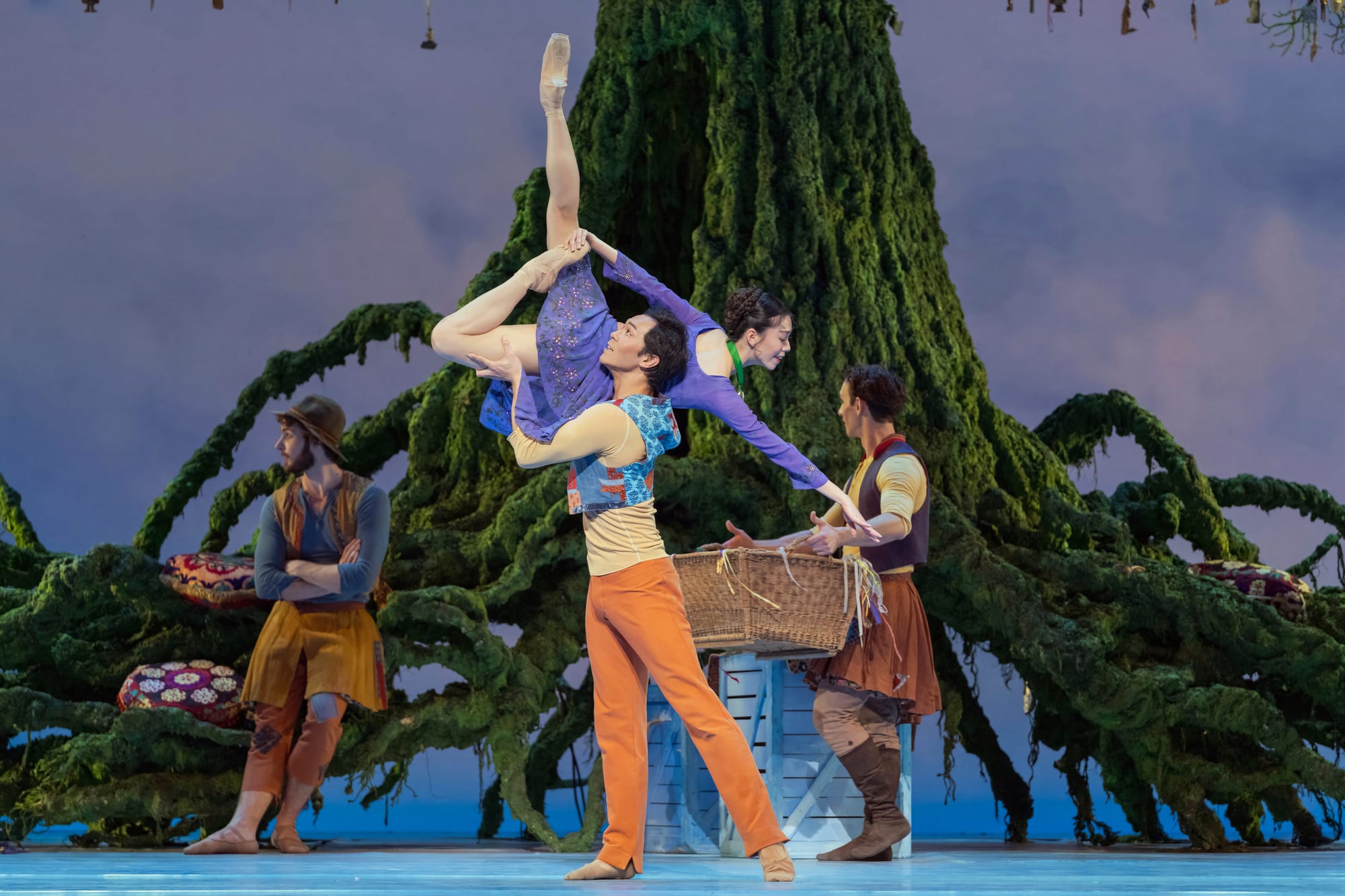
Act II transports the audience to Bohemia, 16 years later. The huge glimmering wishing tree provides a visual focal point, signifying life and rejuvenation. The music is upbeat and lively, with the on stage banda adding dimension with bansuri, dulcimer, accordion and various percussion instruments. The costumes and props lean into the boho chic vibe – the characters look like they raided an Anthropologie boutique. Many of the outfits for both men and women have skirts that move beautifully with the spirited ensemble choreography, which involves a lot of hip swivels. There are elements of comedy, such as Polixenes unconvincingly disguising himself as a villager to spy on his son. As the young lovers, Florizel and Perdita, Ebe and Tirion Law breezed through Wheeldon’s intricate choreography that is filled with jumps and acrobatic lifts. Erica Lall and Albjon Gjorllaku gave a stand out performance as a young shepherdess and shepherd’s son. Both danced with a lovely lightness and carefree attitude. Polixenes’ fury at discovering his son’s engagement to a shepherdess mirrors Leontes’ rage in Act I, although Thom’s acting is a bit over the top and not as convincing.
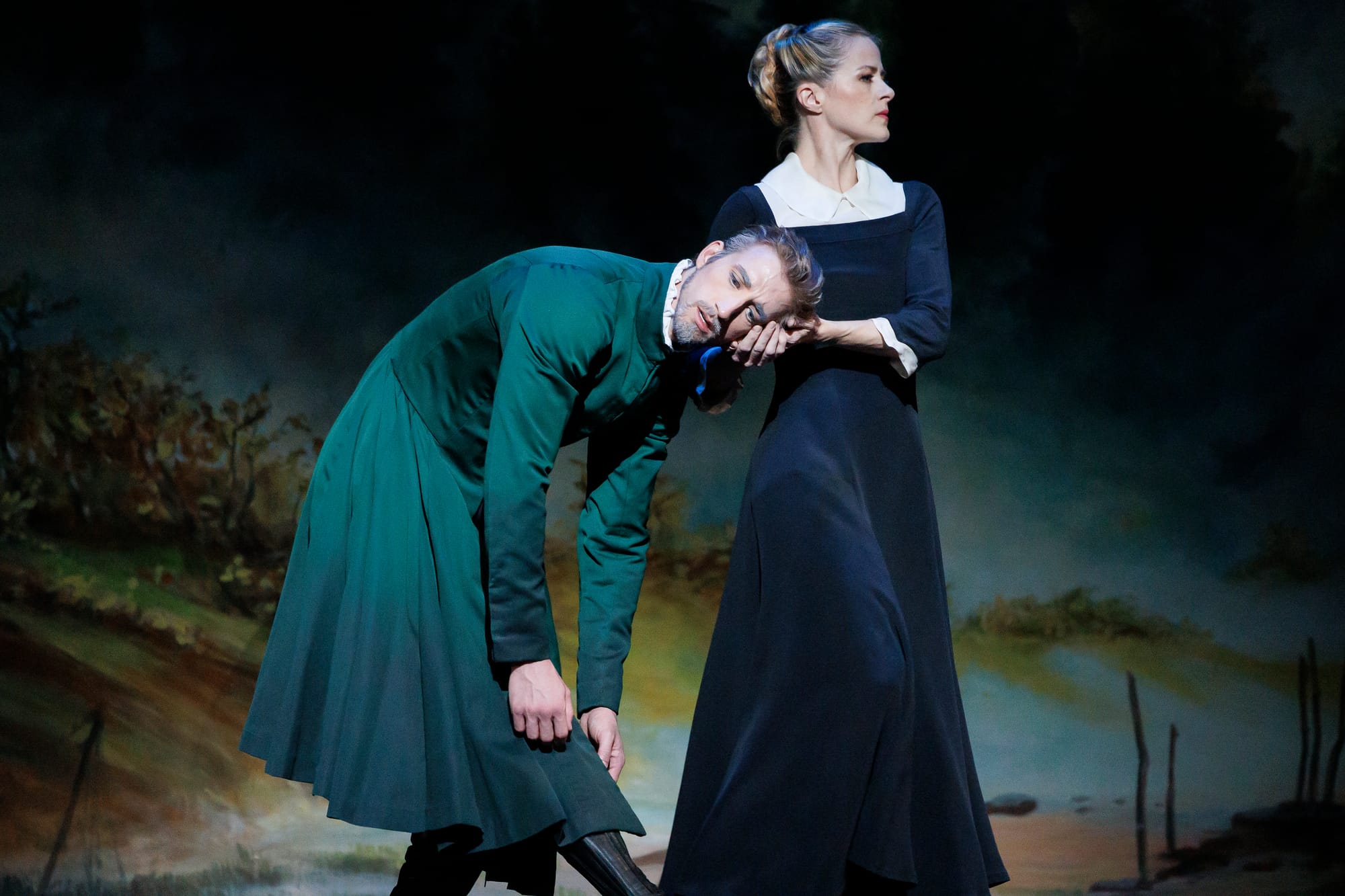
Act III brings a satisfying resolution as Perdita’s true identity is revealed, allowing her to wed Florizel and to reunite with her parents. Leontes and Polixenes are friends once again. Paulina reveals Hermione, alive and hidden all these years, to a remorseful and changed Leontes. The act begins with Leontes almost immobile, frozen in the past, hunched over with his head resting in Paulina’s hands. He is literally stuck in his grief. When Hermione returns, a spell is broken and they are able to move forward as a couple. Rudisin and Kinch were very connected in their pas de deux, where Hermione uses hand gestures to remind Leontes of their wedding vows. The ballet ends with Paulina, finally at peace (and looking very pious – her plain gown with a high, white collar makes her look like a nun). The ballet is long, at 2 hours 40 minutes. But it has enough drama and dancing to hold the audience’s attention and does justice to Shakespeare’s play.
Copyright © 2025 by Denise Sum