Too Much Imagination
"Chaconne", "The Emperor Jones", "Jamelgos"
Limón Dance Company
Joyce Theater
New York, NY
October 14, 2025
In his affable introduction to the week-long Limón season at the Joyce celebrating the company’s 80th anniversary, Dante Puleio, the Artistic Director, dedicated the performances to his predecessor the late Carla Maxwell, who died this year. She directed the company from 1978 to 2015, one of the early pioneers in maintaining a modern dance company which had been build around a founding choreographer. She worked to revive many of Limón’s older works, while commissioning new works, a formula which has been followed by other modern dance companies. Puleio also introduced the evening’s performances, explaining that he has tried to reimagine the productions, especially “The Emperor Jones”, Limón’s 1956 examination of the Eugene O’Neill play, stressing its (apparently newly discovered) queer subtext. “Jamelgos”, a premiere by the Mexican choreographer Diego Vega Solorza, who, Puleio said, is from the same Mexican region as Limón, is also a work which “explores contemporary queer masculinity”, to quote the program.
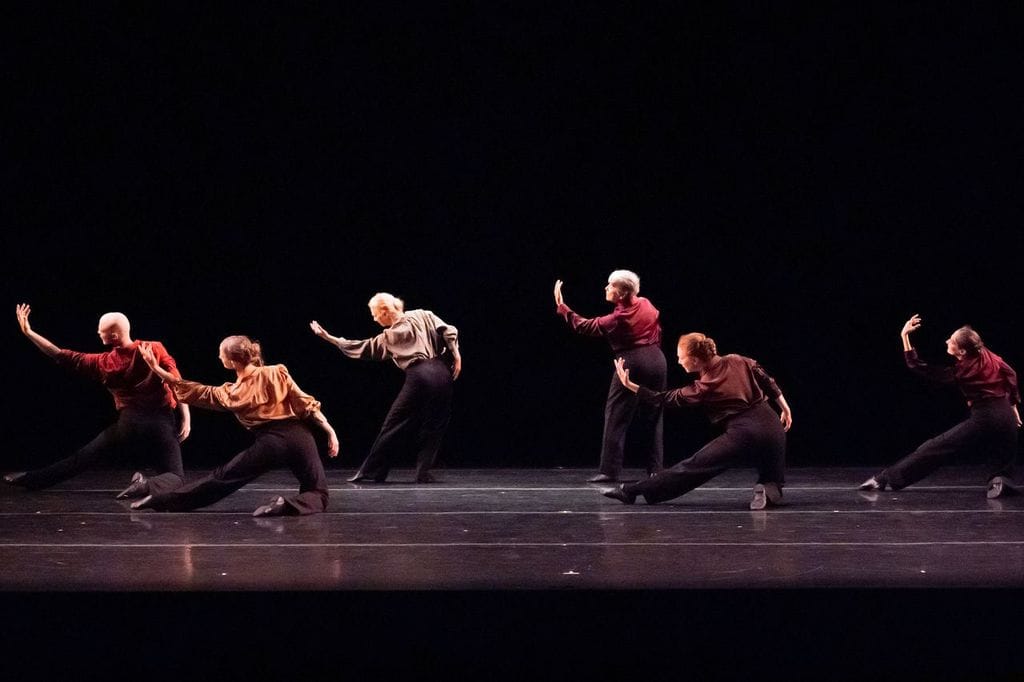
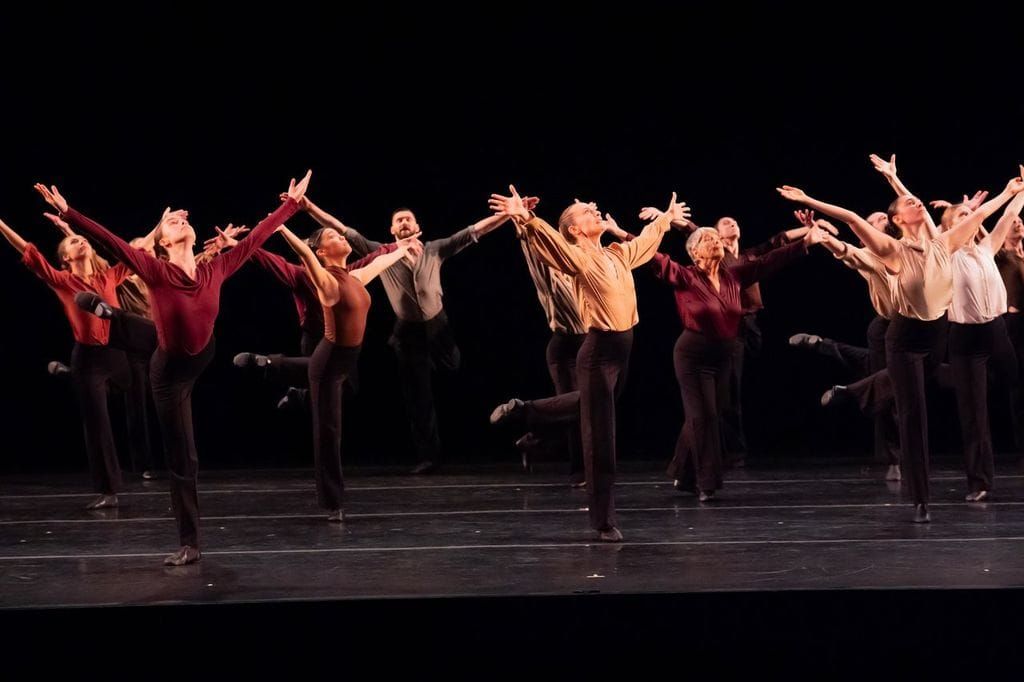
The evening opened with the equivalent of a group hug, as Limón’s early solo “Chaconne” (1942) was reconfigured as a large dance for the company, several retired Limón dancers, and students. The music, the Chaconne from Bach’s Partita #2, was played live by violinist John Marcus. The stately group, dressed in back pants and shirts of muted colors, glowed in the light, as they acknowledged the musician with gracious arms. The simple, elegant, and dignified moves, repeated with subtle variations, as smaller groups and occasional soloists emerged from the mass (Lauren Twomley danced an especially incisive solo), seemed to build in excitement. It was also quite moving to see retired Limón dancers like Jonathan Riedel and Kathryn Alter, whose incisive upper body was a standout, on stage again.
In 2011 Carla Maxwell revived Limón’s “The Emperor Jones”, which had not been performed for 25 years. It was reconstructed by Clay Taliaferro, who at the time was the only person, other than Limón, to dance the lead; Puleio was in the cast. The 2011 revival had new scenery, though it kept the original libretto and included Limón’s own description of the work in the program; “Jones, a fugitive from a chain gang, sets himself up as emperor of an island domain…[and] elaborates on the central theme, that of the superstitious terror of the haunted emperor”. As I recall, the scenery was dark and atmospheric, with a feeling of the overpowering jungle.
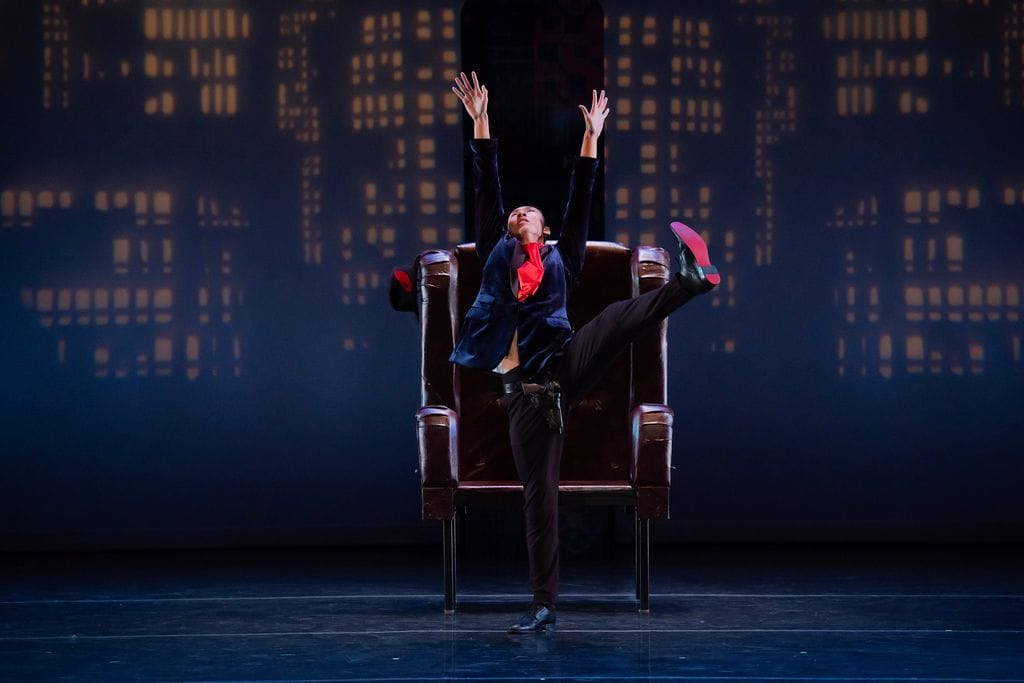
This production has shifted the location to a large city, which what looks like the New York skyline projected in the background, and opens with Jones (Johnson Guo) seated in a large midcentury-modern executive’s chair and wearing a business suit with a snappy fedora. The original Emperor sat on a throne, wearing a grandiose military uniform, a powerful and threatening presence which disappeared in the new production. Guo, a rather slight dancer, seemed frantic rather than dangerous, and the move to the city, with its open and bright atmosphere, destroyed the overwhelming sense of mysterious evil that the jungle had.
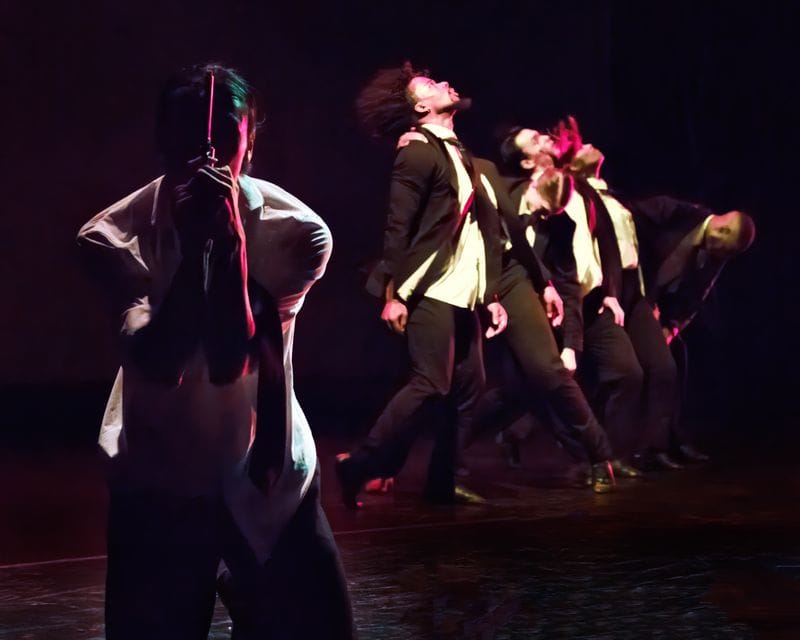
Jones’s companions (called “subjects” in the program, though the new Jones clearly didn’t claim to be royal) were also dressed in business suits, which made the usually powerful chain gang section a bit confusing—working in a cubicle may not be a lot of fun, but unless one is extremely fond of outdoor activity, it clearly beats sweating in the fields. Joey Columbus was the mysterious Man in White (the White Man in Limón’s original production, stressing the racial aspects the O’Neill play). In this production, he and Jones have a rather laborious homo-erotic relationship, which makes the downfall of Limón’s violent, powerful, failed emperor seem nothing more than an affair gone wrong.
“Jamelgos”, which is a slang term for a skinny horse, has striking visual aspects, though it is hard to see how it was “a powerful response to Limón’s oeuvre”, as described in the program. It opened with an apparently naked man lying as if crucified (the lighting was in the shape of a cross), while another apparently naked man hung above him; he was eventually lowered and walked over him, finally picking him up in a haze of bright light and trotting off formed like a centaur. (What the Christian symbolism and the pagan centaurs had to do with contemporary queer masculinity was not clear.)
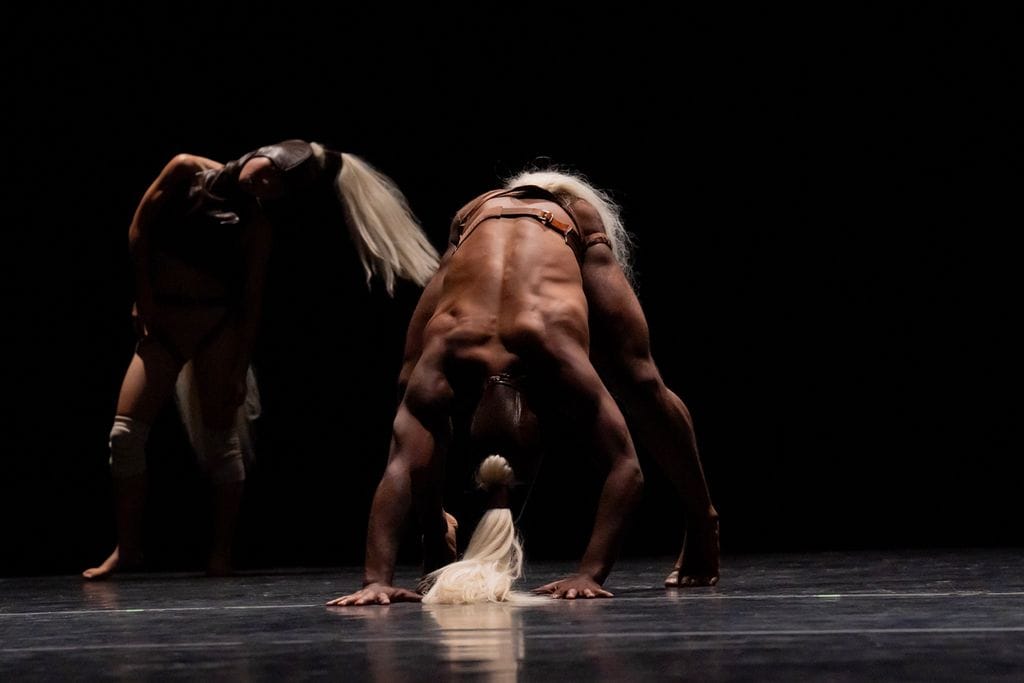
There was some ominous music (commissioned from Ebe Oke, an experimental composer based in London) and eventually six dancers emerged from the gloom wearing manes and tails and little else. They posed, slunk, and crawled through a series of poses, which had a hypnotic fascination—Ty Morrison was especially powerful. However, horses wearing bondage outfits may be imaginative but they seem to be trotting to an artistic cul de sac.
copyright © 2025 by Mary Cargill



