To Everything There is a Season
“Suite Donuts,” “The Moor’s Pavane,” “There is a Time”
José Limón Company
Streamed Live at Kaatsbaan Cultural Park
Tivoli, NY
December 19, 2020
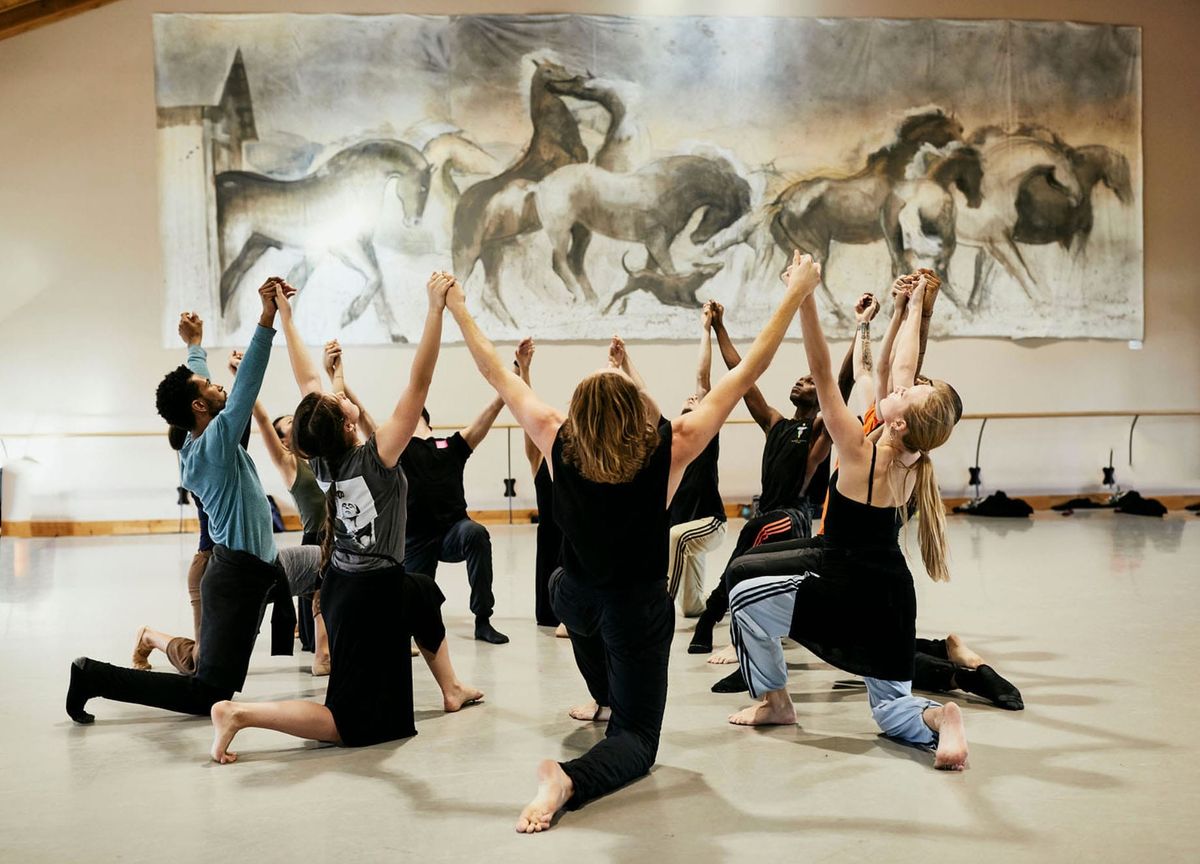
As the José Limón Company began “There is a Time,” the final piece in their live- streamed performance at Kaatsbaan Cultural Park, the dancers swept into the circle of time that Limón created in this 1956 classic. Based on the biblical wisdom of Ecclesiastes (“for every time, there is a season,”) the twelve dancers swayed, knees bent, and wove like interconnected threads. The simple elegance of a grapevine step brought the past into the present. In this time, where connection is most missed, the gift of seeing dancers unmasked and safely touching, it was a reminder of the timelessness of Limón’s finest choreography.
Kaatsbaan Cultural Park, along with other residency centers that focus on supporting artistic creation, has been improvising platforms for dancers to work together again during this time, oh so carefully, and oh so cocooned, with state health guidelines framing every aspect of the work. The Limón Company has been working in class via Zoom throughout the pandemic, but their four-week December residency allowed the company to finally come together to rehearse and create.
With their complex safety procedures in place, the company rehearsed two of Limón ‘s classic works, “The Moor’s Pavane” (1949) and “There is a Time”, and created and premiered a new work by emerging choreographer Chafin Seymour, entitled “Suite Donuts.” The company’s new artistic director, Dante Puleio, staged the Limón works, and oversaw Seymour’s new piece, which had been commissioned by the American Dance Festival for their 2020 festival. The pandemic cancelled those plans, but the dance found its way to Kaatsbaan.
The performance was dedicated to Betty Jones, a founding member of the company, and renowned dance teacher of many decades, who met Limón and Doris Humphrey in their early years at Jacob’s Pillow. In a sad double blow, the Doris Duke Theater at the Pillow burned down on November 17, the same day Jones died.
Seymour’s “Suite Donuts ” led off the program. Taking his cue from the way Limón enlisted gravity to build dynamic movement, Seymour’s characters swooped to the floor onto their stomachs and slid back upward in joyous, powerful arcs. The music, a mash-up of hip-hop, contemporary, and a bit of Eric Satie, gave magnetic energy to the intersecting bodies, as they leaned into space and let the pull of the earth aid their lithe moves. In tight clusters of their bodies (lots of heights and colors and shapes, a crowd of beautiful diversity,) they moved like a multi-headed organism, sweeping their heads in the same direction, then breaking apart.
To the punchier rhythms, the dancers’ movements turned crisp; to the ooze of the softer jazz, the movement melted; Seymour leaned into the lessons of Limón’s musicality, too. One of the sweet (donut) moments came in a musical shift, when the sound of an ovation accompanied the group collapsing flat, before a new solo began; it was the sound of an audience applauding the live-recorded music; it was also a reminder that the performers miss us as much as we miss them.
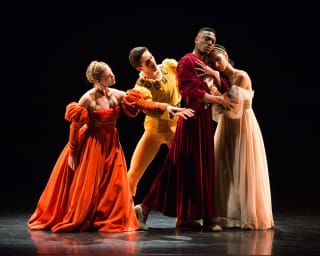
The evening’s middle piece was “The Moor’s Pavane,” Limón’s most renowned work, a marvel of economy and power. To the stately music of Henry Purcell, a group of four dancers enacted the drama of “Othello,” a short piece of tightly-coiled emotions, and the dangerous intersection of race, love, envy, and rumor, all anchored in a formal, stately diamond. Mark Willis, the Moor, embodied overpowering emotions in both body and expression, stillness and a stone face as expressive as his powerful movement. His Friend, David Glista, was serpent-like, twining his neck behind Willis’s to plant suspicion in the ear of the powerful Moor he envied. Even with his own wife, danced by Mariah Gravelin, Glista’s movement was seductively slippery, as he coaxed her to bring him the white handkerchief that was the evidence that sealed this tragedy.
Limón’s choreography anchored each move in the weight of the regal music’s rhythm. The Moor’s physical dignity, along with the jealousy that tightened his face, played out as a battle in him. Savannah Spratt’s delicacy as the Moor’s Wife (a role originally created by Betty Jones) suffused both her love and her confusion with palpable innocence. In the early steps of the pavane, she floated freely in her white gown. By the story’s end, her long neck and bare shoulders leaned back in Willis’s arms, the image of a sacrificial lamb.
The urgency – and inventiveness – of making dance and preserving dance after ten months of lockdown in America has never felt so acute. At the beginning of the pandemic, most dance stalled, halted by the rigidity of enforced social distance. A few months in, choreographers and dancers found ways to inhabit squares of Zoom. Depending on the slash of the camera icon, they performed for seen or unseen viewers and collaborators from their own solitary spaces. The slow, careful return to creating live dance is building. And it is time.
In this season of worldwide pain, Limón’s work is balm and anchor. “There is a Time” wended, in solos, duets, and large groups, through cycles of birth and death, planting and reaping, killing and healing, mourning and weeping, just as the world has been doing throughout this year. There is also a time to laugh.. and a time to dance. Dance companies are heroic in holding on and pressing forward. Limón’s work is heroic; the legacy of his movement and musicality continues to honor both him, and all of them.
copyright © 2020 by Martha Sherman



