Times expressed: present, future and nowhere
Purchase Dance Company
Spring Concert
Pepsico Theatre
Purchase College, Purchase, New York
April 21, 2006
One of the most exciting, but unheralded, developments in the current dance scene is the dedication of college dance programs to reviving older works. College programs have the time, the staff, and the will to coach and rehearse these ballets, something that professional companies often lack. So while Nijinska’s undisputed modern masterpiece, “Les Noces”, hasn’t been seen in New York for years, the students at SUNY Purchase were given the opportunity to dance it, and the audience the opportunity to be awed by its brilliance.
The program opened with another well-rehearsed revival, Mark Morris’s 1984 “Gloria”, to Vivaldi’s “Gloria in D”, which was performed with live music provided by the Purchase College Chorus and the Purchase Symphony Orchestra—live music is another benefit of performing arts’ schools performances. “Gloria” is an oblique and profound observation of religion in man’s life, inspired but not bound by the music. There is no sense that the piece is tied to the music’s period—the dancers wear variations of grey tunics, and the movement is modern, weighted and expansive. The combination is exhilarating and timeless. The dancers responded wonderfully, and though it was a true ensemble performance, the cheerful and brilliant dancers of the bright “Laudamus Te” section were a highlight.
Gerald Arpino’s 1971 “Valentine” is rooted in the ‘70’s; it's a cartoon look at the then emerging battle of the sexes. Like many comedies, it goes on too long for a single joke (a man and a woman duking it out), but the performers, Heather Daane and Jaime Rodney, had an understated and very funny stage presence, sharing the jokes with the audience, but avoiding the temptation to oversell the piece.
The only premiere was Lauri Stalling’s “The Great Quiet. It was a trendy mood piece for a large corps, with men in skirts, dancing to atmospheric but somewhat portentious music, not identified in the program, by Arvo Pärt. The gender bending seemed somewhat obligatory and aimless—most of the women, too, were in fluffy, slightly scruffy, longish skirts, with spiky hair and blank faces. The dancers occasionally struck classical positions, and moved, for all the unconventional attire, in a slightly restrained manner. It looked a bit like a graduation dance of the Punk’s School of Etiquette and it is hard to imagine it lasting as long as the other works in the program; today becomes yesterday’ nowhere in a blink of an eye.
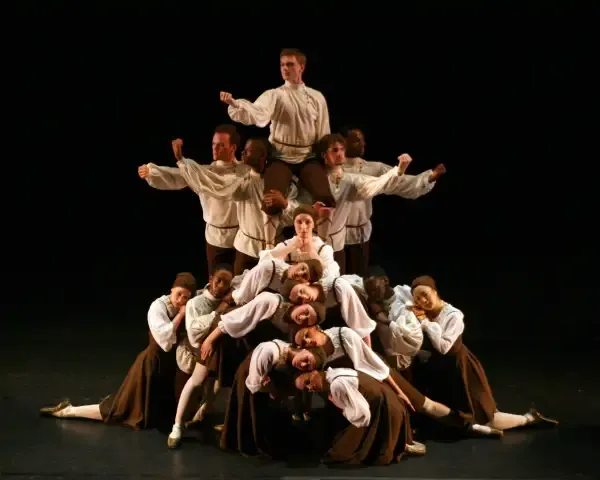
The final, glorious piece was “Les Noces”, so firmly rooted in the Contructivist 1920’s, and yet so timeless. The music was recorded—but the demands of the score had even defeated the resources of the New York City Ballet. This snapshot of a Russian peasant wedding is an homage to human suffering and endurance, its shapes seemingly carved from stone. The young dancers did not have all of the weight and resonance of a more experience company, of course, but were incredibly well-rehearsed and got the complicated rhythms—the quick jumps and turns were always in unison. There were some quibbles; the girls’ skirts seemed at bit too short and too full, and the parents looked as young as their children. The bride’s mother, though, Margaret Houston, caught the mood of resigned sorrow as she mourned the loss of her daughter. But the production was a powerful and poignant reminder of how magical and timeless a greatcwork can be.
copyright ©2006 Mary Cargill



