Those Were the Days
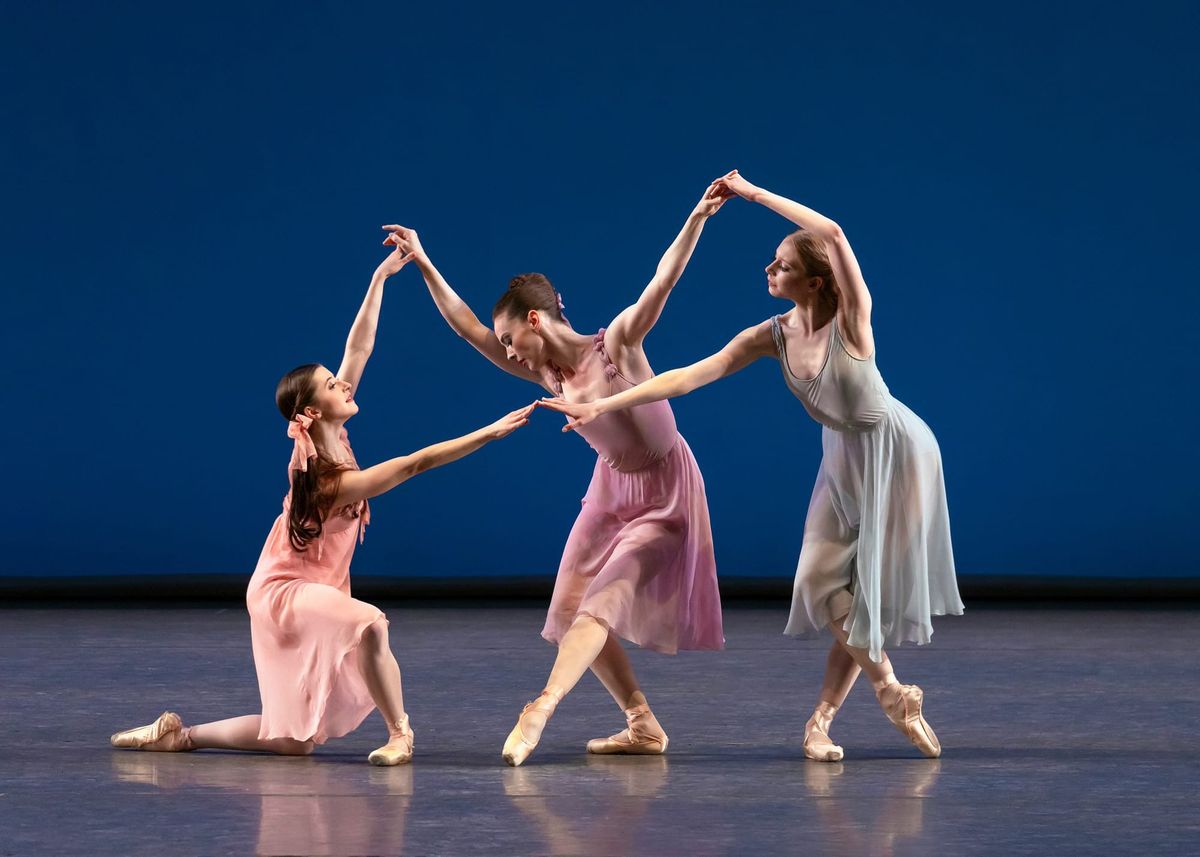
"Dances at a Gathering", "Brahms-Schoenberg Quartet"
New York City Ballet
David H. Koch Theater
Lincoln Center
New York, New York
May 12, 2024
The double bill of Jerome Robbins’ “Dances at a Gathering” and Balanchine’s “Brahms-Schoenberg Quartet” was a glimpse back at an idealized European past, where elegant youths wore colorful chiffon while dancing to Chopin and, in an idealized Vienna, beautiful and mysterious women enticed stalwart men while luscious Gypsies cavorted on the green. Both ballets can seem long and occasionally overly sentimental, but these fresh and lively casts gave committed and moving performances.
“Dances at a Gathering”, set to a selection of Chopin’s mazurkas, waltzes, etudes, and a final nocturne, played with rhythmic verve by Hanna Hyunjung Kim (who received a blast of applause at her curtain call), is set in no specific time or place, though there are hints of Eastern European folk dancing, a bit of cinnamon in the whipped cream. Anthony Huxley, as the opening boy in brown, entered softly, looking around; he had a quiet, contemplative air, though his walk was a bit studied and I missed the slightly casual, impromptu air of someone caught up in his memories. He is a bit softer and slighter than many earlier men in brown, and, though his dancing was sharp and clear, didn’t quite convey the sense of leadership, of his feelings evoking the dances that followed.
The dances that followed were certainly worth evoking and the emotions—love, loss, joy, friendship, daring, and the final resigned acceptance, were rich and varied; it is a ballet seemingly made up of brief, lovely lyrical poems. Aaron Sanz, in green, was absolutely focused on his partners, and used his long legs so beautifully, extending his arabesques with lyrical control. Chun Wai Chan, in purple, was more outgoing, jumping into his deep plies with a wonderful swagger. He was very funny in his competitive duet with Huxley, convinced that he could out dance him. (It was a tie.)
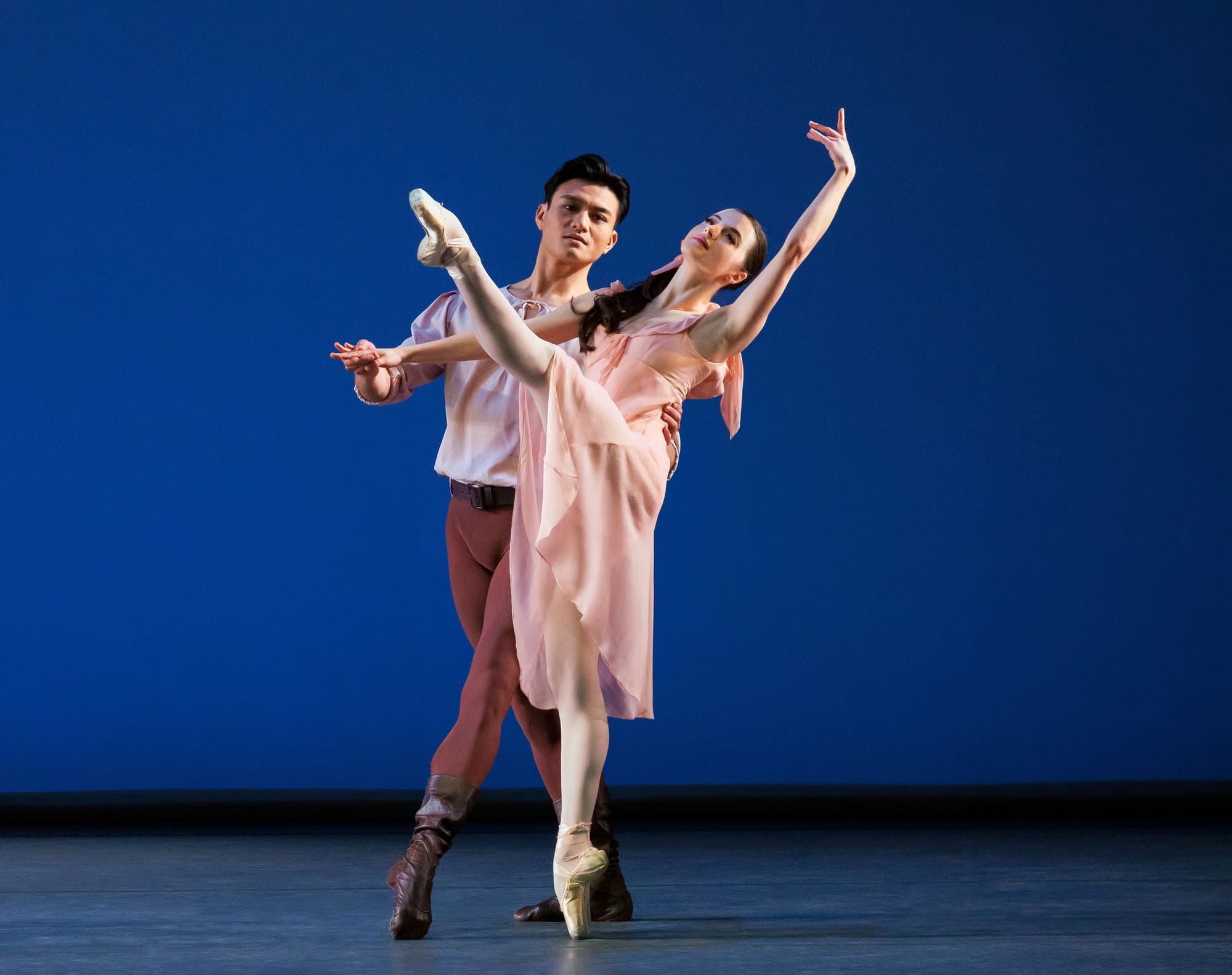
Indiana Woodward was both witty and elegiac as the girl in pink, and seemed to be in her own world; the final sweep of her hand looked like she had modeled her wrist on the Pietà. Ashley Bouder, in green, was definitely in her own world, and seemed to be revisiting past triumphs in her solo; she gave it a slightly bitter sweet air. There was a lot of sweetness, as well as some unease in Emilie Gerrity’s plangent mauve, and she gave her final dance a slightly uneasy air, as if she were desperately looking for something; she was profoundly moving without any self conscious acting.
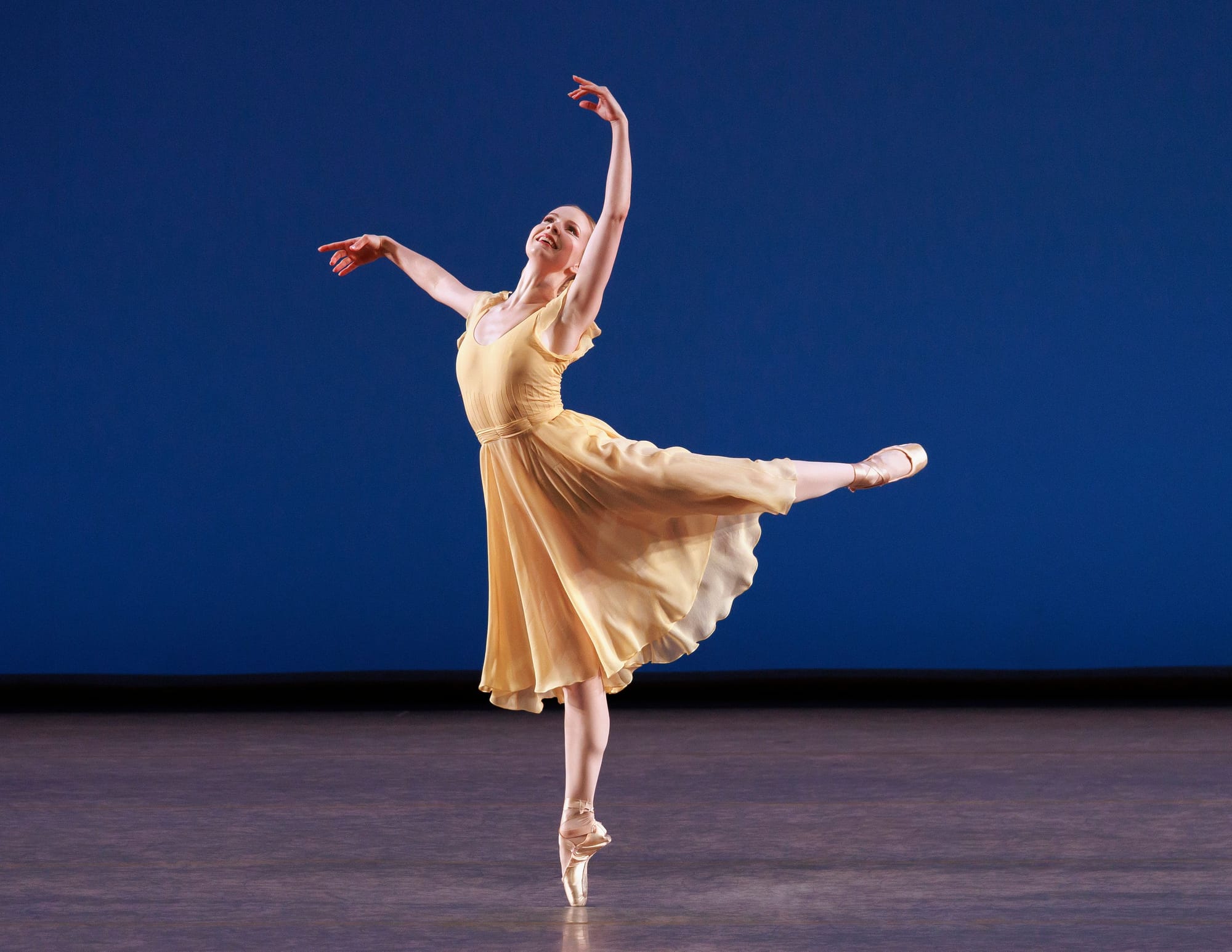
Olivia MacKinnon, with Victor Abreu, sparkled in the infectious giggle dance, and she hurled herself through the air with breathtaking courage in the last of the always gasp inducing series of jumps, caught at the very last moment by Sanz. Even to dancers in blue (Dominika Afanasenkov and Davide Riccardo) who can sometimes disappear in the apparently inexhaustible series of dances, made distinctive impressions; Riccardo is a noble presence, and Afanasenkov has a commanding lyricism. But fine though the individual dances were, I found the thread of friendship, of sharing, of companionship which connected every one of stage to be even more impressive.
Balanchine’s “Brahms-Schoenberg Quartet” is a more formal excursion into the 19th century, with wonderfully varied corps patterns. The music, Schoenberg’s orchestration of Brahms’ “First Piano Quartet”, is gloriously melodic and chocolate box pretty. The costumes (Karinska) and setting, lush, full-length curtains parted to show a vista of Austria’s Schönbrunn Palace, blend into a mauve mist. The audience seemed to be seeing things through a haze; an elegant, Romantic vision.
The first three sections can sometimes merge together in a swirl of net and shifting corps formations, but the dancers gave them distinct flavors. Alexa Maxwell floated through the opening movement like a haunting memory, appearing and disappearing at will, with little runs and flowing arms and she was quietly dominating. She haunted Peter Walker, who was a generous partner, but whose forthright and openhearted persona seemed more suited to the American plains than the Viennese woods; it looked like he was a 20th century visitor trapped in an Austrian Brigadoon, an interpretation which certainly had its own powerful effect.
Miriam Miller led the well-drilled cohort of sylphs with a sweeping vigor—a Lilac Fairy with a hint of Myrta’s steely determination. The dancers did seem to be moving on moss, their point shoes making no sound; Balanchine used a fair amount demi point in this movement which certainly helped eliminate any tap-tap-tap, and gave a 19th century charm to the little skittering runs.
There was no skittering in the second movement, danced by Mira Nadon and Gilbert Bolden III. The haunted ballroom aura and the three female soloists certainly resemble Balanchine’s earlier “La Valse” but why let a good idea go to waste? The restless, pulsating music and the somewhat ambiguous ending remove any feeling of ultra sweet sentimentality and Nadon used her innate and slightly remote glamour and her rich, deep backbends to sweep through the music, supported nobly and unostentatiously by Bolden.
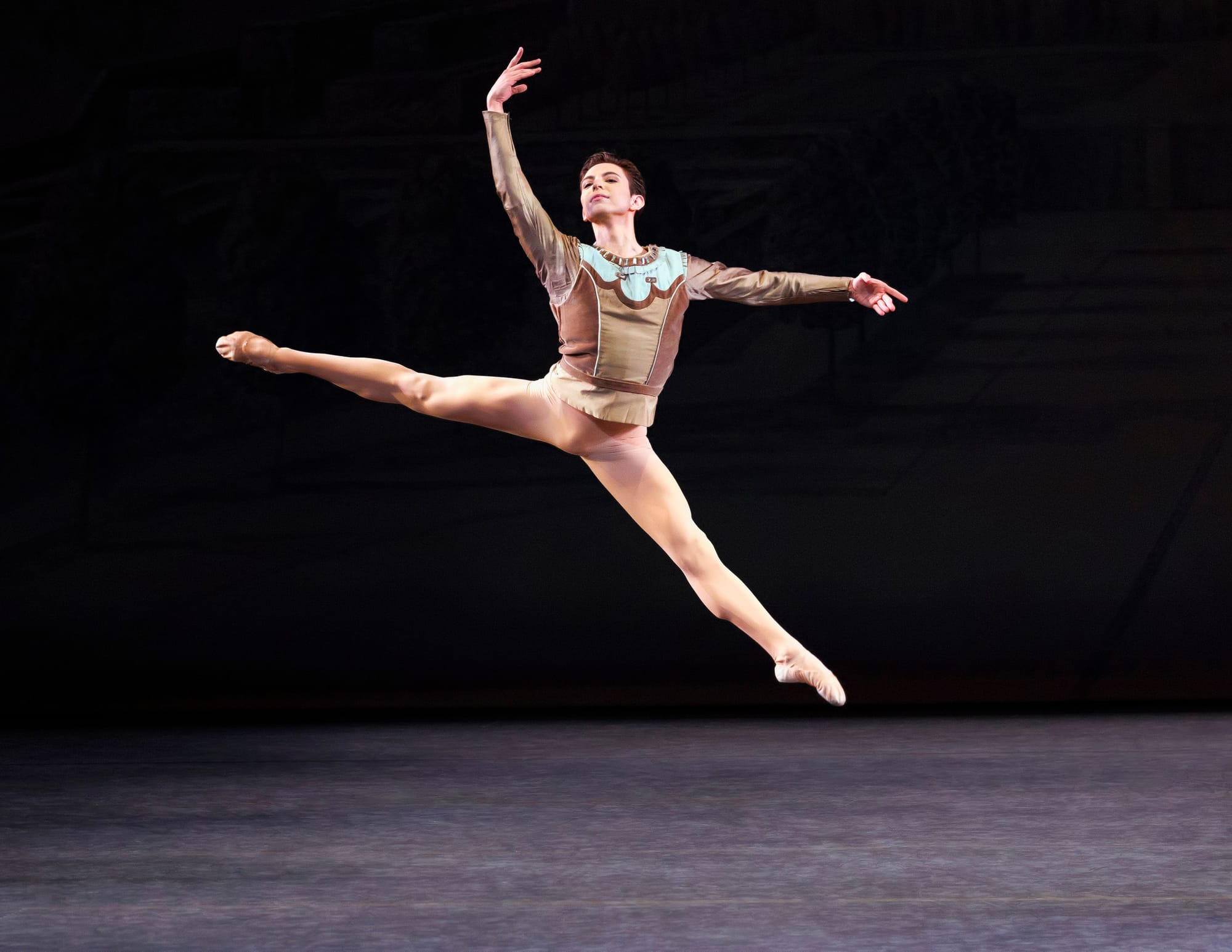
The third movement went back outside, with more sylphs, this time with a more martial air, as they surrounded the couple (Erica Pereira and Andres Zuniga). Zuniga danced with a lyrical nobility and a stylish explosiveness, shaping his arms in a calm and generous curve and using his head and shoulders as if he were wearing plumes and holding a lance. Pereira was neat and precise, though she gave her dancing a rather youthful, sunny air, so at odds with Zuniga’s richer, elegiac approach; she skipped through her solo as if she were practicing for “Stars and Stripes.”
Unity Phelan and Andrew Veyette got to romp through the Ronda alla Zingarese with all the gypsy cliches intact; it was an invigorating finale. Phelan, who can at times be somewhat blandly perfect, seemed to be having the time of her life, playing with the music and flirting with Veyette (and the audience). She threw herself into the backbends and the high kicks, and looked stunning in her beribboned costume. Veyette, too, seemed to be having a wonderful time commanding his cohorts. His jumps may not have been as effortless as they were several years ago, but his concentrated energy and smoldering masculinity, just this side of parody, were a glorious reminder of just how much fun showing off can be.
copyright © 2024 by Mary Cargill



