There is a Season
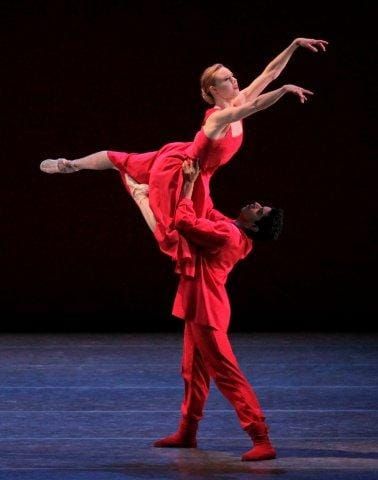
"Russian Seasons", "Namouna, a Grand Divertissement"
New York City Ballet
David H. Koch Theater
New York, New York
April 26, 2017
The Ratmansky evening of New York City Ballet's heartily advertised "Here/Now Festival" (ballets created for the company in the last thirty years) had two works, both featuring a generous supply of fine and striking dancing. "Russian Seasons" from 2006 with its color-coded costumes and folk-inflected weighty choreograph looks a bit as if the peasants of Nijinska's "Les Noces" decided to produce "Dances at a Gathering" but it is in no way copy or a reduction of those two great works. It is powerful, haunting, and timeless, an unsentimental sculpture of the eternal peasant.
The music, evoking the four seasons though the calendar of the Russian Orthodox Church, includes some songs (sung live by Veronica Mitina) and it is a shame the lyrics were not provided or at least summarized; Sara Mearns' fierce, frantic dancing, so powerful on its own, would have been even more dramatic had the audience understood that she was being forced into a marriage, a bitterly ironic comment on Spring's bounty. But the ballet's arc from spring to winter was clear as the dancers gave their stylized gestures both strength and a hard-won beauty.
Taylor Stanley, in his debut as the main male character, had both grace and weight, especially in his folk-inflected solo with the fast footwork. The three featured women (Mearns, Megan Fairchild, and Rebecca Krohn) all danced with distinctive flavor. Mearns, of course, can make any move look shattering, as she kicked against her fate. Fairchild shed her youthful, piquant charm for a fluid, expansive, and rather dark approach, pulled by the uneasy, ominous music, especially in the autumnal section as she climbed over a group of men with desperate little grabs, reaping, perhaps, the remains of the harvest.
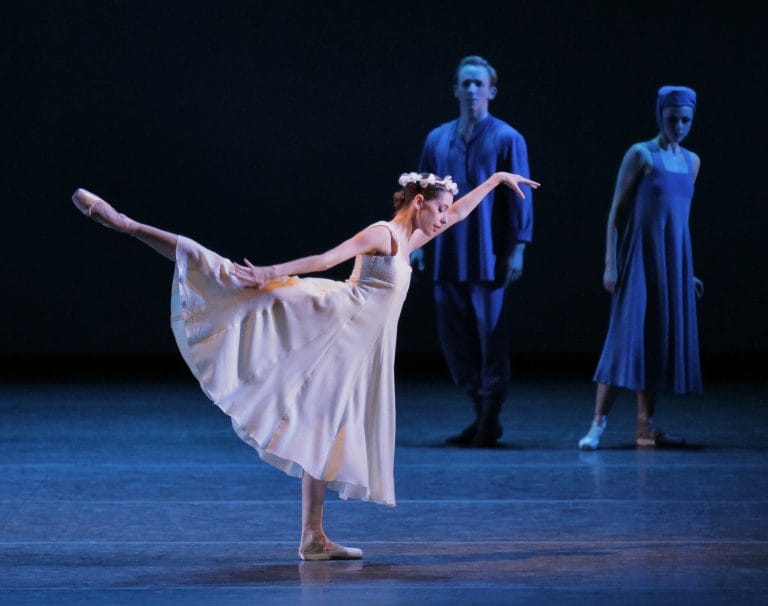
Krohn was the lonely outsider; one lyric told of her picking daisies, which were echoed in her flowered crown as she and Stanley, now in white, ended the ballet by merging into the light as the singer's "Hallelujah" soared through the music.
"Namouna, a Grand Divertissement" also featured one man and three women (Tyler Angle, Mearns, Ashley Bouder, and Stirling Hyltin) and a distinguished score (by Edouard Lalo). This was criticized at its 1882 premiere for being too Wagnerian, a frequent nineteenth century put down of sophisticated dance scores. The original ballet, choreographed for the Paris Opera Ballet by Lucien Petipa, elder brother of Marius, was a complicated story of a slave girl with two admirers, and included dueling, pirates, an island retreat with lots of veiled women, and a cigarette. (Namouna the slave girl was supposed to smoke seductively and reportedly Rita Sangalli practiced inhaling but the opera decided she should only light up.)
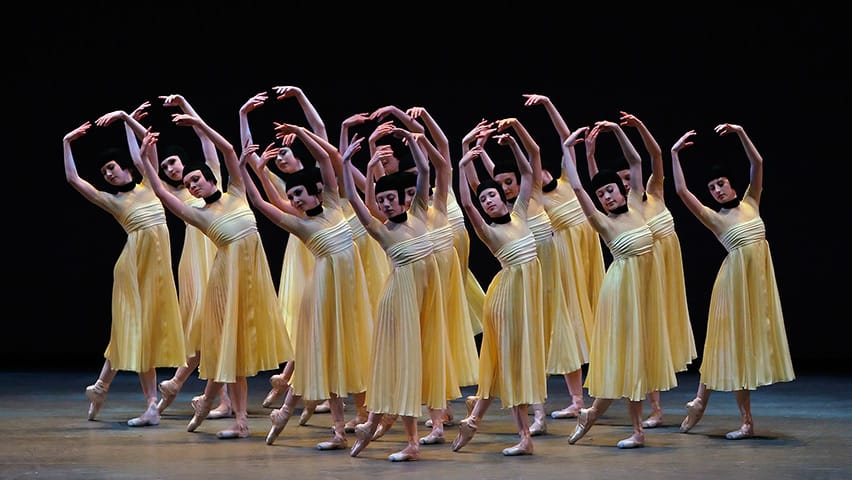
Ratmansky did not to recreate the ballet but rather do evoke its atmosphere. He did this with his tongue firmly in his cheek which, for me, undercut the light-hearted, spun sugar rhythmic beauty of the music. The cigarette motif, which must have been daring and exotic in the original, was pounded for yucks, much like the Hayworth/Astaire accidental bump was in Robbins' "I'm Old Fashioned". Boulder, the corps, and Angle all blew smoke energetically and quit unselectively and Bouder even dropped some ashes into the orchestra pit, practically begging for laughs.
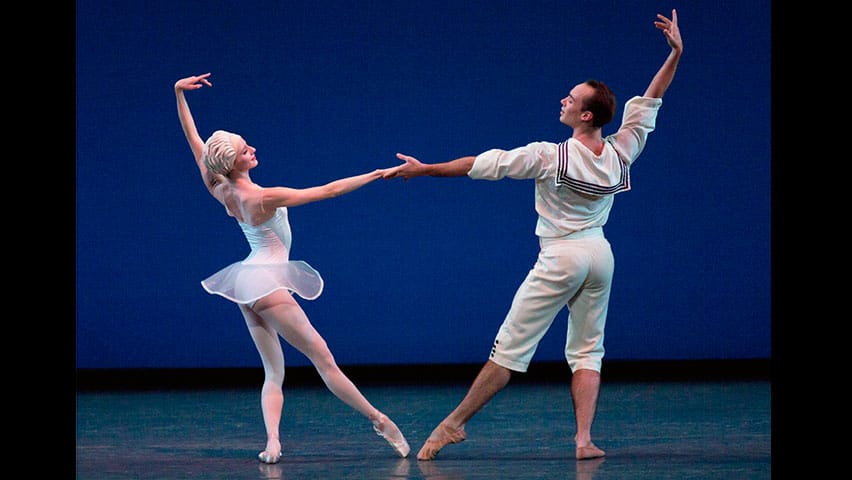
The costumes, too, undercut the music's sweetness, with the corps in black Louise Brooks helmets and the three women (and later the corps) in white, lumpy, and very unflattering bathing hats, which made them look like their brains were exposed. The man's little boy sailor suit may be a dig at the dim-witted, childish nineteenth century hero but it undercut much of the grown-up emotion of the final pas de deux.
There are some striking choreographic images underneath the costumes, especially in the opening corps formations and in the beautifully made underwater scene with the swaying corps. But the work seemed to wander disconcertingly between respect for ballet's traditions (Angle got to mime a version of "Oh, you beautiful women, I am looking for love" with a heartfelt and moving sincerity) and an elbow in your ribs undercutting of those same traditions. But the music is wonderful.
Copyright © 2017 by Mary Cargill