Theme Music
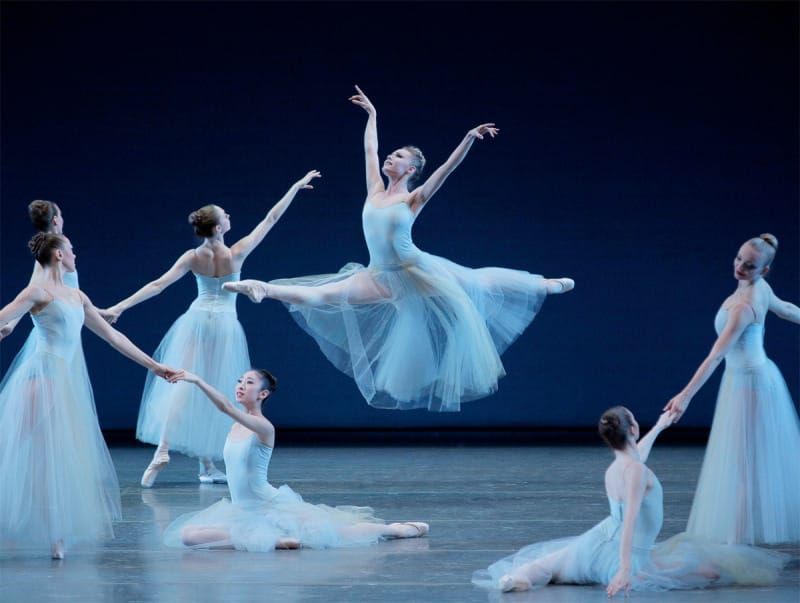
"Serenade", "Mozartiana", "Tschaikovsky Pas de Deux", "Tschaikovsky Suite No. 3"
New York City Ballet
David H. Koch Theater
New York, NY
Sept. 24, 2014
New York City Ballet is continuing its theme evenings, performing ballets that the marketing department can group together. The official opening night of the season (after the fashion-themed gala) featured all Balanchine/all Tschaikovsky. All of these ballets are glorious, of course, but performing them together does seem to imply that the program wasn't really carefully curated. However, any performance that opens with "Serenade" is halfway home. Sara Mearns danced the Waltz with her usual dramatic intensity. There is something so vibrant about her presence, yet she never seems to be overdoing it--the stage is her world and we are privileged to watch. For her the Waltz girl did not seem to be the elegiac, almost wistful memory of happiness that some have made her, but a free woman forging her own path. The section where the woman dances ahead of the man, looking back and urging him on, only apparently to fade to mist, for Mearns was not a gloss of the old Romantic ideal of the unattainable but rather a forceful pushing forward. She was simply breathtaking.
Sterling Hyltin as the so-called Russian girl almost matched her urgency, dancing with a windblown power, flying through her jumps. I missed some gentle pathos that the little pas de cinq can have, as the Russian girl gives her hands to her cohorts seeming to seek or give solace; there was something very sunny about her persona which suited Mearns' triumphant approach.
Maria Kowroski has also shown in sunny pieces; she is a fine comedian when she has a part to play. But "Mozartiana" is completely exposed, both spiritually and technically, and there is nowhere to hide. She seemed a bit abashed in the opening prayer of the "Preghiera", tiptoeing politely around the edges as if she were afraid of disturbing Suzanne Farrell's ghost. There is spirituality but no romance in "Mozartiana", as the couple dance their solos as if there were giving a set of exalted monologues. Even the adagio, where they dance together, is not romantic; they spend most of their time dancing side by side, two halves of a perfect whole. The off-centered, witty speed was a challenge for Kowroski, but she certainly presented the steps clearly. Tyler Angle, in the role created for Ib Andersen, a Danish quicksilver artist with a slightly aloof presence, danced very well. He played with those quick, sharp changes of direction musically and confidently.
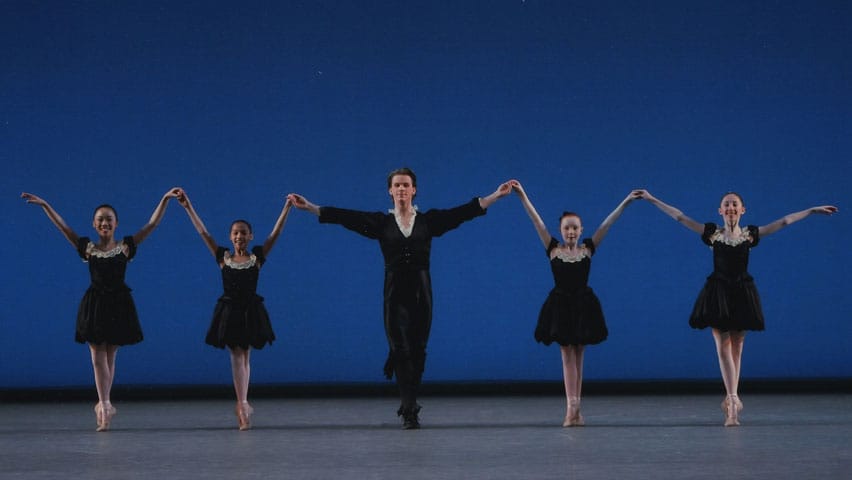
Daniel Ulbricht danced the "Gigue", toning down his natural bravura with a smooth, gracious, and delicately filagree upper body. His lower body, of course, tore through those little jumps effortlessly, but what I remember the most was his warmth towards the little girls and his slow, noble walk off the stage.
There is no walk off stage in the "Tschaikovsky Pas de Deux", which got an exuberant performance from Ashley Bouder and Gonzalo Garcia. Bouder is a technical marvel, but she used her strength to delineate the steps, and it seems as if any freeze frame of her dancing would show an immaculate classical shape. She does have a tendency sometimes to play a bit too obviously with the music, holding her poses and then whipping her arms into the next one, but the pure joy she shows in dancing is irresistible. Garcia, too, danced with an openhearted eagerness. His upper body,though, is a bit stiff and he had a bit of trouble with the speed, making it appear at times as if he were racing to catch up. His jumps and turns, on the other hand, had real juice.
The opening sections of "Tschaikovsky Suite No. 3" need a lot of juice, as the women rush through those haunted ballrooms, hair flying. Rebecca Krohn danced with dramatic extensions and lots of hair, but with little of the sense of mystery that makes the opening movement so potent, as the woman seems to appear and disappear at will. There is something dangerous about this room, as Ask la Cour, with his Danish training, showed; he approached those mysterious women hesitantly, as if he knew he was being drawn into something uncontrollable. The final scene, as he huddled on the ground alone, seemed to imply that he would never quite recover from this brush with the unattainable.
The second movement, too, has a slightly dangerous woman, as Abi Stafford constantly blocked Justin Peck with her arms. Stafford, like Krohn, is a fine dancer, but again lacked mystery. The third movement, led by Erica Periera and Antonio Carmena, while full of constantly whirling patterns, doesn't have the orchid-scented romanticism of the opening two, and does at times seem like filler, fine though the dancing was.
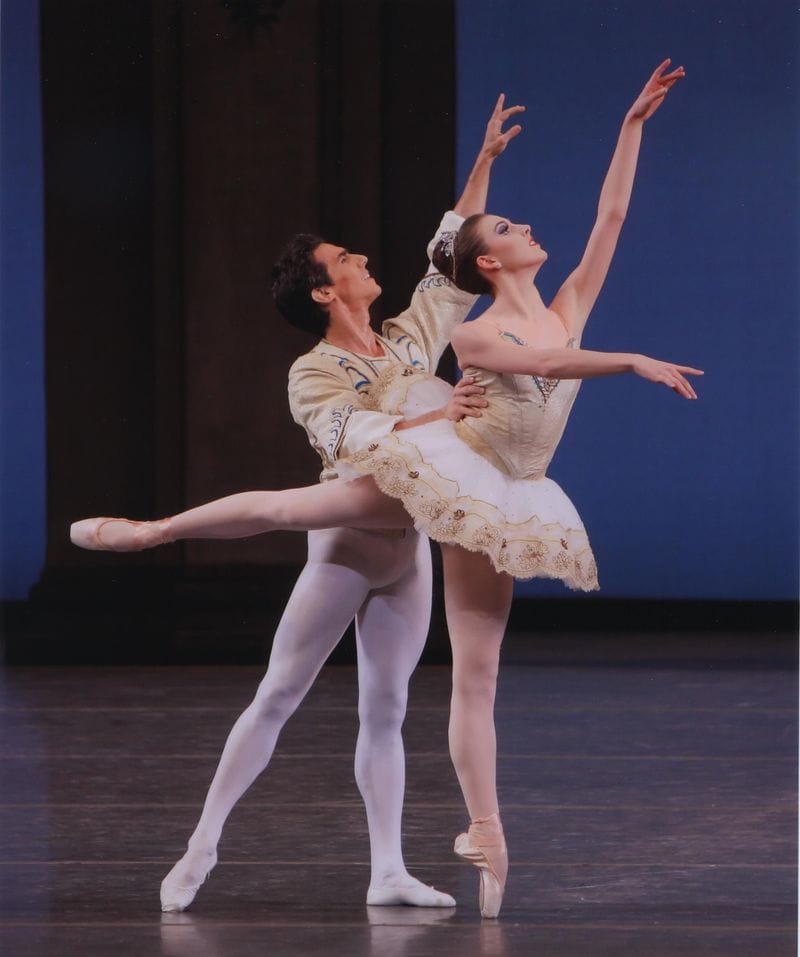
The final section, originally the stand alone "Theme and Variations," is one of Balanchine's homages to "The Sleeping Beauty". The costumes and decor are turquoise and orange, a somewhat inadequate American translation of red and gold. Tiler Peck and Joaquin de Luz were the grand couple. Peck was in absolute control of the opening choreography, played at quite a clip, and her solo was impeccable. The perky music meant that the miniature vision scene, where Aurora (as she might as well be called) twists and turns with her nymphs, didn't have the subtle melancholy it can have. This speed also meant that the pas de deux was also a bit rushed, and the dancers couldn't relax into those beautiful positions--of course, it also meant that there was no self-indulgent posing. De Luz toned down his firebrand approach which can be so dynamic in other works, and he clearly understood the nobility built into the role, dancing with a plangent flow. Unfortunately, he is too short to tower over Peck, so the protective reverence of the pas de deux, where he must lift her so effortlessly, didn't have the emotional resonance it can provide. But nevertheless, watching a dancer who understands and respects the choreography the way de Luz does Balanchine has its own rewards.
copyright © 2014 by Mary Cargill



