The Winter, It is Past
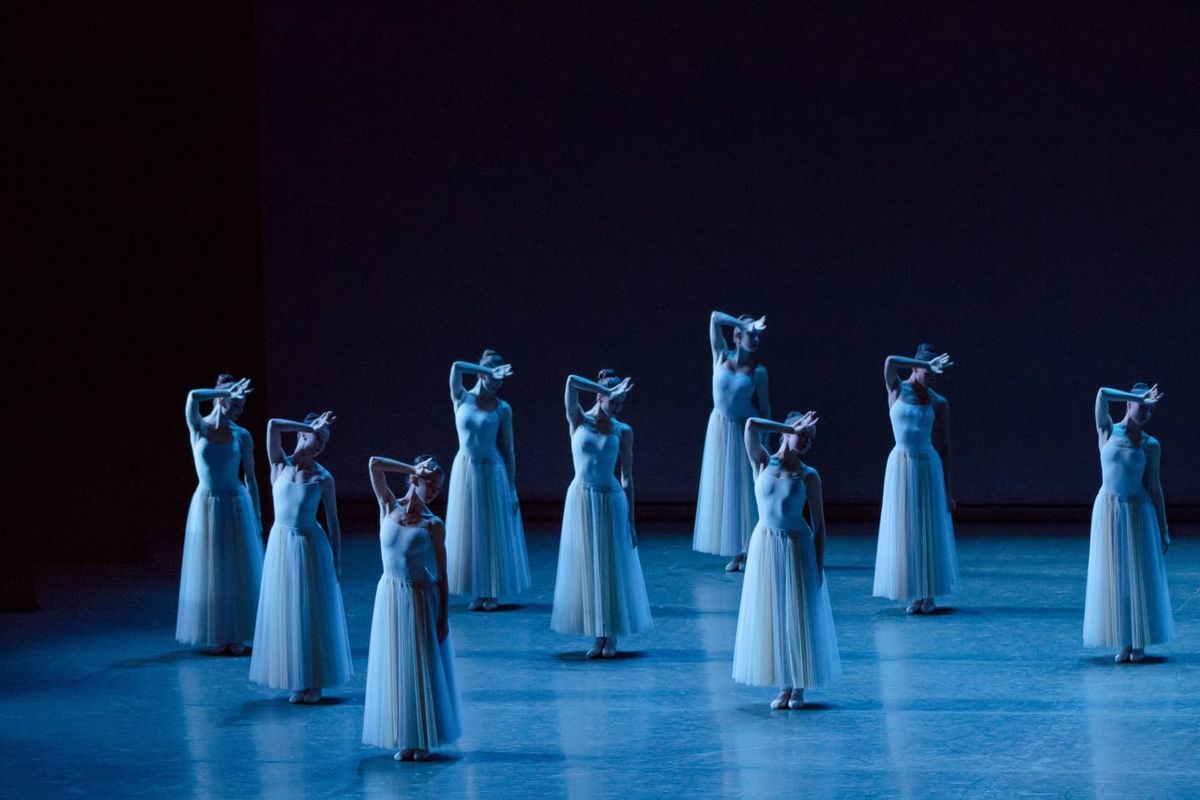
"Serenade", Kamermusik No. 2", "Brahms-Schoenberg Quartet"
New York City Ballet
David H. Koch Theater
New York, NY
May 2, 2012
One sure sign that spring is here is opening night of the New York City Ballet, and this season opened with a generous serving of Balanchine. The corps in "Serenade", the curtain raiser, looked very well rehearsed, dancing with a delicate urgency and a coherent, but not overly drilled, precision. Janie Taylor was an unusual waltz girl, more of a vibrant memory than the more familiar romantic swoon. There is something ethereal about her, an other-worldly glow that gave her dancing a somewhat Giselle-like tinge which gave her dancing a sense of mystery which even an slight fall couldn't damage. And her loose hair! I remember reading a German fairy tale of a woman whose golden hair was so rich that a lock of it would guarantee a lifetime of gold to the owner. Taylor has that same kind of hair, and swinging free it seemed to have a life of its own.
Ashley Bouder, the Russian girl, doesn't have that kind of hair, but her dancing was equally distinctive. She controlled her firecracker approach, using her strength to shape her dancing, holding some beautiful poses just long enough for the image to linger. Her arms, especially, were soft and flowing, while her jumps were daring. The so-called Dark Angel, Rebecca Krohn, unfortunately, was not in their league, as she tended to fling her limbs with little control, though in the quieter, more dramatic moments, she was quite effective. The two men, Jonathan Stafford and Ask la Cour, were elegant and supportive, and la Cour, especially, gave his final walk a dignified intensity.
"Kammermusik No. 2" has a lot of intensity and a knotty Hindemith score. The four soloists, Sara Mearns, Teresa Reichlen, Jared Angle, and Amar Ramasar, were all making debuts; the ballet hasn't been danced for almost ten years. It is a fascinating contrast to the feminine world of "Serenade", since the two women are surrounded by an all-male corps, lunging and hurling through the music with almost grotesque movements, almost as if, in this late ballet, Balanchine decided to revist Prodigal's Goons. The ballet was dominated by Sara Mearns' predatory, forceful dancing. She managed to be both daring and graceful, always in control. Even the rather cliched "I am hiding my eyes to be dramatic" gestures seemed to be a declarative sentence. Reichlin was less emphatic, more balanced, but shaped her dancing well. Angle is probably too inherently generous for the propulsive role, but it suits Ramasar's less traditional physique very well. This will probably never be one of Balanchine's most popular works, but it is an interesting challenge.
"Brahms-Schoenberg Quartet" is another challenge; the European nostalgia, the feeling of dancing in a lost world, doesn't really suit American optimism, and by and large, this got a pretty, chocolate box performance which missed the surging restlessness of the music. Abi Stafford and Sebantien Marcovici were the first couple and Stafford gave a neat, precise, and bright performance of a role that can be all shading. Sterling Hyltin's "Intermezzo", too, missed much of the smokey curves build into the choreography; she is all angles and her sprightly dancing had little mystery. Her partner, Robert Fairchild, however, gave a Byronic intensity to his dancing, as he focused on Hyltin with an almost physical force. His partnering, with the difficult one handed moves, was smooth and effortless, but what I remember most was his sweeping down on his bended knee and raising his arm in a fruitless effort to catch his vision. He was absolutely magnificent.
His sister Megan Fairchild, with Andrew Veyette, danced the "Andante", with it hints of a soldier going off to war. Fairchild danced with a new expansiveness, combining precise, sharp footwork with open and sweeping arms. Veyette's beats were equally sharp, and he got the underlying melancholy in the final pose, but he tends to push his jumps, giving his dancing an odd hitch, which detracted from a fine performance.
The "Rondo", with its gypsy hijinks, got a lighthearted go from Maria Kowroski, but piece, with its final conflagration, should be more than legs and ribbons and funny faces. She missed the smoldering sensuality and the subtle feeling of farewell to a lost empire. Tyler Angle made his debut as her partner. He danced powerfully, but his innate gentle lyricism doesn't match the flamboyant snap of the choreography.
Copyright 2012 by Mary Cargill



