The Spirit Lives
"The Traitor", "Scherzo", "The Quake that Held Them All", "Two Ecstatic Themes", "Missa Brevis"
Limón Dance Company
Joyce Theater
New York, New York
November 6, 2024
The Limón Dance Company’s Joyce season presented a generous program, with revivals of three significant Limón works, “The Traitor”, “Scherzo”, and “Missa Brevis”, The first and final pieces emphasized Limón’s spiritual qualities and command of movement, while “Scherzo” was a delicious playful romp. The company also offered a solo by Doris Humphrey, “Two Ecstatic Themes”, and a new work by Kayla Farrish, “The Quake that Held Them All”, inspired by a lost Limón lost 1951 work “Redes”.
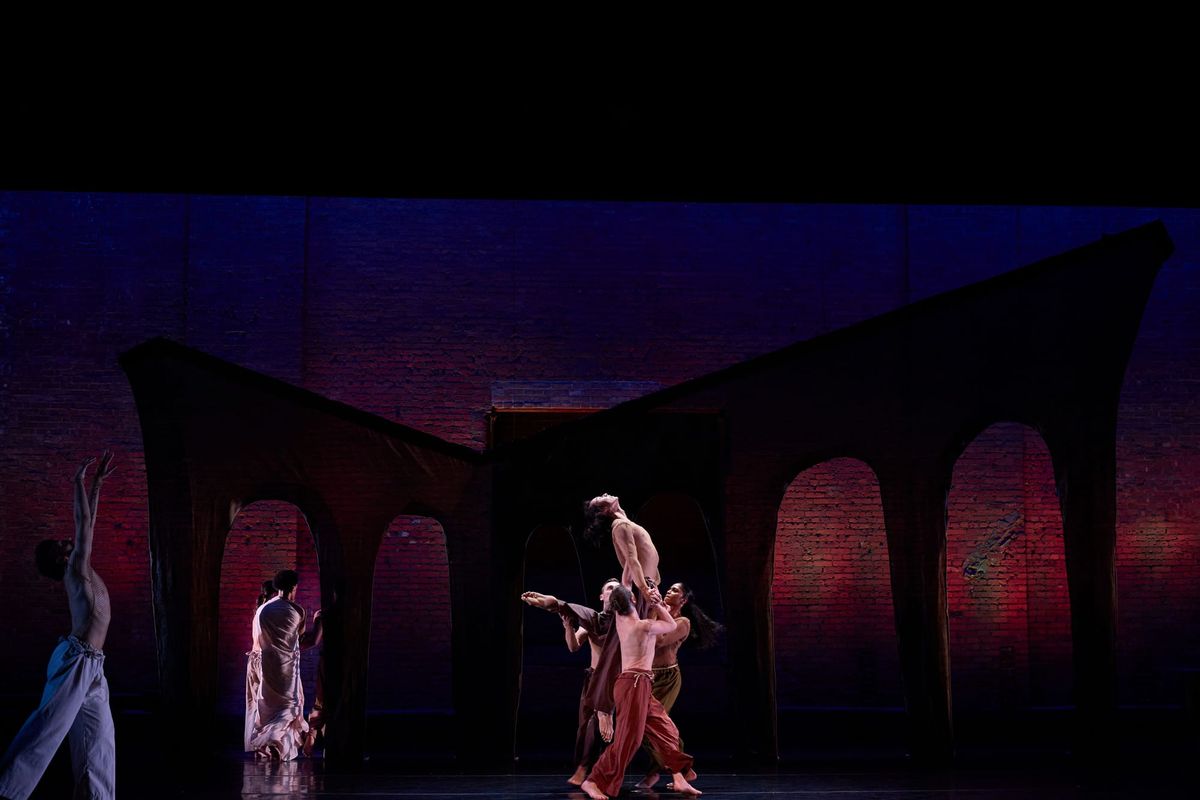
“The Traitor”, from 1954, was, according to the program, Limón’s response to the McCarthy hearings. It was not overtly political, though, and retold, in simple and imaginative ways, the story of the Last Supper, focusing on Judas’ reactions to his betrayal; its layered allegory made it a universal study of guilt and shame. The two lead dancers, The Leader (Eric Parra) and The Traitor (Johnson Guo), and their six followers were all originally male, though this revival has cast three women as followers. The six followers entered, creeping through a classical archway, wary and crouching, with low runs, in an atmosphere of watchful fear, reinforced by Gunther Schuller’s percussive music. The lighting and the weighted, clear movements made them look like rough hewn wooden statues from an old monastery. They variously huddled together or attacked each other, signs of what fear can do to a community.
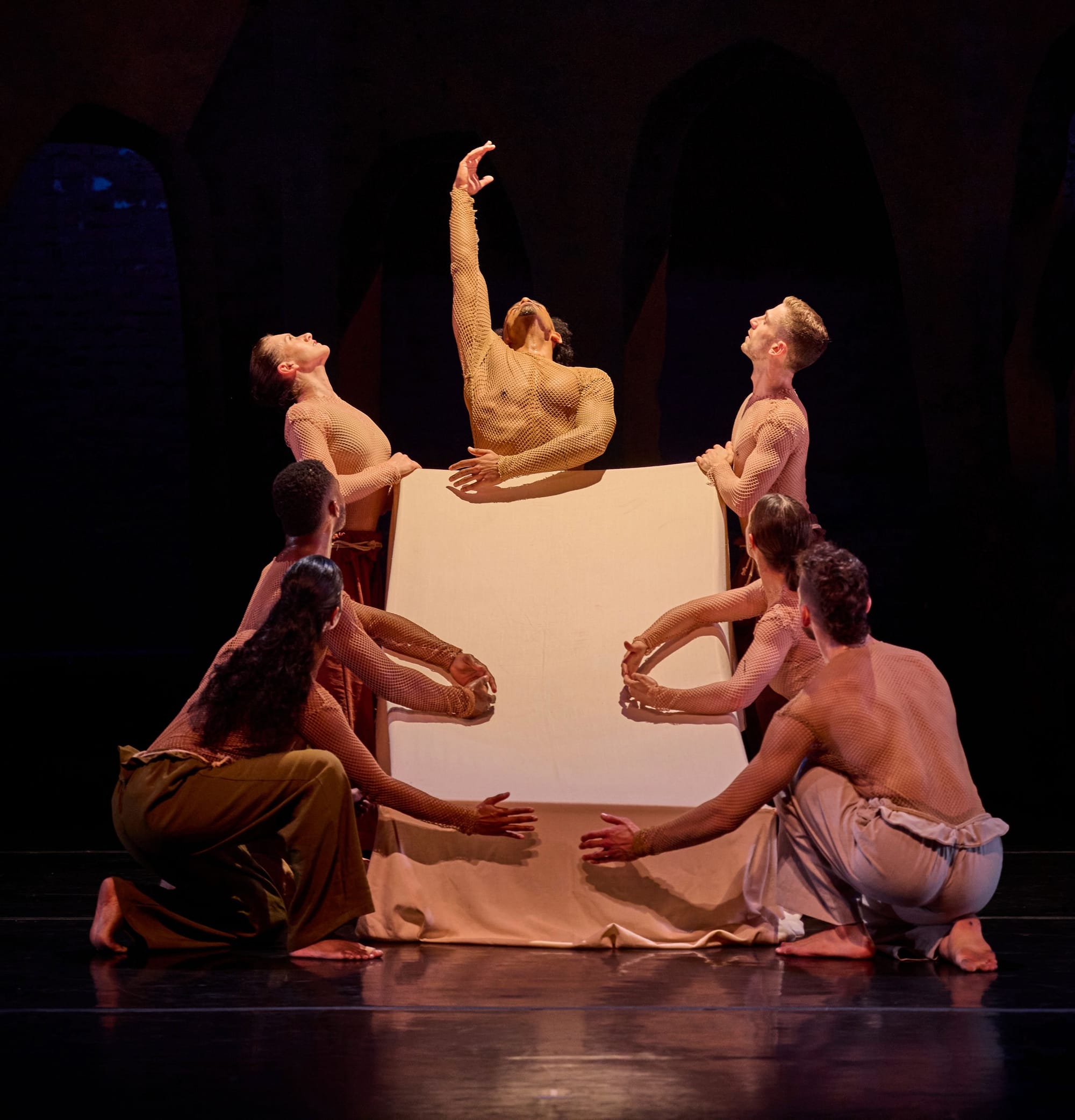
The Biblical symbolism was clear in the brief Last Supper scene, as a white cloth was turned into a table with The Leader at the head, blessing the followers, a cloth which turned into the Leader’s white robe, arranged with a classical simplicity as he was carried off. The sculptural shapes of the choreography, danced with a solid, resonant, and profound dignity, was incredibly moving.
Parra as the leader/Christ figure had a smooth, almost resigned dignity, accepting his betrayal as inevitable; it was a haunting performance. Guo as the traitor/Judas figure gave a powerful performance, alternating between anger, desperation, and grief; he gave his suicide a suicide a sharp, fierce anger, avoiding any melodramatic exaggeration.
Guo got to be much more cheerful in “Scherzo”, from 1955, as he, Joey Columbus, and Nicholas Ruscica frolicked to the live drumming by Douglas Perkins, playing Hazel Johnson’s music. In their white pants, they could have been a modern group of the classical Graces, as they wove in and out of bounding shapes with a joyful verve. They were given a rest when Kieron King appeared with his own drum, dancing and beating it in a dialog with Perkins—who knew that drums could be so witty.
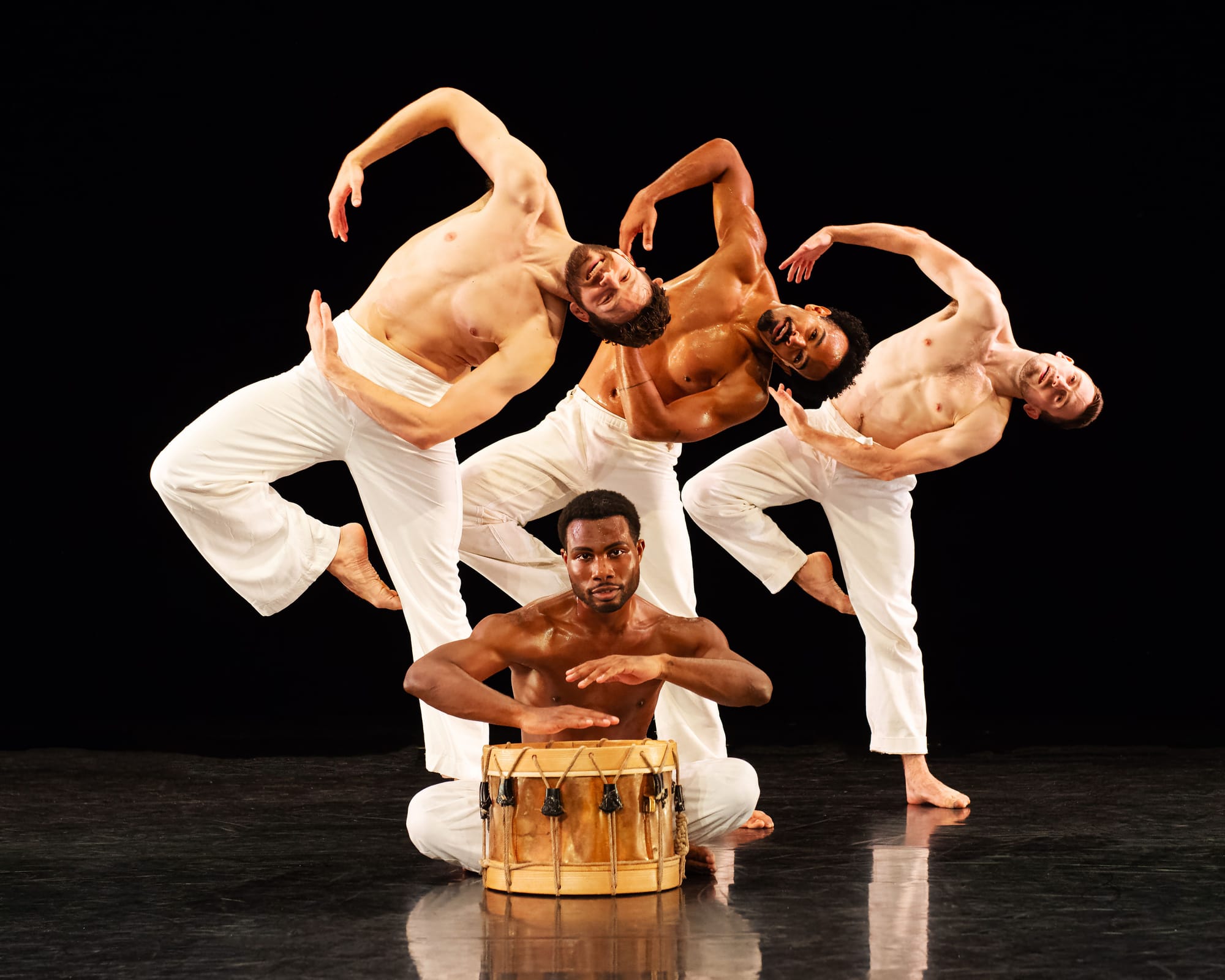
The earlier group then joined King for a glorious game of keep away, tossing the drum to each other with apparently effortless accuracy while dancing to increasingly more complicated rhythms, all the while making it look like the most fun game in the world. This lighthearted, infectious work had disappeared for some 25 years before Carla Maxwell, former head of the Limón Company reconstructed it in 1980, working from a silent film and dancers’ memories. This is yet another reminder of how fragile dances can be and how lucky we are to be able to enjoy this little gem, so elegantly choreographed and so strongly danced.
Kayla Farrish, a New York based choreographer and filmmaker, wrote in the program that her “The Quake that Held Them All”, a premiere, was based on migrants’ stories, imagining “these communities who have held onto one another and pushed for transformation and revolution together”. Unlike the powerful simplicity of Limón’s choreography for “The Traitor”, her dancers raced around with admirable but ceaseless energy, falling, rising, pointing aggressively, with loose, swiveling spines and sudden shards of movement. There were moments of apparent narrative, as a girl seems to be danced to death (shades of “The Rite of Spring”), and two dancers break out of a circle. They even break into shouts near the end of a long and diffuse dance. It may have been long but the dancers’ energy and commitment were phenomenally impressive, and it was visually arresting as the dancers dressed in loose flowing tunics moved through the warm bronze lighting.
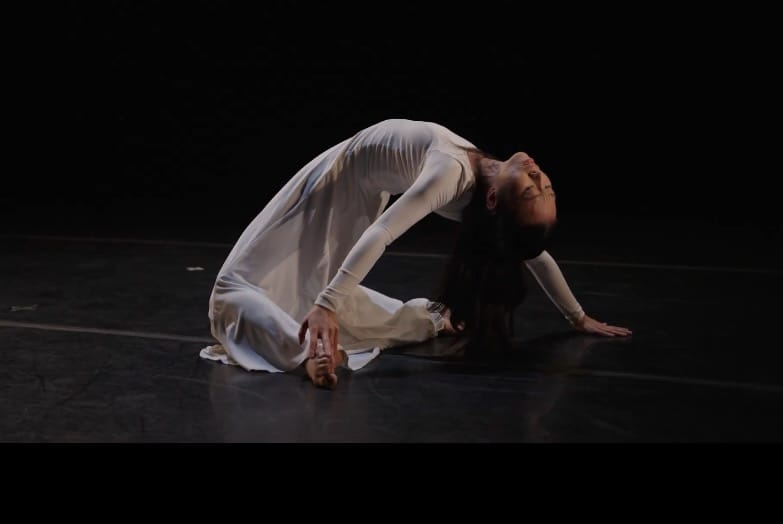
Doris Humphrey’s 1931 “Two Ecstatic Themes” was much shorter. It is a solo set to two piano pieces by two fairly obscure composers, Nikolai Karolivich Medtner and Gian Francesco Malipiero, played live by Michael Scales and danced by Mariah Gravelin. The two themes flowed into one another; the first used soft, rounded arms and curving movements and the second, with a shift of emphasis, was more angular, with arms pointing upwards. Gravelin, dressed in a white gown, gave each movement a distinctive quality. She was liquid in the first, as her arms and torso looked seamless, and her backbends melted into the ground. With an almost imperceptible tightening of her body, the second movement became more restless, more angular, more eager. It was a mesmerizing performance.
Limón choreographed “Missa Brevis” to Zoltán Kodály’s “Missa Brevis in Tempore Belli” in 1958; in 1957 he had toured Europe and his visit to Poland, still not recovered from the war, inspired him to honor the survivors. There is a cast of 21 with one soloist, The Outsider, originally José Limón. The current version has cast the role with both a man and a woman and I saw Lauren Twomley as The Outsider; though she was committed and dynamic, I did miss the strength a man would have given the brief partnering and the grounded solidity of the Limón Company’s male dancers.
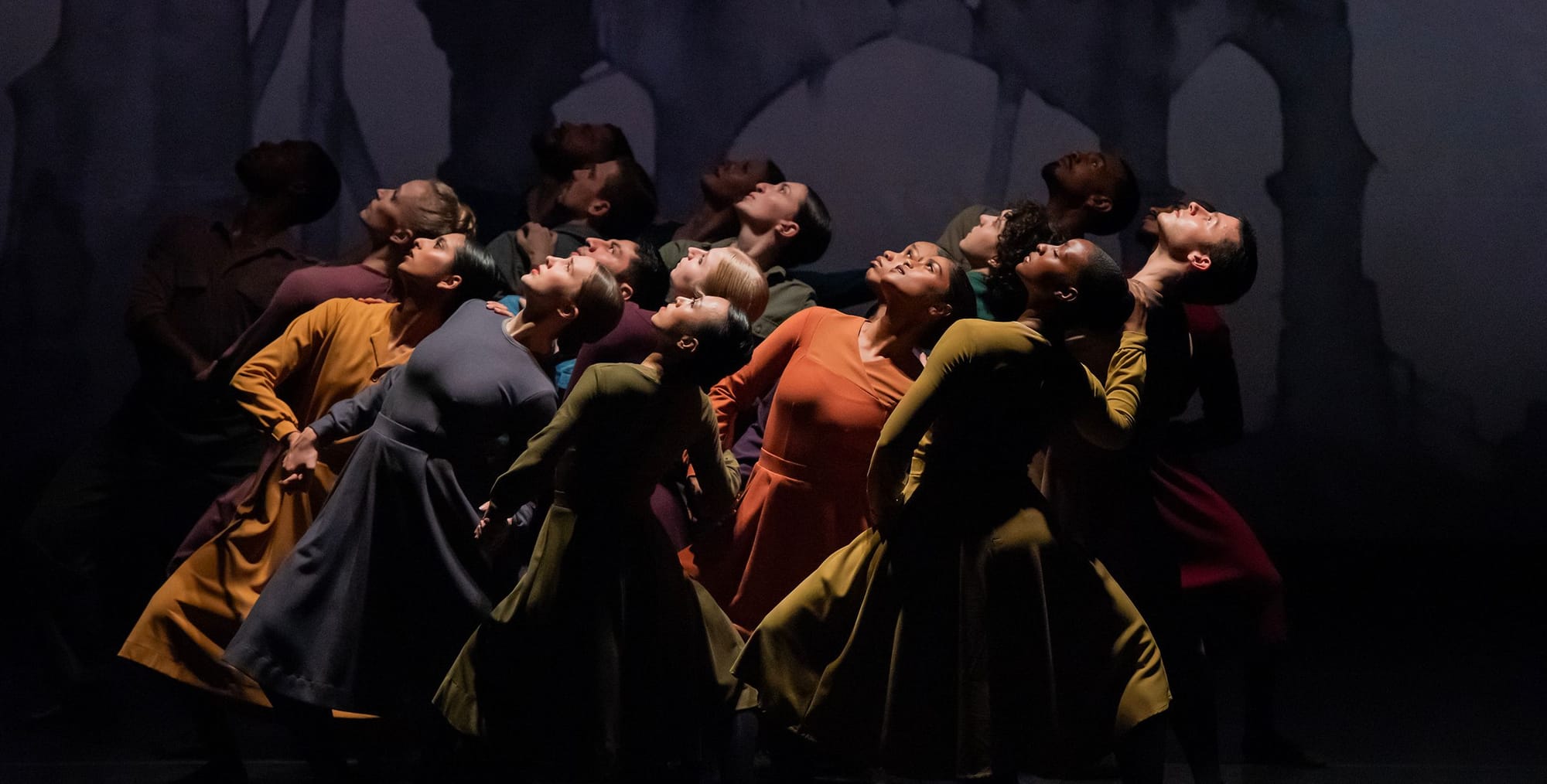
The work, like the opening one, is clearly a spiritual piece, and opens with soaring organ music (played on tape). Limón didn’t try to compete with the grandeur, his choreography is restrained and concentrated, as if shocked that such cruelty could exist. The women wore simple dress of various soft hues, and the men were in colored shirts with casual pants. They often danced in simple circles, evoking the folk elements in Kodály’s music. Those soft colors revolving around the stage with the weighted, stylized, simple movements were magical and inexplicably moving. It is a magnificent and uplifting work, full of emotions ranging from joy to suffering to peace and finally to hope. But my overwhelming emotion was gratitude, thankful that the company danced with such force and beauty.
© 2024 Mary Cargill



